Katakana "Ju" Coloring Pages


About Katakana "Ju"
The "Ju" in "Jewelry"
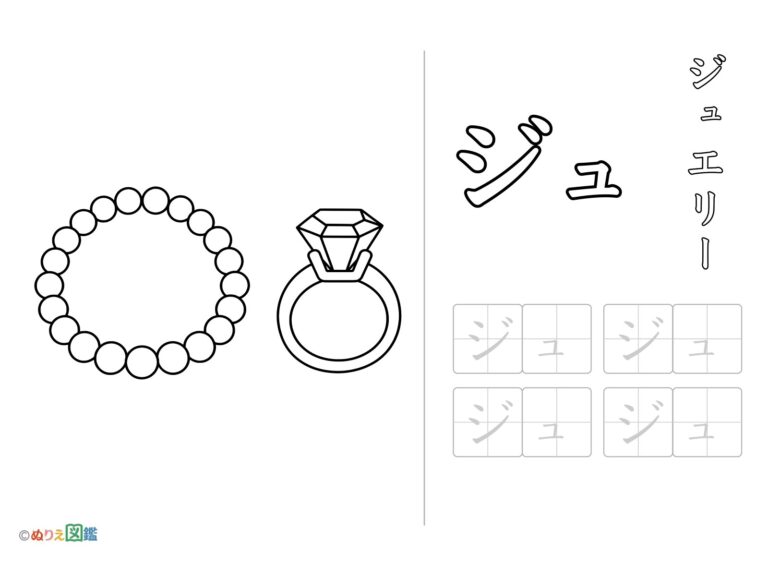
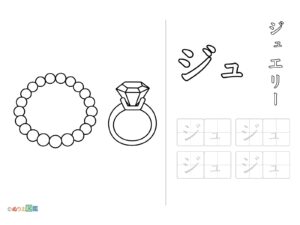
This coloring page features Katakana "Ju".Katakana "Ju"This page is for practicing Katakana "Ju".
Words are"Jewelry"This is a Katakana "Ju". They are decorations you wear, made with things like gems and pearls!
On the left, there is a string of pearlsnecklaceand one, with a gemstoneringThere is 1 drawn here.
Round pearls line up one by one, and the gem on the ring shines brightly!
Two letters make one sound
Katakana "Ju" is made of two characters, "Ji" and a small "Yu", andOne soundmeans Katakana "Ju".
This is how we combine smaller "ャ," "ュ," and "ョ" to make a single sound.Contracted soundsIt is called Katakana "Ju".
When you say it out loud, don't separate "Ji" and "Yu"—try to say them together all at once!
How Katakana "Ju" came to be
Katakana was created a long time ago by people who took parts of KanjiPartwere created by taking a part of a Kanji character or by making its shape simpler.
"Ju" is the letter "Shi" with two little dots. The dots areDakutenIt is also called this.
The original "Shi" came from a simplified version of the kanji "之".
Small Katakana "Ju" is a smaller version of the character "ユ". "ユ" came from a part of the kanji "由".
While Hiragana came from whole Kanji written in a cursive style, Katakana came from parts of Kanji, so it has many straight lines.
How to write Katakana "Ju"
Katakana "Ju" has 5 strokes in total—3 strokes for "Shi", plus 2 small dots!
For "Shi", you draw two dots on the left side, stacked vertically from top to bottom.
For the 3rd stroke, write from the bottom left to the top right, making a nice flick up.
It is easy to mix up with "ツ", so be careful with the way the dots line up and the direction of the 3rd stroke.
For the small dots, let's write two short dots next to each other at the top right at the very end.
Small Katakana "Ju" has 2 strokes. For the 1st stroke, draw a line that goes across and then bends down. For the 2nd stroke, draw a longer line across at the bottom.
Write the small characters about a quarter of the size of the box. For horizontal writing, place them in theBottom left, and when writing vertically, it goes in the boxTop rightWrite it close to .
If you write Katakana "Ju" too big, it will be read as two separate sounds, "Jiyu", so be careful!
Words with Katakana "Ju"
Katakana "Ju" isWords from other countriesis often used when writing
"Jewelry" is another word that came from English!
Words that start with Katakana "Ju" include things that everyone loves,Juicea, or showing younger people and childrenKatakana "Ju"There is Katakana "Ju".
It shows a scheduleScheduleLike this, there are also words with Katakana "Ju" in the middle.
Grilling meatSizzle-sizzleThese sounds also have the "ju" sound in them!
How to Color Katakana "Ju"
Color the big Katakana "Ju" in your favorite color
Try coloring the big outlined Katakana "Ju" on the top right in any color you like.
Make it vivid like a shiny jewel using colors like red, blue, green, or purple.
To keep it neat, color slowly along the inside of the lines first, and then fill in the middle!
Color the pearls white with a soft touch of color
Leave most of the necklace pearls white, and add just a little light pink, light blue, or light gray near the edges.
If you leave a tiny white spot on the top left of each pearl, they will look shiny and glossy!
Color the ring's gem with dark and light shades
The gem on the ring will look like a ruby if you use red, a sapphire with blue, or an emerald with green.
If you color each side of the gem with dark and light shades, it will sparkle nicely!
Color the band part gold, yellow, or silver.
Trace each pair nicely and carefully
In the bottom right boxes, you will find four pairs of light gray Katakana "Ju".
Use a dark or soft pencil to trace slowly over the faint letters.
Look at the vertical and horizontal center lines in the boxes. They help you see the size difference between the big and small letters.
Saying the stroke order out loud as you write makes it easy to remember!
Write each pair carefully, just like connecting pearls one by one.
Fun Facts About Katakana "Ju"
Pearls Are Born Inside Shellfish
Pearls are gems that are made inside shellfish living in the sea.
When a tiny piece gets inside a shell, the shellfish wraps it in shiny stuff. It takes many years to grow big!
In Japan, people raise shellfish called Akoya pearl oysters to make pearls.
Pearls are also known as the birthstone for June.
Diamonds Are Related to Pencil Lead
Diamonds are famous for being the hardest stone in nature.
Actually, they are made from carbon, which is the exact same thing used in pencil lead!
Even though they are made of the same carbon, a different way of joining together can make a sparkling gem or black lead!
Jewelry Is an English Word
The word "Jewelry" comes from the English word "Jewel," which means gemstones.
In Japanese, it is also called Hoshokuhin.
Accessories you wear—like necklaces, rings, and earrings—are called jewelry all together.
Let's Write It in Romaji
When you write Katakana "Ju" in Romaji, it becomes ju or zyu.
There are two ways to write Romaji. The way that uses "j" is often used on signs at train stations and on roads.
You will learn Romaji in Japanese class around the 3rd grade in elementary school.
It is also written on station names and road signs, so try to read it when you find it!
Share These Katakana "Ju" Coloring Pages


-
Tracing the letter "J" (Jewelry)
-