Katakana "Bya" Coloring Pages


About Katakana "Bya"
"Bya" as in "Byakko" (White Tiger)
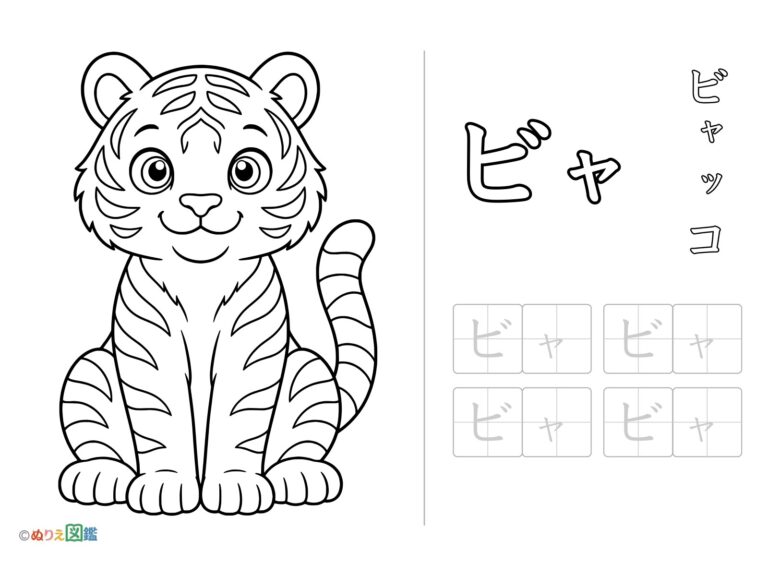
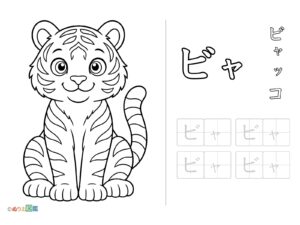
This coloring page is Katakana "Bya"Katakana "Bya"This page is for practicing Katakana "Bya".
The words are"Byakko"is here. In kanji, it is"White Tiger"and write,White tigerThis page is all about Katakana "Bya".
On the left, one white tiger is sitting down and looking right at you.
The stripes on the body are drawn with lines without being filled in, so try coloring them in yourself.
The sharp, focused face looks super cool!
Two characters for one sound
"Katakana "Bya"" is made of two characters: "ビ" and a small "ャ", andOne soundIt shows .
Letters like this, made by adding a small "ya," "yu," or "yo" to form a single sound, areContracted soundsIt is called Katakana "Bya".
When you say it out loud, do not split "bi" and "ya". Try to say them together as one sound! The small "tsu" in Byakko is written small, and it shows that you pause the sound briefly.
How Katakana "Bya" Came to Be
Katakana was created a long time ago by people who used parts of KanjiA PartThey are characters made by taking parts of kanji or making their shapes simpler.
"Bi" is the letter "Hi" with little dots added. The little dots areDakuten (Voiced Sound Marks)It is also called this.
The original "ヒ" was created from the right side of the kanji "比".
The small "ャ" is a smaller version of "ヤ". "ヤ" comes from a simplified shape of the kanji character "也".
While Hiragana came from cursive forms of Kanji, Katakana was made from parts of Kanji, so it has lots of straight lines.
How to write Katakana "Bya"
"Bi" is made by adding 2 dots to the 2 strokes of "Hi", making 4 strokes in total!
The 1st stroke of "Hi" is a short horizontal line.
For the 2nd stroke, go down from the top, and then curve right.
For the two small dots, draw them side by side at the top right at the very end.
The small "ャ" has 2 strokes. The 1st stroke is a line that bends like "フ", and the 2nd stroke is a slanting line that crosses it, written from top to bottom.
Write the small letters at about one-fourth the size of a box. When writing horizontally, put them in theBottom left, and when written vertically, in the boxTop rightWrite it close to .
If you write the "ャ" too big, it can be read as two separate sounds, "ビヤ", so be careful!
Words with Katakana "Bya"
Katakana is used for words that come from other countries, as well asAnimal namesIt is also often used for words that express sounds or actions like "ya".
"Byakko" is originally written with kanji, but it is written in katakana on this coloring page so you can practice Katakana "Bya".
Actually, there are very few words that start with Katakana "Bya".
Tree with a nice scentSandalwood...and that is about the only one you can easily find!
But, the number ofthree hundredLike this, Katakana "Bya" can sometimes appear in the middle of words.
Try writing 300 with your finger while saying "San-byaku"!
How to Color Katakana "Bya"
Color the big Katakana "Bya" in your favorite color
Try coloring the big outlined Katakana "Bya" on the top right in any color you like.
If you want to make Byakko's white fur stand out, cool colors like light blue or gray are wonderful choices.
To keep it neat and inside the lines, gently trace the outer edges first, and then fill in the middle.
Leave the white tiger white
Leave most of Byakko's body white.
If you add just a little bit of light gray or light blue where shadows fall on the tummy and legs, the white fur will look soft and pop right out!
If you color the stripes with black, dark brown, or dark gray, they will stand out clearly against the white body.
Make the eyes look sharp with blue
Real white tigers often have blue eyes.
If you color the eyes blue or light blue, Katakana "Bya"'s Byakko will look cool and magical.
Try using light pink for the nose!
Trace carefully, one pair at a time
In the boxes on the bottom right, light gray Katakana "Bya" characters are lined up in 4 pairs of 2.
Use a dark or soft pencil to trace slowly over the light letters.
Look at the vertical and horizontal center lines in the boxes to help you see the difference between big and small letters.
Saying the stroke order out loud as you write will help you remember it.
Check to see if the 2nd stroke of "ヒ" bends nicely to the right at the bottom.
Fun Facts About Katakana "Bya"
4 Sacred Beasts Protecting the Four Directions
In ancient China, people believed that 4 sacred animal guardians protected the four directions: East, West, South, and North.
In the east is the blue dragon Seiryu, in the south is the red bird Suzaku, in the west is the white tiger Byakko, and in the north is the turtle wrapped in a snake, Genbu.
This way of thinking came to Japan, too!
Katakana "Bya" Drawn on Tomb Walls
In Nara Prefecture, pictures of these 4 guardians were drawn on the walls of the Kitora Tomb and the Takamatsuzuka Tomb.
People think these pictures were drawn about 1,300 years ago, and Katakana "Bya" is in them, too!
It is amazing that such old pictures are still around today, isn't it?
Real White Tigers
The white tigers you can see at the zoo are called White Tigers.
They are the same kind as normal tigers, but they were born with lighter fur.
There are very few of them, so you can hardly ever see one in the wild.
Let's Try Writing It in Romaji
When you write Katakana "Bya" in Romaji, it becomes bya.
For sounds with a small "ya," "yu," or "yo," you add the letter y in Romaji.
You learn Romaji in Japanese class around the 3rd grade in elementary school.
It is also written on station names and road signs, so try to read it when you find it!
Share These Katakana "Bya" Coloring Pages


-
Traced writing of "Bya" (Byakko)
-