Katakana "Myo" Coloring Pages


About Katakana "Myo"
"Myo" as in "Myoga"
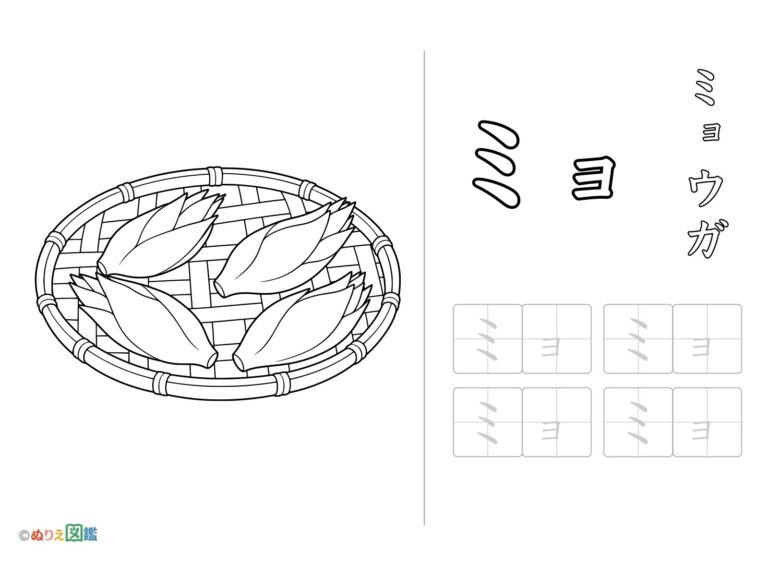
The character on this coloring page is Katakana "Myo".
The word is "Myoga". It starts with Katakana "Myo".
Myoga is a fresh-smelling vegetable that goes on top of somen noodles and cold tofu.
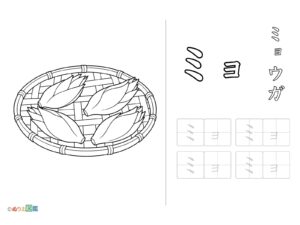
The picture on the left shows 4 myoga bulbs on a bamboo tray. They look plump like water drops.
Katakana is often used for words from other countries, names of animals and plants, and sounds or animal noises. In picture books, plant names are usually written in Katakana. "Myoga" is also written in Katakana because it is the name of a plant.
"Mi" and small "Yo" make 1 sound
Katakana "Myo" is written by adding a small "Yo" after "Mi".
You write it with 2 characters, but you read it as 1 sound: "Myo". Sounds like this are called Contracted Sounds.
If you write a big "Yo" to make "Miyo", it becomes 2 separate sounds: "Mi" and "Yo". How you read it changes if you write it big or small.
Try saying "Myoga" while clapping your hands. You only need to clap once for Katakana "Myo".
The Kanji that made Katakana "Myo"
Katakana characters were made by taking pieces of Kanji or using Kanji shapes.
Long ago, monks started using them to quickly write down how to read Kanji in sacred books.
"Mi" was made from the Kanji "三" (three). Writing it with 3 lines is just like "三", too.
Small "Yo" is a shrinked version of big "Yo", and "Yo" was made from the Kanji "与".
Tips for writing
"Mi" takes 3 strokes.
Write 3 short lines, starting from the top.
Slant every line from top-left to bottom-right, and stop at the end.
If you leave the same space between the 3 lines and make the 3rd line a little longer, it will look super nice.
Small "Yo" uses the same stroke order as big "Yo", and takes 3 strokes.
When writing sideways, write it small in the bottom-left of the box. Be careful not to make it the same size as "Mi".
Words that start with Katakana "Myo"
There are very few words that start with Katakana "Myo".
For words written in Katakana, Myoga might be the one you see the most.
For words written in Hiragana, "Myo" is in Myoji (family name) and Myonichi (tomorrow).
Try saying your own family name with someone in your family.
How to Color Katakana "Myo"
Color the Large Katakana "Myo" with Two Different Colors
The large Katakana "Myo" on the top right is an outline letter for you to color in.
If you color the big "ミ" and the small "ョ" in different colors, it is easy to see that it is made of two letters.
If you make "ミ" pink like a Japanese ginger and the small "ョ" yellow-green, you will get real Japanese ginger colors!
It is also fun to change colors line by line, following the stroke order.
Japanese Ginger Is Pink and Yellow-Green
Japanese ginger is a mix of pink or red-purple and light yellow-green.
If you color the tips and outside pink, and the bottom part white or light yellow-green, it will look just like the real thing.
Adding a little darker pink along the overlapping skin lines makes it look 3D.
Color the bamboo strainer light brown or ocher, and try coloring each mesh pattern carefully.
Tracing Is Done as a Pair
In the bottom-right boxes, there are 4 pairs of light gray Katakana "Myo". The "ミ" is in the left box, and the small "ョ" is in the right box.
Hold your pencil correctly and trace slowly over the gray lines without going outside.
Use the vertical and horizontal center lines in the boxes as a guide to help you get the position and size right.
Check to see if the small "ョ" fits neatly in the bottom left of its box, too.
Every time you trace one pair, say Katakana "Myo" out loud, and you can learn the letters and the sound together!
Fun Facts About Katakana "Myo"
What You Are Eating Is a Flower Bud
The myoga that we eat is actually a group of flower buds.
It pops right up out of the soil.
If you leave it without picking it, pale yellow flowers will bloom!
A Plant That Likes the Shade
Katakana "Myo" is a plant that grows well in damp shade away from too much sun.
Some houses grow it in a corner of the garden or under a tree.
From summer to autumn, new buds come out one after another.
The Legend About Forgetfulness
People long ago used to say, "If you eat myoga, you will become forgetful."
But this is just a story from long ago, so it is not true at all!
Don't worry, and enjoy its refreshing flavor.
Let's Compare Katakana "Myo" with Hiragana "みょ"
When you write Katakana "Myo" in hiragana, it looks like "みょ".
The hiragana "み" came from the kanji character "美", and the katakana "ミ" came from the kanji character "三".
Even though they make the same sound, their original kanji characters are different. That is why "み" and "ミ" look so different!
The small "ょ" and "ョ" both came from the kanji character "与", so they are like brother and sister characters.
Share These Katakana "Myo" Coloring Pages


-
Tracing "ミョ" (Japanese Ginger)
-