Katakana "Zu" Coloring Pages


About Katakana "Zu"
The "Zu" in "Tsuzumi" (Katakana "Zu")
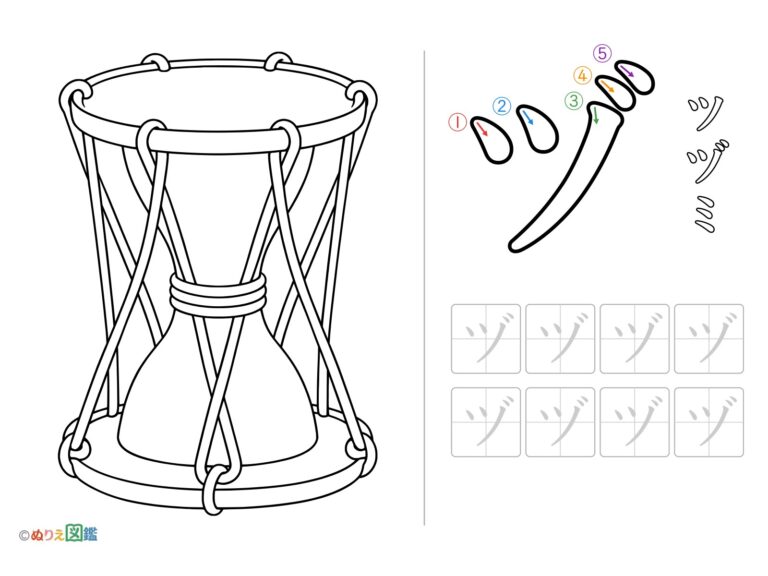
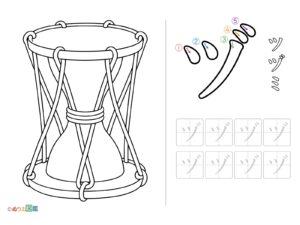
This coloring page shows the Katakana "Zu"Katakana "Zu"Here is a coloring page where you can trace Katakana "Zu".
The picture on the left shows a traditional Japanese instrument,Katakana "Zu"What is it?
An hourglass-shaped body has round leather heads on the top and bottom, and the ropes that tighten the heads are wrapped around the body.
"Tsuzumi" is usually written in hiragana or with the kanji "鼓," but on this coloring page, it is written in katakana as "ツヅミ" so you can practice Katakana "Zu".
"Tsuzumi" has Katakana "Zu" in it.2ndThis is a word that uses Katakana "Zu".
Katakana "Zu" is a very rare character
With Katakana "Zu"StartThere are almost no words.
In Katakana, we rarely use Katakana "Zu", and the same sound is usually written as "Katakana "Zu"" is written like this.
Katakana "Zu" isWords that came from other countriesYa,Names of animals and plants, such as "Woof-woof" or "Thump-thump"Words that describe sounds and statesIt is often used when you write Katakana "Zu".
But there are almost no words from other countries that use Katakana "Zu".
The Katakana "Zu" is used when a "tsu" sound comes right after another, like in "tsuzuku" (to continue) or "tsuzumi" (a drum), and turns into a voiced sound. You also use it when two words join together, like "ko" and "tsutsumi" making "kodzutsumi" (small parcel), and the sound changes.
Because it's a rare letter, let's learn to write Katakana "Zu" carefully!
The Kanji That Katakana "Zu" Came From
"Zu" in Katakana is the Katakana "Tsu" withtenten (voiced sound marks)is a letter with a added to it.
The original Katakana "Zu" came from the KanjiRiverIt was born by taking the shape of .
It is said that long ago, monks made Katakana by taking just small parts of Kanji. They did this so they could quickly write down how to read holy books that were written only in Kanji.
When you add two little dots, the clear "Tsu" sound changes into the buzzier "Zu" sound.
Tips for writing Katakana "Zu"
"Katakana "Zu"" is made by adding two dots to the three strokes of "Tsu," and5 strokesLet's write Katakana "Zu".
The 1st stroke and 2nd stroke are short dots lined up at the top.
The 3rd stroke is a long line going from the top right to the bottom left.
"Zu" is a Katakana"Shi"It looks a lot like , so be careful!
The dots of Katakana "Zu" areFrom top to bottom, and the dots for "Shi" areFrom left to rightLet's write Katakana "Zu".
The 3rd stroke of "ツ" is alsoFrom top to bottomSweep your brush up, but for "Shi,"From bottom to topFlip it up!
Finally, write two little dots in the top right.
How to Color Katakana "Zu"
Color the Big Katakana "Zu" in Your Favorite Colors
Try coloring inside the lines of the big Katakana "Zu" at the top right with your favorite colors.
If you color the main "Tsu" part and the two dots in different colors, you can easily see where the special dots are.
If you color it red or orange to match the drum cords, it will look like a classic Japanese letter.
Color slowly near the edges so you don't go outside the lines, and color freely in the middle.
Color the Drum Black with Vermilion Cords
The body of a real small Japanese drum is often coated in lacquer, making it shiny and black.
Sometimes there are gold patterns on the body, so adding flower or grass patterns on top of the black with yellow or gold will look wonderful, too.
Color the round drumheads at the top and bottom in cream or light tan.
If you color the cords that hold the drumheads in vermilion or orange, they will look bright and lovely against the black body.
There are many cords, so color them carefully, one by one.
Trace the Letters Slowly with a Pencil
There are 8 light gray Katakana "Zu" lined up in the boxes at the bottom right.
Use a pencil instead of a crayon, and trace over the gray lines.
The dotted lines going up, down, and across inside the boxes are your guides.
To make sure it does not look like "Shi", write the top two dots from top to bottom.
Write each one carefully. When you write them well, show them to your family.
By the time you finish all 8, your hand will surely remember the shape.
Fun Facts About Katakana "Zu"
Instruments used in Noh and Kabuki
The Kotsuzumi is an instrument used in Noh and Kabuki music.
You rest it on your right shoulder and strike the drumhead with your right fingers to make sounds like "pon" and "ta."
A big hand drum is called an Otsuzumi, and you rest that one on your left knee to play it.
Squeeze the cords to change the sound
You use your left hand to squeeze or loosen the cords holding the drumhead to change the pitch and sound of the Kotsuzumi.
The sound changes based on where and how hard you hit it, too.
It is amazing that you can make so many different sounds with just one instrument!
They say the drumhead of the Kotsuzumi makes a better sound when it is a little bit damp.
So, the player blows their breath onto the drumhead or sticks damp paper on it to keep it just wet enough.
What is "Shitatsuzumi"?
When you eat something super tasty and click your tongue without thinking, that is called "smacking your lips" (shitatsuzumi).
This Japanese phrase compares the clicking sound of your tongue to the sound of hitting a hand drum.
When you eat a delicious meal, try telling your family, "I clicked my drum-tongue!"
There are other old Japanese words that came from musical instruments, too.
Share These Katakana "Zu" Coloring Pages



-
Tracing "ヅ" (Tsuzumi)
-