Katakana "Kyu" Coloring Pages


About Katakana "Kyu"
The "Kyu" in "BBQ"
The letters on this coloring page are the Katakana "Kyu".
The word is "バーベキュー" (Barbecue). Katakana "Kyu" is not at the start of the word, but near the end.
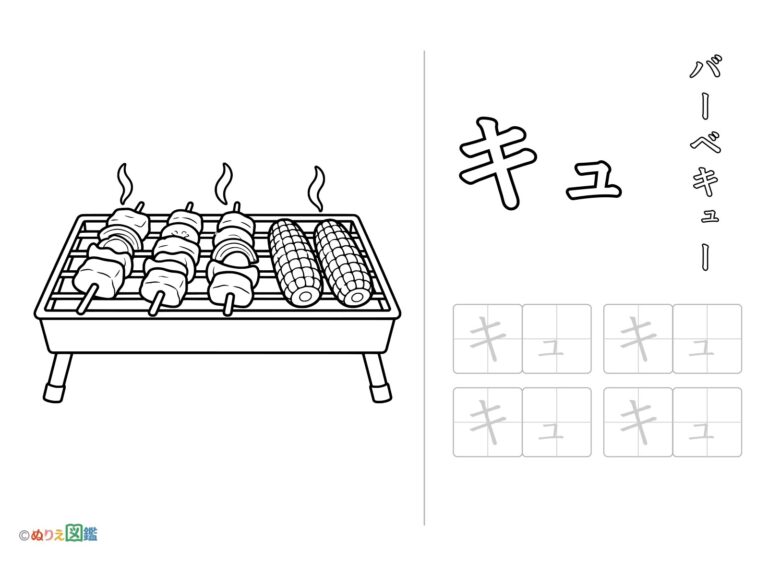
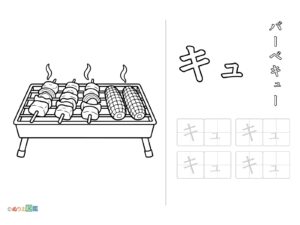
The picture on the left shows a barbecue grill. On the rack, there are meat and vegetables on skewers, plus corn on the cob, with warm steam rising up.
Grilling and eating together outside makes a barbecue a popular, fun meal for camping or at the park.
Katakana letters are often used for words from other countries, names of animals and plants, and sounds or animal noises. "Barbecue" comes from English, so we write it in Katakana.
"Ki" and a small "Yu" make one sound together
Katakana "Kyu" is written by putting a small "ュ" after "キ".
Even though you write it with 2 letters, it makes 1 single sound when you read it: "Kyu". A sound like this is called a contracted sound.
If you write a big "ュ" to make "キユ", it becomes 2 separate sounds: "Ki" and "Yu". The way you read it changes depending on whether you write it small or big!
Try saying "BBQ" while clapping your hands. At the "Kyu" part, you only need to clap your hands 1 time!
The Kanji that Katakana "Kyu" came from
Katakana are characters made by taking part of a Kanji or using the shape of a Kanji.
It is said that they started when monks long ago used them to quickly write down how to read Kanji in sacred texts.
"Ki" is a character made by taking part of the Kanji "幾".
The small "ュ" is just a smaller version of the big "ユ", and "ユ" was made based on the Kanji "由".
Tips for writing Katakana "Kyu"
"Ki" has 3 strokes.
Strokes 1 and 2 are horizontal lines, and you should write both of them slanting slightly upward to the right. If you make the bottom line a little longer than the top line, it will look just right.
For the 3rd stroke, bring the vertical line down from the top so it goes through both horizontal lines, and stop at the end.
Small "yu" is written in the same stroke order as big "Yu", and it has 2 strokes.
When writing horizontally, draw it small in the bottom left of the box. Be careful not to make it the same size as "Ki".
Words with Katakana "Kyu"
Let's look for words that start with or include Katakana "Kyu".
There is the vegetable cucumber, a square cube, and rescue for helping people.
The squeaky kyu-kyu sound of shoes rubbing on the floor uses Katakana "Kyu", too!
See how many words with Katakana "Kyu" you can say compared to your family.
How to Color Katakana "Kyu"
Color the big Katakana "Kyu" with 2 different colors
The big Katakana "Kyu" on the top right is a letter for you to color inside the outline.
If you color the big "キ" and the small "ュ" in different colors, you can easily see that it is made of 2 letters.
Color "キ" in red or orange like fire, and color the small "ュ" in yellow like corn to make it look just like a barbecue!
It is also fun to change colors for each line, like the 1st stroke and 2nd stroke of the stroke order.
Color the meat and veggies in roasted colors
Color the meat on the skewer in brown or dark brown to make it look nicely roasted.
For veggies, green is great for green peppers, light yellow for onions, and red for bell peppers.
Color the corn kernels one by one in yellow, and add some orange over them to make them look grilled!
Color the body and legs of the grill in black or gray. Leave the steam white.
Tracing is a set of 2 letters
In the boxes on the bottom right, there are 4 sets of light gray Katakana "Kyu". There is "キ" in the left box, and a small "ュ" in the right box.
Hold your pencil correctly, and slowly trace over the gray lines so you do not go outside them.
Use the vertical and horizontal center lines inside the boxes as a guide to easily learn the position and size of the letters.
Check if the small "ュ" fits nicely in the bottom left of its box.
Every time you trace 1 set, say "Kyu" out loud so you can learn the letter and its sound together!
Fun Facts About Katakana "Kyu"
How the Word "Barbecue" Started
"Barbecue" is an English word, but people say it came from a word for a wooden frame used by people living in the Caribbean to grill meat.
That word became "barbacoa" in Spanish, and then it entered English to become "barbecue."
Words travel across the ocean, too!
Rows of Corn Kernels
Kernels of corn are lined up in straight rows.
If you count those rows, almost all of them are an even number like 14 or 16 rows.
Also, the silk coming out of the top of the corn connects to each kernel one by one. So, the number of silks and the number of kernels are almost the same!
The Alphabet "Q" is Also "Kyu"
The English alphabet letter "Q" is read as "Kyu" in Japan.
Also, when you write the number 9 in Hiragana, it is "Kyuu," so it has the "Kyu" sound in it.
The "Kyu" sound is hiding in lots of places all around you!
Let's Compare Katakana "Kyu" with Hiragana "Kyu"
When you write Katakana "Kyu" in Hiragana, it is "Kyu".
Actually, both the Hiragana "Ki" and the Katakana "Ki" came from the same Kanji, "幾".
Hiragana was made by smoothing out the whole Kanji shape. Katakana was made by taking just one part or shape of the Kanji. That is why they look different, even though they came from the same Kanji!
The small "yu" in Hiragana and Katakana both came from the Kanji "由," so they are like brother and sister letters!
Share These Katakana "Kyu" Coloring Pages


-
"Kyu" Tracing (BBQ)
-