Katakana "Pi" Coloring Pages


About Katakana "Pi"
The "Pi" in "Piano"
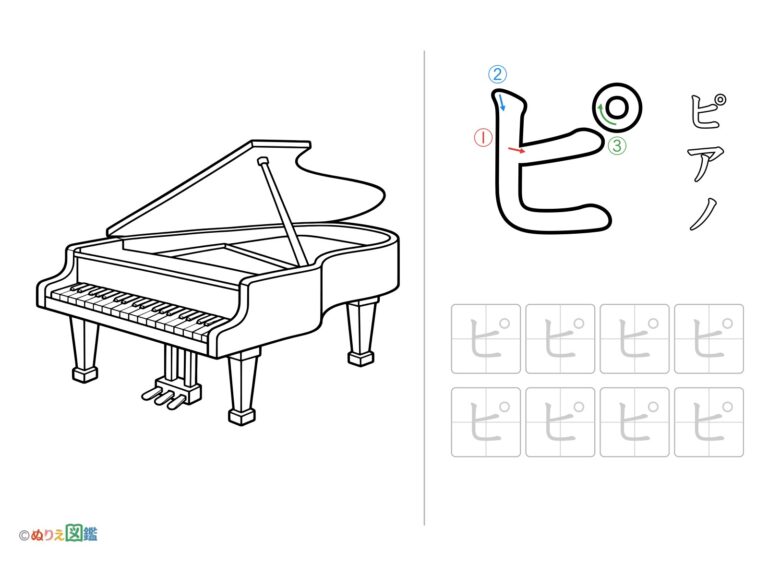
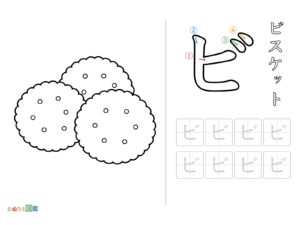
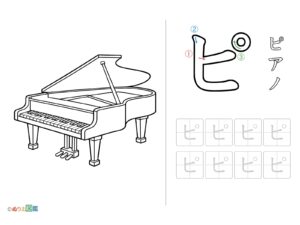
This coloring page is for Katakana "Pi"Katakana "Pi"This is a coloring page where you can trace Katakana "Pi".
The picture on the left showsgrand pianoThis shows what Katakana "Pi" looks like when you view it from an angle.
The big lid is open, and black and white keys are lined up in front.
The black lines are drawn just as outlines without being filled in.
"Piano" is a word that came from another country, so you write it in Katakana.
Katakana "Pi" isWords that come from other countriesYa,Names of animals and plants, like "wan-wan" or "doki-doki"Words that show sounds and statesIt is often used when writing Katakana "Pi".
Even instrument names,Guitar,violin,Trumpetand many other things written in Katakana!
The Kanji That Katakana "Pi" Came From
"Pi" has two small dots on the top right of the Katakana "Hi,"maru (handakuten)is a letter with a circle attached.
The original "ヒ" comes from the KanjiKatakana "Pi"It came from the right side of .
It is said that long ago, monks made katakana by taking just a small part of kanji characters. They created them to quickly write down how to read holy texts and books.
When you add a small circle to "Hi", it becomes "Pi", and when you add two small dots, it becomes "Bi".
Say "Hi," "Bi," and "Pi" out loud and compare the differences in sound.
Tips for writing Katakana "Pi"
Katakana "Pi" adds a 1-stroke circle to the 2 strokes of "Hi",3 strokesI'll draw it in Katakana "Pi".
Line 1 goes from left to right, slanting slightly upward.
The 2nd stroke is a line that goes down from the top and bends to the right at the bottom.
Make the bottom line of the second stroke longer than the first stroke and stretch it to the right. This gives Katakana "Pi" a nice, sturdy shape!
Finally, add a smallCircleLet's write Katakana "Pi".
If you write the circle slightly above the right end of the 1st stroke, Katakana "Pi" will look nice and neat!
Be careful not to confuse it with Katakana "Bi", which has the two little dots.
Words that start with Katakana "Pi"
Words that start with Katakana "Pi" includePianoIn addition toBell pepper,Pizza,Clown,Pinkand more!
All of these are words that came from other countries, so you write them in katakana.
"Pi" comes up a lot in words that describe actions or sounds, like "pika-pika" (sparkling) and "pyon-pyon" (hopping)!
A chick's chirp, "piyo-piyo," starts with Katakana "Pi," too.
Sing along to the piano sound and say words that start with Katakana "Pi"!
How to Color Katakana "Pi"
Color the Big Katakana "Pi" in Your Favorite Colors
Try coloring inside the lines of the big Katakana "Pi" at the top right with your favorite colors.
If you use a different color for the "Hi" part and the small circle at the top right, the circle will really stand out.
It also looks stylish to color it with two colors to match the white and black of a piano.
To keep inside the lines, color slowly near the edges and freely in the middle.
Color the Piano Shiny Black
Many grand pianos are shiny black.
When you color it black, leave thin white lines along the edges of the lid and corners to make it look shiny and bright.
It also looks wonderful if you make it a white, dark brown, or red piano.
For the keys, color only the black keys black and leave the white keys white.
The black keys are small and lined up together, so color them slowly one by one so you do not go out of the lines.
If you color the inside of the lid ocher or gold, it will look just like the inside of a real piano.
Trace Slowly with a Pencil
In the boxes at the bottom right, there are eight light gray Katakana "Pi".
Use a pencil instead of a crayon to trace over the gray lines.
Use the vertical and horizontal dotted lines inside the boxes to help you.
Draw the long line at the bottom of the second stroke below the horizontal dotted line, stretching it smoothly to the right.
Write each one carefully, and when you do a good job, show it to your family.
By the time you finish writing all eight, your hand will surely remember how to write it.
Fun Facts About Katakana "Pi"
88 Keys on the Keyboard
A normal Katakana "Pi" has 88 keys.
There are 52 white keys and 36 black keys.
The black keys are lined up in repeating groups of 2, 3, 2, 3.
If you see a real Katakana "Pi", try counting them!
The Hammer Hits the String
When you press a key on Katakana "Pi", a small hammer inside hits a tight string.
The vibrating string makes the sound!
If you open the lid of a grand Katakana "Pi", you can see many strings inside.
Strings for low sounds are thick and long. Strings for high sounds are thin and short.
That is why a grand Katakana "Pi" has a longer shape on the low-sound side.
"Soft Sounds and Loud Sounds Too"
Katakana "Pi" was born in Italy about 300 years ago.
At first, it was called a name that meant "can make soft sounds and loud sounds too" in Italian.
People say that name became shorter and turned into "Katakana "Pi"".
That is why it makes a soft sound when you press a key gently, and a loud sound when you press it hard!
Share These Katakana "Pi" Coloring Pages


-
Tracing the "Pi" Kana (Piano)
-