Katakana "Hyo" Coloring Pages


About Katakana "Hyo"
"Hyo" as in "Hyotan" (Gourd)
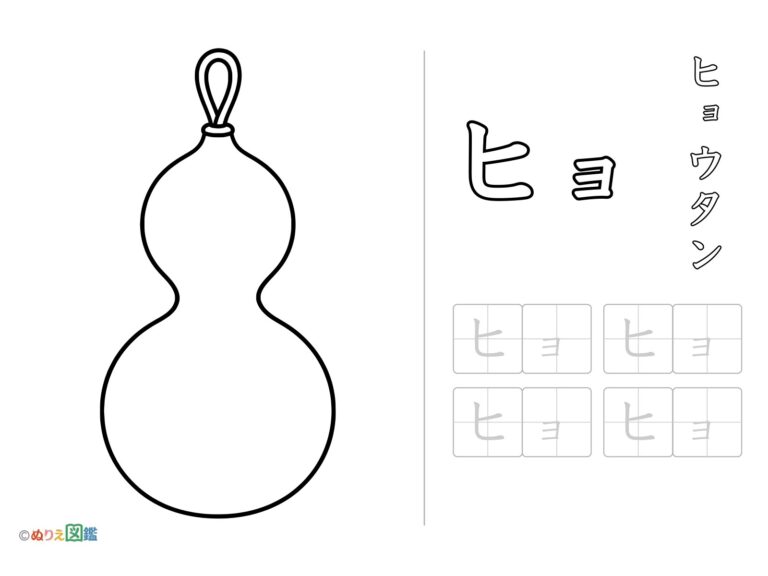
The character on this coloring page is the Katakana "Hyo".
The word is "HYOUTAN" (gourd). It starts with "Hyo".
Hyoutan is a plant that grows on vines, and its fruit is also called "hyoutan".
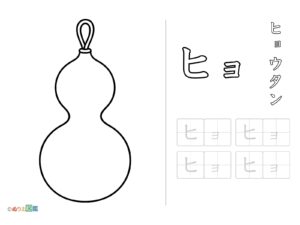
The picture on the left shows the hyoutan fruit. It has a fun shape with rounded top and bottom parts and a tightly pinched middle. A string is tied around the top.
Katakana characters are often used for words from other countries, names of animals and plants, and sounds or animal cries. In science books, plant names are often written in Katakana.
"ヒ" and a small "ョ" make 1 sound
To write Katakana "Hyo", you write "ヒ" and then add a small "ョ" after it.
You write it with two letters, but you read it as one sound: Katakana "Hyo". Sounds like this are called youon.
If you write a big "ヨ" to make "ヒヨ", it becomes two separate sounds: "ヒ" and "ヨ". Writing it small or big changes how you read it.
Try saying "HYOUTAN" while clapping your hands. For the Katakana "Hyo" part, you only need to clap your hands once.
The Kanji That Made Katakana "Hyo"
Katakana are characters made by taking parts of Kanji or by using the shapes of Kanji.
It is said that they started long ago when monks used them to quickly write down how to read the Kanji in scriptures.
"Hi" is a character made from the right side of the Kanji "比".
Small "Yo" is a smaller version of big "Yo", and "Yo" was made based on the Kanji "与".
Tips for writing
Katakana "Hyo" has 2 strokes.
For the 1st stroke, draw a line from left to right, and make it go up a little to the right.
For the 2nd stroke, go down from top to bottom, and turn to the right at the bottom.
It will look nice and neat if the 2nd stroke's line goes through the end of the 1st stroke's line.
The small "ョ" has the same stroke order as the big "ヨ", and it has 3 strokes.
When writing from left to right, write it small in the bottom left of the box. Be careful not to make it the same size as Katakana "Hyo".
Words that start with "Katakana "Hyo""
Words that start with "ヒョ" include the animal ヒョウ (leopard).
"ヒョ" also appears in words that describe how things look or move, like ヒョコヒョコ for walking with a waddle or a hop, and ヒョロヒョロ for looking tall, thin, and weak.
Try moving your body and pretending to go ヒョコヒョコ or ヒョロヒョロ!
How to Color Katakana "Hyo"
For the big Katakana "Hyo", use different colors for the 2 letters
The big Katakana "Hyo" on the top right is a letter you color inside the lines.
If you color the big "ヒ" and the small "ョ" in different colors, it is easy to see that it is made of 2 letters.
It looks great if you make "ヒ" ocher like a gourd, and the small "ョ" green like a leaf.
It is also fun to change colors line by line, following stroke 1 and stroke 2.
Dried gourds are ocher
Gourds growing in the field are green.
When you pick and dry them, gourds turn light brown or ocher. You can color them in either color.
If you color the edges of the rounded parts a little darker, they look round and plump.
If you color the string in red or purple, it looks fancy like a decoration!
Trace the letters in pairs of 2
In the boxes on the bottom right, there are 4 pairs of light gray Katakana "Hyo". You can see "ヒ" in the left box and a small "ョ" in the right box.
Hold your pencil correctly, and trace slowly over the gray lines without going outside.
Use the center lines that go up, down, and across the box as a guide. It makes it easy to find the right spot and size for the letters.
Check to see if the small "ョ" fits neatly in the bottom left of its box, too.
Every time you trace 1 pair, say Katakana "Hyo" out loud. You can learn the letter and its sound together!
Fun Facts About Katakana "Hyo"
Gourds as Containers
If you scoop out the inside of a gourd fruit and dry it, it becomes a hard, light container.
People long ago put water or sake inside gourds to carry them around.
If you tie a string like in the picture, you can hang it from your waist!
White Flowers That Bloom in the Evening
Gourds grow white flowers in the summer.
These flowers bloom from evening into the night.
After the flower finishes blooming, the fruit grows little by little into that pinched shape.
"A Horse From a Gourd"
There is a saying: "A horse from a gourd."
"Koma" means a horse. It means that something totally unexpected comes true, just like a horse coming out of the small opening of a gourd!
People use this when something said as a joke turns out to be real.
Let's Compare Katakana "Hyo" with Hiragana "ひょ"
If you write Katakana "Hyo" in hiragana, it is "ひょ".
Actually, both hiragana "ひ" and Katakana "Hyo"'s "ヒ" were born from the same kanji, "比"!
Hiragana came from writing the whole kanji in a rounded way. Katakana was made from one part or shape of the kanji. So even though they came from the same kanji, they have different shapes.
The small "ょ" and "ョ" were also both born from the kanji "与," so they are like brother and sister letters!
Share These Katakana "Hyo" Coloring Pages


-
Tracing "ヒョ" (Gourd)
-