Katakana "Ru" Coloring Pages


About Katakana "Ru"
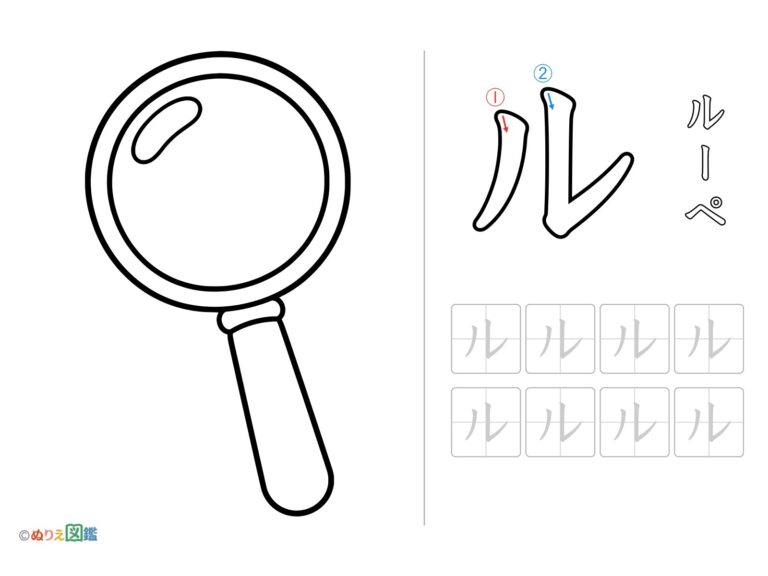
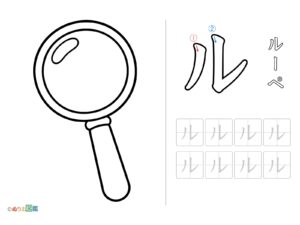
"Ru" for "magnifying glass" ("Ruupe")
The character on this coloring page is Katakana "Ru"Katakana "Ru"It is Katakana "Ru"!
Words are"Magnifying glass"It is.
On the left side, there is a magnifying glass drawn with a round lens and a handle.
A magnifying glass isMagnifying glassThis is all about Katakana "Ru".
When you look through a lens, small bugs, flowers, and lettersIt looks bignda.
"Loupe" (magnifying glass) isGermancomes from another language, so we write it in Katakana!
"Katakana "Ru"" came from "流"
Katakana was created by people a long time agoPart of a Kanjiis a character made from taking part of the character.
Katakana "Ru" is"Flow"character forBottom rightIt is said that Katakana "Ru" came from this part of the character.
The hiragana "Ru" comes from the kanji "留", so the hiragana "Ru" and Katakana "Ru" come from different kanji!
That's why their shapes look totally different, isn't it?
How to write Katakana "Ru"
"Ru" in Katakana is2 strokesWrite Katakana "Ru" here.
The first stroke is the line on the left, going from the top.Sweep down to the leftIt is "nda".
The second stroke is the vertical line on the right side. Once you write it all the way down,Brush up to the top rightYo.
The trick is to leave a little space between the two lines so they do not touch.
The hook at the end of the second stroke looks just like the end of the Katakana "Re".
Words that start with Katakana "Ru"
Words that start with Katakana "Ru" includeMagnifying glass,Ruby,Katakana "Ru",Roulette…and more!
There are not very many words that start with Katakana "Ru".
But,Ball,Pool,Towel,TableThere are lots of words that end with Katakana "Ru"!
When you get "Ru" in a word chain game, it might be a little tricky!
See how many words starting with "Ru" you can think of!
Compare with Hiragana "Ru"
The Hiragana "Ru" turns around and makes a small circle at the end.
Katakana "Ru" is made of two lines, and it has no round parts at all.
This is where the Hiragana "Ru""Ru"from, Katakana "Ru" is"Flow"That's because they came from different Kanji characters.
Among Hiragana and Katakana, there are some letters that come from different original Kanji like this, you know.
Try writing "る" and "ル" side by side to see how their shapes are different.
How to Color Katakana "Ru"
Color the big Katakana "Ru" with clear colors
Try coloring the big Katakana "Ru" in the top right with your favorite color, like green, blue, or purple.
If you use different colors for the 1st stroke and the 2nd stroke, you can easily see how the two lines are written differently.
If you color carefully near the edges, it is easier to stay inside the lines.
Make the magnifying glass lens look bright
If you color the lens of the magnifying glass with a very light sky blue or leave it white, it will look like clear glass.
If you leave the light shape inside the lens white, it will look like it is shining brightly.
Try coloring the frame around the lens in silver, gray, or gold.
If you color the handle brown, it looks like a wooden handle. If you color it red or black, it looks like a plastic handle.
If you make the sky blue a little darker near the edge of the lens, it makes the round lens look curved.
Tracing the Katakana "Ru": Sweeping and flicking strokes
In the grid boxes at the bottom right, there are 8 light gray Katakana "Ru" lined up.
Trace over the gray lines slowly with a pencil.
For the 1st stroke, sweep smoothly down to the left. At the end of the 2nd stroke, flick up to the right.
If you write it so the center line of the grid box comes between the two lines, it will look well-balanced.
Write each one carefully.
Look inside the lens
It is also fun to draw things magnified inside the lens, like a ladybug or a flower.
Think about what you would like to see through a magnifying glass as you draw.
Fun Facts About Katakana "Ru"
Never look at the sun with a magnifying glass
The lens of a magnifying glass focuses light into one spot.
So if you look at the sun with a magnifying glass, you will hurt your eyes.
Also, when it gathers sunlight, it can get hot enough to burn paper.
When you use a magnifying glass, be very careful not to point it at the sun.
The middle of the lens bulges out
The lens of a magnifying glass is thick in the middle and thin around the edges.
A lens with this shape is called a convex lens.
Light bends when it passes through a convex lens, making things look bigger!
Nature observation with a magnifying glass
When you look at a leaf with a magnifying glass, you can see lots of tiny veins.
You can also clearly see an ant's legs, or the stamens and pistils in the middle of a flower.
Even with things you see every day, looking through a magnifying glass might lead to a new discovery!
Magnifying glasses and "Mushi-megane"
In Japan, a magnifying glass is also called a mushi-megane.
It is said people started calling it this because it is a tool used to make small things, like bugs, look bigger.
You might use a magnifying glass in science class when you observe plants and insects!
Share These Katakana "Ru" Coloring Pages


-
Tracing the letter "Ru" (Magnifying glass)
-