Katakana "Re" Coloring Pages


About Katakana "Re"
The "Re" in "Lettuce"
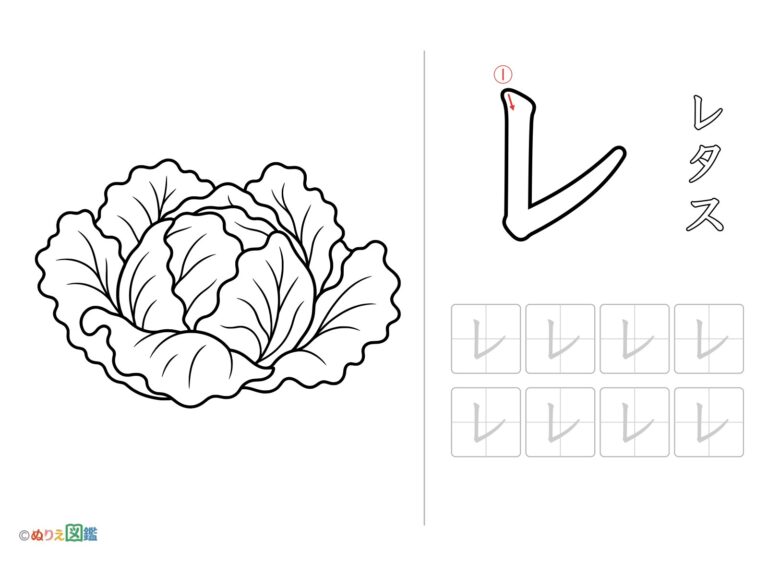
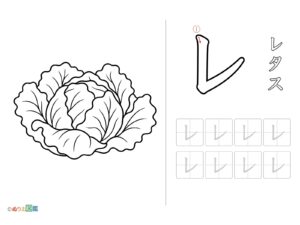
The letter on this coloring page is Katakana "Re"Katakana "Re"It is.
Words are"Lettuce"It's Katakana "Re"!
On the left side, there is one round lettuce, right?
The outer leaves spread out wide, and the leaves havestripehas lots of Katakana "Re" in it!
Lettuce is often used in salads and sandwiches,Crisp and crunchyIt is a crisp and crunchy vegetable.
"Lettuce" comes from English, so you write it in Katakana.
Names of vegetables and animals are often written in Katakana, aren't they?
"Katakana "Re"" came from "礼"
Katakana were created by people a long time agoPart of a Kanjiis a character made from taking a part of "礼".
"Re" in Katakana is"Re"characterRight sideIt came from a part of the kanji.
The right side of "礼", which goes straight down and flicks to the right, became Katakana "Re" just as it is!
The hiragana "Re" comes from the same character "礼", too!
How to write Katakana "Re"
"Re" in Katakana is, believe it or not,1 strokeYou can write Katakana "Re" with .
From the topStraight downBring it down, and when you reach the bottom, keep goingBrush up to the top rightnda.
The key is to write the vertical line a bit longer and sweep the stroke toward the top right smoothly at an angle!
It looks like the line on the right side of Katakana "Re".
There are a few Katakana characters with just 1 stroke, like "No" and Katakana "Re".
Words that start with Katakana "Re"
Words that start with Katakana "Re" includeLettuce,Lemon,Restaurant,Rail,Red pandaand more.
Both lettuce and lemons are words that came from other countries.
CurryYaToiletLike this, some words have "レ" in the middle or at the end, too.
Look inside your fridge and try to find foods that start with Katakana "Re".
It is rare to find a character you can write with just 1 stroke
Most katakana are written with 2 or 3 strokes.
But Katakana "Re" iswithout lifting your pencil even onceIt's a rare character that you can write!
In Katakana, you can also write "ノ", "フ", and "ヘ" with just 1 stroke.
For a 1-stroke character, the secret is to write without stopping in the middle and pay attention to how the line flows.
The Katakana "Re" is drawn with 2 strokes in Hiragana, so it's neat that Katakana "Re" and its Hiragana have a different number of strokes.
When you write Katakana "Re", try to pay attention to the place at the bottom where you make a sharp turn.
How to Color Katakana "Re"
Color the Big Katakana "Re" All in One Go
Try coloring the big Katakana "Re" in the top right with colors that match lettuce, like yellow-green or green.
Since it is made of just 1 stroke, color along the line from top to bottom, and then up to the right, just like when you write it.
If you color carefully near the edges, it is easier to stay inside the lines.
Lettuce Is Green Outside and Yellow-Green Inside
Try coloring the big outer leaves of the lettuce with green or yellow-green.
If you make the round leaves wrapped in the middle light yellow-green or light yellow, it will look like real lettuce.
Making the outside dark and getting lighter toward the inside shows how the leaves layer over each other.
Leave the leaf veins whitish, or trace them thinly with light yellow-green.
If you layer a little dark green on the wavy edges of the leaves, it will look 3D.
Trace Without Stopping in the Middle
In the boxes at the bottom right, there are 8 light gray Katakana "Re"s lined up.
Slowly trace over the gray lines with a pencil.
Since it is a 1-stroke character, do not lift your pencil at the bottom—just sweep it right up to the top right.
If you start writing a little to the left of the box's center line, the character will fit right in the middle.
Write each one carefully.
Put It on a Plate and Make a Salad
It is also fun to draw tomatoes or cucumbers around the lettuce to make a salad.
If you color the tomatoes red and the cucumbers dark green, they will go great with the yellow-green lettuce.
Fun Facts About Katakana "Re"
Name Comes from "Milk"
When you cut Katakana "Re"'s stem or core, white liquid comes out.
It is said that Katakana "Re" got its name from an old word that means milk because of this white liquid.
In Japan, it used to be called "Chisha," which also comes from a name that means "milk grass."
It's Mostly Water
About 95% of Katakana "Re" is made of water.
That is why it is so juicy and crunchy when you bite into it.
It tastes fresh and yummy when you eat it in the hot summer!
Nagano Is Famous for Katakana "Re"
The place that grows the most Katakana "Re" in Japan is Nagano Prefecture.
The highlands in Nagano stay cool even in summer. This makes it easy to grow Katakana "Re" during the summer, even though it does not like heat.
The Katakana "Re" you eat in summer often comes from these cool highlands.
Katakana "Re" Is in the Daisy Family
Believe it or not, Katakana "Re" is a plant in the daisy family.
If you keep growing it, the stem gets longer and small yellow flowers that look like daisies bloom.
The soft leaves you always eat are picked before the flowers bloom!
Share These Katakana "Re" Coloring Pages


-
Tracing the letter "Re" (Lettuce)
-