Katakana "Pya" Coloring Pages


About Katakana "Pya"
Katakana "Pya" in "Pyat"
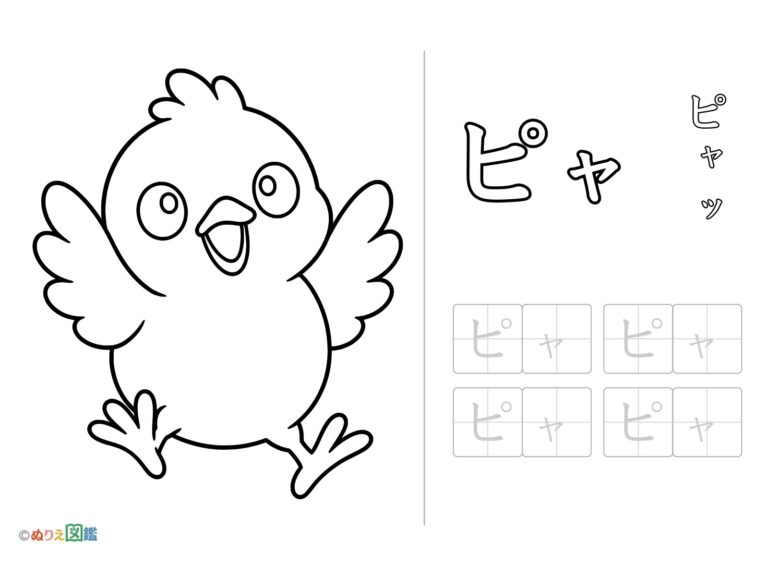
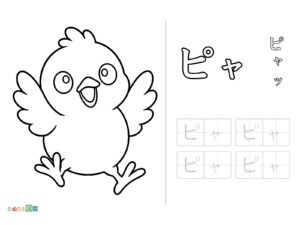
This coloring page is for practicing the Katakana "Pya".
The word is "Pyat". It is a word that shows how someone looks or sounds when they get surprised and jump up.
On the left, there is a cute chick jumping up and spreading its wings in surprise, going "Pyat!".
It is trying its best to spread its little wings with its eyes round and wide.
It is also fun to make up a story about what surprised it!
One sound made of two letters
Katakana "Pya" uses two letters: "Pi" and a small "Ya," but they make one single sound.
Letters made like this, with a small "Ya," "Yu," or "Yo," are called 拗音 (youon / contracted sounds).
When you say it out loud, try saying them together as one sound instead of separating "Pi" and "Ya." If you stop the sound quickly at the small "Tsu" at the end, it really sounds like a surprised voice!
How Katakana "Pya" came to be
Katakana characters were made a long time ago when people took a part of a Kanji or made its shape simpler.
"ピ" is the character "ヒ" with a little circle. This circle is also called a handakuten.
The original "ヒ" came from the right side of the Kanji "比".
The small "ャ" is just a tiny version of "ヤ". "ヤ" was made by simplifying the shape of the Kanji "也".
Hiragana was made by swooping whole Kanji, but Katakana was made from parts of Kanji, so it has a lot of straight lines!
How to write Katakana "Pya"
Katakana "Pya" has 3 strokes in total: 2 strokes for "ヒ" plus 1 stroke for the circle.
The 1st stroke of "ヒ" is a short horizontal line.
For the 2nd stroke, draw a line going down from the top, and then turn it to the right.
For the circle, draw a small loop at the top right at the end. Make sure you do not mistake it for dots!
The small "ャ" has 2 strokes. The first stroke bends like "フ", and the second stroke is a diagonal line that crosses it, written from top to bottom.
Write small letters about a quarter the size of the box. For horizontal writing, put it near the bottom left of the box, and for vertical writing, put it near the top right of the box.
If you write "ャ" too big, people will read it as two sounds, "Pi-ya", so be careful!
Words with Katakana "Pya"
Besides words from other countries, Katakana is also often used to write words that show sounds, voices, and how things look.
"Pya!" is one of those words, too.
Actually, there are almost no words that start with Katakana "Pya".
But you can find it in the middle of words, like in numbers like roppyaku (six hundred) and happyaku (eight hundred).
Try saying the hundreds out loud—one hundred, two hundred, three hundred—and see if you can find where Katakana "Pya" pops up!
How to Color Katakana "Pya"
Color the big Katakana "Pya" in any color you like
Try coloring the big outlined Katakana "Pya" at the top right in your favorite color.
If you use yellow or orange to match the chick, it will look bright and cute.
Color slowly along the outside first so you do not go over the lines, then fill in the inside to make it look neat!
The chick is soft and fluffy yellow
Try coloring the chick's body in lemon yellow or yellow.
If you make the tips of the wings and bottom of the tummy a little bit dark yellow or golden yellow, the fluffy feathers will look 3D!
Color the beak and feet in orange to make it look just like a chick.
Color the eyes in black and leave a tiny white shiny spot to make the eyes look full of life.
Add surprise marks all around
Try drawing short surprise lines or star shapes around the chick!
If you color them in red or light blue, your picture will show the "Pya!" surprise feeling even more.
Trace carefully, one pair at a time
In the boxes at the bottom right, light gray Katakana "Pya" characters are lined up in 4 sets of 2.
Use a dark colored pencil or a soft pencil to slowly trace over the light characters.
If you look at the vertical and horizontal center lines in the boxes, you can clearly see the size difference between big and small characters.
Say the stroke order out loud while you write to help you remember it easily.
Make sure you write the circle for "Pi" without confusing it with the dots for "Bi"!
Fun Facts About Katakana "Pya"
Chicks can walk right after they are born
When a baby chicken hatches from an egg, it starts to walk on its own two feet right away.
Its body is covered in soft, fluffy feathers, and it walks right behind its parent.
It also learns how to peck for food all by itself in no time!
Eggs hatch in about 3 weeks
When a parent bird keeps a chicken egg warm, a chick hatches in about 21 days.
The chick uses a tiny, sharp point on the tip of its beak to break the shell from the inside and come out.
It works so hard with its little body to be born!
Numbers with "pya" in them
Let's try counting by hundreds from 100 to 900 in Japanese!
It goes hyaku, nihyaku, sanbyaku, yonhyaku, gohyaku, roppyaku, nanahyaku, happyaku, kyuhyaku.
The sound "hyaku" changes to "byaku" or "pyaku" to make it easier to say together with the sound before it.
Let's write it in Romaji
When you write Katakana "Pya" in Romaji, it becomes pya.
For sounds with a small "ya," "yu," or "yo," you use the letter y in Romaji.
You will learn Romaji in Japanese class around 3rd grade in elementary school.
It is also written on train station names and road signs, so try reading it if you find it!
Share These Katakana "Pya" Coloring Pages


-
Tracing the "ピャ" (ピャッ)
-