Katakana "Nyo" Coloring Pages


About Katakana "Nyo"
The "Nyo" in Katakana "Nyo"
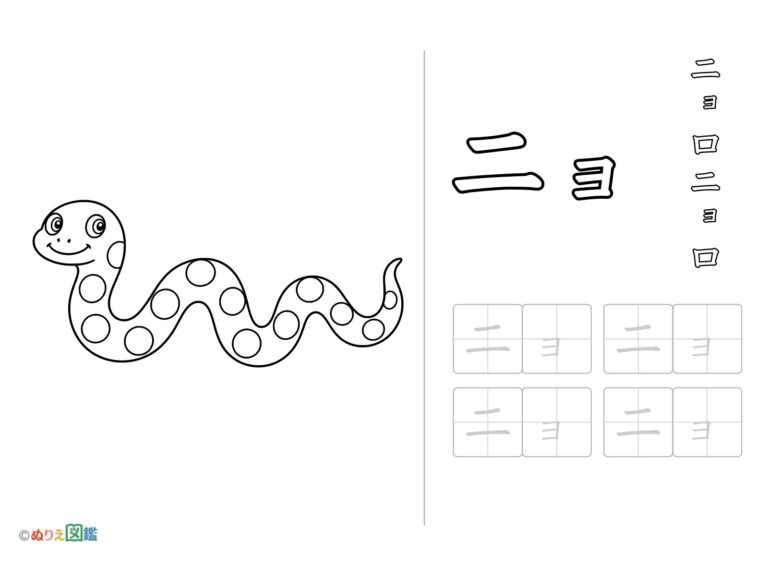
The character on this coloring page is Katakana "Nyo".
The word is "Nyoronyoro". It starts with Katakana "Nyo"!
"Nyoronyoro" is a word that shows how something slithers and wiggles like a snake. It is not the name of a thing. It is a word that shows how something moves.
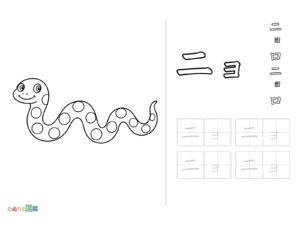
The picture on the left shows a happy, smiling snake slithering along. Look at the big round dots lined up on its body!
We often use Katakana to write words from other countries, names of animals and plants, and sounds or animal noises. Words like "Nyoronyoro" that show sounds or movements look extra lively when you write them in Katakana!
"Ni" and a small "yo" make one sound
Katakana "Nyo" is a character you write by adding a small "ョ" after "ニ".
Even though you write it with 2 characters, you read it as 1 sound: "Nyo". A sound like this is called a contracted sound.
If you write a big "ョ" to make "ニヨ", it becomes 2 separate sounds: "Ni" and "Yo". How you read it changes depending on whether you write it small or big!
Try saying "Nyoronyoro" while clapping your hands. For the "Nyo" parts, you only need to clap once!
The Kanji That Made Katakana "Nyo"
Katakana are characters made by taking parts of kanji or using the shapes of kanji as a base.
It is said they started when monks long ago used them to quickly write down how to read the kanji in sacred texts.
"Ni" came from the "二" on the right side of the kanji "仁".
The small "yo" is just a shrunk-down version of the big "Yo", and "Yo" was created based on the kanji "与".
Tips for writing
"Ni" has 2 strokes.
You write it with two horizontal lines. The trick is to make the top line short and the bottom line long!
Leave a little space between the two lines, draw both from left to right, and stop clean at the end.
The small "yo" has 3 strokes, and you write it in the same order as a big "Yo".
When writing horizontally, put it small in the bottom-left part of the box. Be careful not to make it the same size as "Ni"!
Words that start with Katakana "Nyo"
Words that start with "Nyo" are very rare!
There are only a few, like Nyoki-nyoki, which describes bamboo shoots or mushrooms popping out of the ground one after another, or Gnocchi, the tasty dish from Italy.
Words that repeat the same sound twice, like "Nyoro-nyoro" or "Nyoki-nyoki," are fun because you can really picture what is happening!
Try to find other repeating words, too!
How to Color Katakana "Nyo"
Color the big Katakana "Nyo" with two different colors
The big Katakana "Nyo" at the top right has outlines for you to color inside.
If you color the big "Ni" and the small "Yo" in different colors, you can easily see that it is made of two letters.
Try coloring "Ni" in green like a snake, and the small "Yo" in yellow or orange to make it look fun!
It is also fun to change colors line by line in the order you write them, like stroke 1 and stroke 2.
Color each round pattern differently
Let's color the snake's body in green or yellow-green.
If you color the big round patterns on its body one by one in different colors, like yellow, orange, or light blue, you will get a colorful snake!
If you color its belly side light yellow, you can tell it apart from its back.
Color the tongue red and the cheeks pink to make the smiling face even cuter.
Tracing is a pair of two letters
In the boxes at the bottom right, there are 4 pairs of light gray Katakana "Nyo". You can see "Ni" in the left box and a small "Yo" in the right box.
Hold your pencil correctly and trace over the gray lines slowly so you do not go outside the lines.
Use the vertical and horizontal center lines inside the boxes as a guide to help you get the position and size of the letters just right.
Also check to see if the small "Yo" fits neatly in the bottom left of the box.
Every time you trace one pair, say "Nyo" out loud so you can learn the letter and sound together.
Fun Facts About Katakana "Nyo"
The Secret to Moving Without Legs
Katakana "Nyo" has no legs.
Instead, it wiggles its body, pushes against bumps on the ground, and catches the scales on its belly to move forward.
It really wiggles along!
Smelling with Its Tongue
Katakana "Nyo" flicks its thin tongue in and out.
It uses its tongue to catch tiny bits of smell in the air and brings them to a special smell spot inside its mouth.
Katakana "Nyo" actually smells things with its tongue!
Eyes That Never Blink
Katakana "Nyo" has no eyelids.
Instead, a clear scale covers each eye.
That is why Katakana "Nyo" never blinks and always looks like its eyes are open.
Let's Compare Katakana "Nyo" with Hiragana "Nyo"
When you write Katakana "Nyo" in Hiragana, it is "にょ".
Actually, both Hiragana "に" and Katakana "ニ" came from the same Kanji character, "仁".
Hiragana was made by writing the whole Kanji in a soft, rounded way. Katakana was made using a piece or shape of the Kanji. That is why they look different, even though they came from the same Kanji!
The small "ょ" and "ョ" also came from the same Kanji character, "与," so they are like brother and sister letters!
Share These Katakana "Nyo" Coloring Pages


-
Tracing the katakana "ニョ" (Hattifatteners)
-