Katakana "Mi" Coloring Pages


About Katakana "Mi"
"Mi" as in "milk"
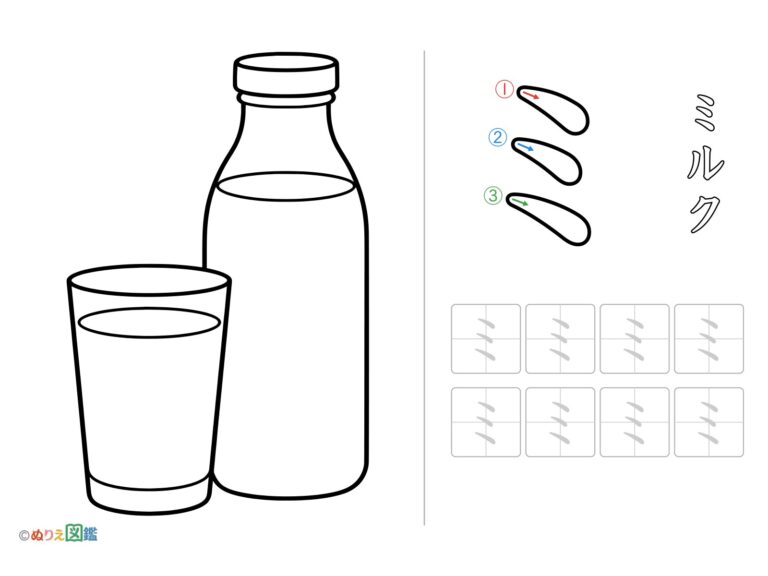
This coloring page is for learning Katakana "Mi".
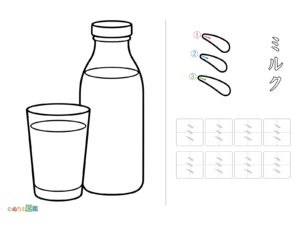
The word is "Milk". On the left, you can see one glass of milk and one milk bottle.
In Japanese, milk is also called gyunyu.
Have you gulped it down at breakfast or school lunch before?
Words from other countries
"Milk" comes from an English word.
Words that come from other countries like this are often written in katakana.
Katakana is also used for the names of animals and plants, as well as sound words like "goku-goku" (gulp-gulp).
It is neat that the same thing can have two different names, like "milk" and "gyunyu"!
Katakana "Mi" was born from the kanji "三"
The Katakana "Mi" was made from the kanji 「三」.
It looks like the 3 straight lines of 「三」 were tilted to the side, right?
The Hiragana "mi" came from a different kanji, 「美」.
Even though they make the same "mi" sound, Hiragana and Katakana come from different kanji!
How to Write Katakana "Mi"
You write Katakana "Mi" in 3 strokes.
All 3 are short lines that go slightly slanting down from top-left to bottom-right.
Write them from top to bottom: stroke 1, stroke 2, and stroke 3.
If you match the direction of the 3 lines and keep the spaces between them even, it will look super neat.
Making the bottom line just a little bit longer is another great tip!
Compare Katakana "Mi", "Shi", and "Tsu"
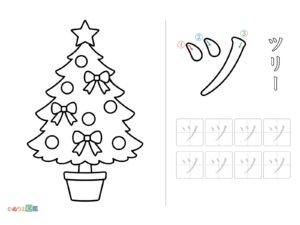
Letters that look like Katakana "Mi" include "シ" (Shi) and "ツ" (Tsu).
"シ" and "ツ" are letters with 2 short dots and 1 long line.
Katakana "Mi" has 3 similar lines lined up together.
If you write them side by side, you can easily see the difference.
Let's look for words that start with Katakana "Mi"
Words that start with Katakana "Mi" include mandarin oranges, honeybees, sewing machines, mittens, and toy cars.
Mandarin oranges and honeybees are the names of living things, while sewing machines and mittens are words that came from other countries.
Sound Words That Start with Katakana "Mi"
The "Mi" in "Do-Re-Mi" is also often written in katakana.
The music note names "Do, Re, Mi, Fa, So, La, Ti" are words that came from other countries.
Try looking for the "Mi" note on a piano or a keyboard harmonica!
How to Color Katakana "Mi"
Color Katakana "Mi" in 3 Colors
Color the big Katakana "Mi" on the top right in any color you like.
If you change the color for each line, like red, yellow, and blue, you can easily see that it is a 3-stroke character.
It also looks great to use similar colors, like light blue, blue, and navy, to make it darker line by line!
Use the White of the Milk
Milk is white, so you can leave the milk part uncolored as white.
If you color just a little bit of light blue or light gray around the edges, the white milk will look like it pops out.
If you want to make strawberry milk, try coloring it light pink! If you want coffee milk, try light brown!
Make the Cups and Bottles Look Clear
For the glass cups and milk bottles, color gently along the edges with light blue to make them look clear.
If you leave thin white lines uncolored, the glass will look shiny and bright!
Try using your favorite colors like red, blue, or yellow for the bottle caps.
Trace Carefully with a Pencil
In the boxes on the bottom right, there are 8 light gray Katakana "Mi".
Trace them one by one carefully with a pencil.
Use the center lines going up, down, and across the box as a guide to keep your characters the same size and position.
Write each line slowly so that all 3 lines point in the same direction.
Once you get used to tracing, try writing Katakana "Mi" without looking in the empty space outside the boxes!
Fun Facts About Katakana "Mi"
Most of milk is water
About 90% of milk is made of water.
The rest has things like protein that builds your body, and calcium that makes your bones and teeth strong.
Why is it white?
Milk looks white because tiny drops of fat and protein are all mixed together inside it.
When light hits these drops, it bounces back in every direction, so it looks white to you!
June 1st is Milk Day
June 1st is Milk Day.
All around the world, June 1st is also celebrated as World Milk Day.
Long ago, there were many more milk delivery workers who brought milk in glass bottles right to house doorsteps every morning.
Even now, you can still find places where you can drink milk from a glass bottle!
Milk comes from mother cows
Milk is the milk that mother cows give after their babies are born.
On farms, people gently collect it using hands or milking machines.
After milking, the milk is heated to get rid of germs, and then put into bottles or cartons.
At some farms, you can even try milking a cow yourself!
Share These Katakana "Mi" Coloring Pages


-
Tracing "Mi" (Milk)
-