Snowflake Coloring Pages
 ~

About Snowflake
Snowflake is a Tiny Grain of Ice
If you look closely at the snow falling from the sky, every single one is a grain of ice with a pretty shape.
We call this a Snowflake.
Inside the clouds, water vapor in the air gets cold and grows as it sticks to small grains of ice.
Usually, they are about a few millimeters big.
They are small, but if you look with a magnifying glass, you will be surprised by their detailed shapes!
Why Does Snowflake Always Have 6 Branches?
Every Snowflake has 6 corners or 6 branches.
This happens because the tiny drops of water that make ice line up into a six-sided shape, just like holding hands, to turn into ice.
So, an ice crystal first becomes a small hexagon, and then it grows bigger in 6 directions.
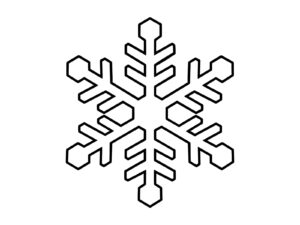
In the first coloring page, 6 branches stretch out from the middle, and every branch has the same shape.
It is said that all 6 look the same because they fall together through the same air and grow in the same way.
Shapes Change with Temperature and Water Vapor
Snowflake does not have just one shape.
There are many kinds, like tree branch shapes, six-sided plates, thin needles, and six-sided columns like pencils.
The shape depends on the temperature when the crystal grows and how much water vapor is in the air.
A scientist named Ukichiro Nakaya from Hokkaido University checked this.
In 1936, he made the world's first artificial Snowflake on the tip of a rabbit hair inside a very cold lab.
The chart that shows the crystal shapes he made by changing the temperature and water vapor is called the Nakaya Diagram.
Snowflake is a Letter from the Sky
Ukichiro Nakaya wrote in his book, "We can say that Snowflake is a letter sent from heaven."
This means that if you look at the shape of a crystal, you can tell the temperature and water vapor way up in the sky.
These words are also famous in a shorter way: "Snow is a letter sent from heaven."
There is also a snow science museum named after Ukichiro Nakaya in Kaga City, Ishikawa Prefecture.
Have Fun on a Snowy Day with 3 Coloring Pages
The first picture has just one large Snowflake shaped like a tree branch.
Small branches line up on both sides, and small six-sided plates are attached to the tips.
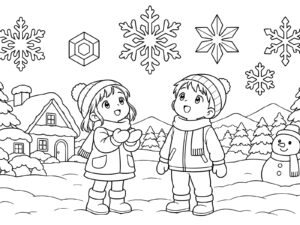
The second picture shows two children looking up at the sky in a snowy field.
One holds up a mitten to catch the snow, and the other looks at the sky with an open mouth.
Big crystals of various shapes fall from the sky, and you can see houses, trees, and a snowman in the background.
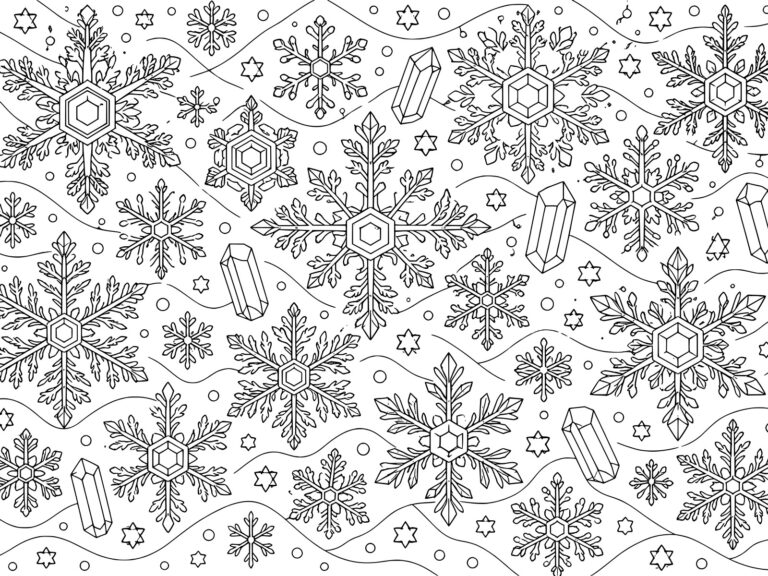
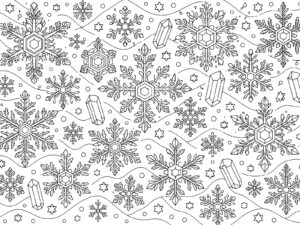
The third picture is a pattern of many shapes packed closely together.
Take your time and enjoy coloring it carefully!
How to Color Snowflake
If You Leave Some White, It Looks Just Like a Snowflake
Snowflakes are made of ice, so they are actually see-through white.
So instead of coloring the whole Snowflake, try leaving white spots here and there. That makes it look bright and icy!
Try adding a thin line of light blue along the edges of the branches, and keep the middle white.
It also looks great if you start from the middle and make the blue a little darker as you go out.
If You Color Around It Dark, the Snowflake Pops Out
On the first page, try coloring the white paper around the Snowflake with navy blue or dark blue.
Your white Snowflake will stand out bright, just like it is floating in the night sky!
The trick is to sharpen your colored pencil and color carefully, right up to the outer lines of the branches.
If you color the 6 branches in the same color order, the hexagon shape will look nice and balanced.
On the Second Page, Show the Difference Between White Snow and Clothes
Keep the snowy field, house roofs, and snowman white, and just color the shadows with light blue or light purple.
Then, use warm colors like red, yellow, or orange for the kids' hats, mittens, and jackets. They will really stand out in the snow!
If you make the sky a grayish blue, the falling white Snowflakes will be easy to see.
On the Third Page, Choose Your Color Group First
There are a lot of Snowflakes on the third page!
First, pick a group of 3 or 4 colors to use, like blue, light blue, and purple. This makes the pattern look nice and neat.
It is also fun to use the same color for each shape—like blue for tree branch shapes, and light blue for hexagon plates.
For the wave pattern in the back, try changing how dark you color each section.
Fun Facts About Snowflake
The "Snow Lord" of the Edo Period
About 190 years ago in the Edo period, there was a lord who studied Snowflake crystals very closely.
His name was Toshitsura Doi, the lord of the Koga Domain in what is now Ibaraki Prefecture.
Toshitsura Doi looked at Snowflake crystals through a microscope from the Netherlands for many years.
Then, around 1832, he made a book called Sekka Zusetsu with lots of drawings of the crystals.
Together with its sequel, the book shows more than 180 drawings of crystals.
When he looked at them, people say he cooled down a black cloth outside and caught the snow on it.
Snow patterns on kimonos, too
The crystal drawings in Sekka Zusetsu became very popular among the people of Edo. It is said they were even used as patterns for kimonos and small items.
Japan has another pattern called Yukiwa, too.
It is a pattern that makes the six-sided Snowflake crystal into a round shape.
You can still see it today on kimonos and family crests.
Let's look at Snowflake crystals
When it starts snowing, put a black cloth or black paper outside and cool it down well.
If you catch the snow with a cold cloth, the crystals will not melt right away.
On a black background, it is very easy to see the white crystals.
Look at them with a magnifying glass or hand lens, and draw their shapes in your notebook!
The trick is to look gently, because your warm breath will melt them.
If you write down the temperature of the day, too, you will see how the temperature and shapes connect.
When you look at them outside, bundle up warmly and go with an adult.
On snowy days, try reading these letters from the sky between games of {SKI} or {YUKIGASSEN}!
Share These Snowflake Coloring Pages


More Sky, Weather & Stars Coloring Pages
-
Big Snowflake
-
A day when snowflakes fall
-
-
Snowflake pattern
-
-