Bagworm Coloring Pages
 ~

About Bagworm
"Mino" Made from Twigs and Leaves
Bagworm is the larva of a type of moth called the bagworm moth.
Using silk from its mouth, the larva weaves together tiny twigs and pieces of dry leaves to make a bag that covers its body.
This bag looks like a straw raincoat called a "mino" that people used to wear on rainy days long ago, which is how it got its name.
The bag is like a home and armor for the larva!
The larva sticks its head and legs out of the bag to walk around, eating tree leaves to grow bigger.
As its body grows, it adds new pieces to the opening of its bag to make the bag bigger, too.
Since it uses materials nearby, each bag looks a little different depending on the tree!
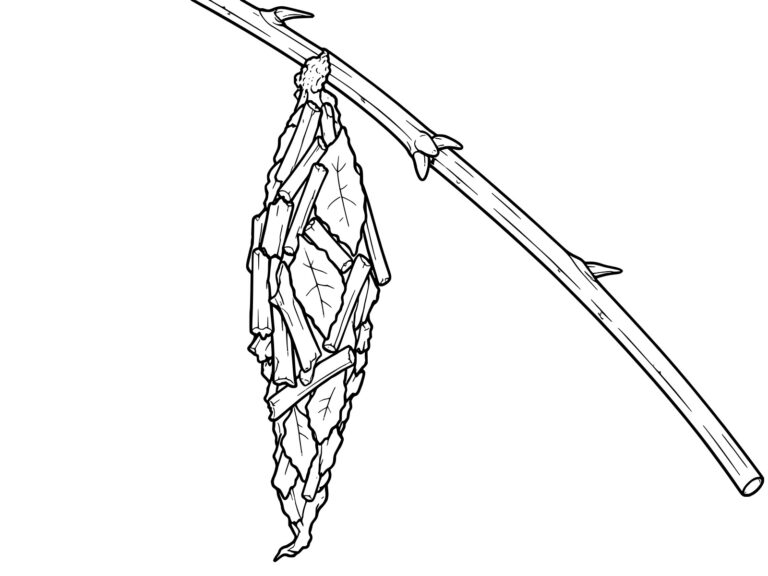
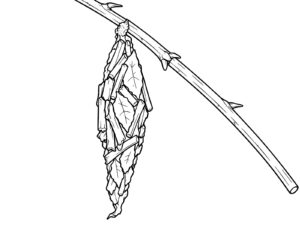
Bagworm hanging from a branch
The first coloring page shows one bag hanging from a twig, drawn based on a photo.
It has a long, thin shape that is narrow at the top, round in the middle, and pointed at the bottom.
Short twigs and leaf bits are packed tightly from top to bottom on the surface of the bag.
The top end of the bag is tied tightly to the branch with silk, so it will not fall off even if the wind blows.
You cannot see the Bagworm larva inside, but it is staying very still in its bag.
It hangs from the middle of the branch just like it is tied on with a string.
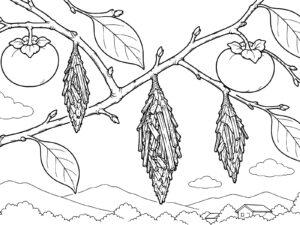
Bagworm on a persimmon tree
The second picture shows three bags hanging from the branch of a persimmon tree at the end of autumn.
On the branch, you can see colorful persimmon leaves and orange persimmon fruits.
Bagworms eat leaves from many kinds of trees, like persimmon, cherry, and plum trees.
When the leaves start to fall, it gets easier to spot the bags hanging from the branches.
In the background, you can see distant mountains and house roofs.
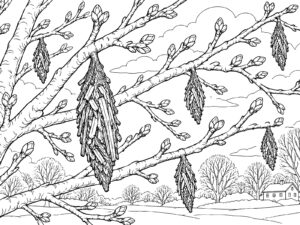
Waiting for spring on a winter branch
The 3rd picture is a cherry blossom tree in winter, with all its leaves gone.
At the tips of the branches, the winter buds that will bloom in spring are growing bigger, and Bagworms are hanging here and there.
At the end of autumn, the Bagworm closes the top of its bag with silk and attaches it tightly to a branch.
Then, it spends the winter as a caterpillar inside its bag.
When spring comes, it turns into a pupa inside the bag, and soon becomes an adult moth.
How to Color Bagworm
Color the Bagworm's coat piece by piece
Color the Bagworm's coat with the colors of dry twigs and leaves, like brown, dark brown, yellowish brown, and gray.
If you use different colors for each little piece of twig or leaf, it will look like a real Bagworm coat!
When pieces are next to each other, switch between dark and light colors so everyone can easily see the shape of each piece.
If you mix in a little light green or reddish brown here and there, they will really look like bits of leaves.
Use shadows to make the Bagworm's coat look round
If you color just one side—either the left or the right—a little darker, the coat will look round and puffy.
For the silk threads near the top that stick to the branch, use white or light gray.
For the branch, color it brown or gray, and make the bumpy joints a little darker.
If the Bagworm's coat has lots of leaf pieces, you can color the whole thing light brown, and then trace just the lines of the leaves with dark brown.
Persimmon trees in autumn and cherry trees in winter
For the second coloring page, mix red, orange, and yellow for the persimmon leaves to make it look like autumn.
Color the persimmon fruit orange, and make the top cap green or brown.
The third page shows winter, so color the sky a light sky blue, and make the faraway trees light brown or gray to create a wintry view.
If you color the winter buds brown or reddish brown, they will look like little buds waiting for spring.
Try coloring trees from autumn to winter together with the Playing with Fallen Leaves coloring page to compare them!
Fun Facts About Bagworm
Females spend their whole lives inside the bag
When spring comes, Bagworm turns into a pupa inside its bag and becomes an adult moth.
Male moths have wings, so they fly out of their bags.
However, females have almost no wings or legs, and it is said that they almost never leave their bags even after becoming moths.
Females lay eggs inside their bags and spend their whole lives there.
The number of Bagworms has decreased
The giant Bagworm, the largest type in Japan, used to be seen everywhere long ago.
However, about 30 years ago, a type of fly from overseas came in and used them as hosts, causing their numbers to drop a lot.
Now, if you find Bagworm in town, it might actually be a little rare!
Even if you find one, do not pick it up, and just watch over it quietly.
Bagworm's silk is super strong
Bagworm's silk is known to be super strong, even though it is thin.
Studies show that it is even stronger than spider silk, and people are researching it to make new materials.
Thanks to this strong silk, tiny Bagworm can keep its bag attached tightly to a tree branch!
Share These Bagworm Coloring Pages


More Other Insects Coloring Pages
-
Bagworm hanging from a branch
-
Bagworm on a persimmon tree
-
-
Bagworm on a winter cherry branch
-
-