Yakitori Coloring Pages
 ~

About Yakitori
Chicken Skewered and Grilled over Fire
Yakitori is a dish made by putting bite-sized pieces of chicken onto bamboo skewers and grilling them over a fire.
At a Yakitori shop, cooks grill them over charcoal until nicely browned, turning the skewers over and over again.
There are two main flavors: sweet and savory sauce, or simple salt.
Besides eating it at restaurants, you can also find it at festival food stalls and in supermarket deli sections.
Many Kinds of Yakitori
There are many kinds of Yakitori made from different parts of the chicken.
Popular choices include Negima, which alternates chicken and green onions; Tsukune, which is made of ground chicken meatballs; Kawa, which is crispy chicken skin wrapped around the skewer; and Momo, which is juicy leg meat.
Sometimes people eat Tsukune by dipping it into an egg yolk.
There are also unique kinds of Yakitori made from parts like the gizzard, liver, and Hatsus (chicken hearts).
3 Coloring Pages
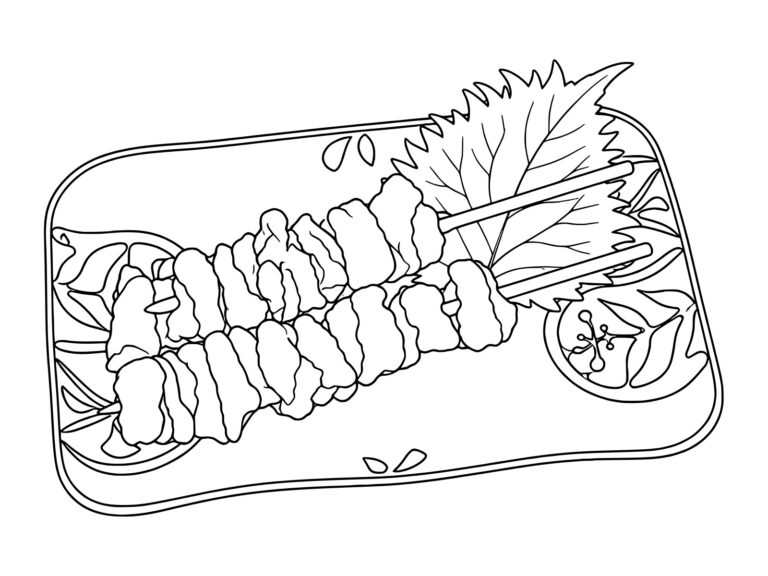
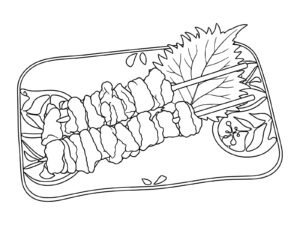
The first page shows two skewers of Kawa Yakitori on a plate with a green shiso leaf.
Try coloring the wavy, crinkly shapes carefully!
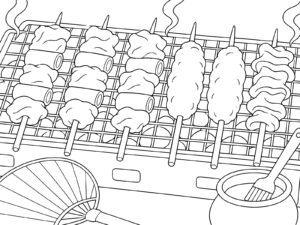
The second page shows Negima and Tsukune grilling on a charcoal grill.
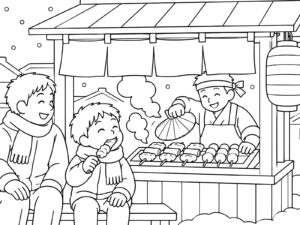
The third page shows a Yakitori food stall on a winter night.
You can see the cook fanning the fire while a parent and child enjoy their delicious Yakitori.
Jobs at a Yakitori Shop
Before opening the shop, the Yakitori cook cuts lots of chicken into equal sizes and carefully puts them on skewers one by one.
Making them all the same size helps every piece cook evenly and taste great.
When customers arrive, the cook lines up the skewers over hot charcoal and grills them while fanning the fire with a fan.
For sauce-flavored Yakitori, the cook dips the skewers into the sauce again and again while grilling to make them shiny and flavorful.
Some shops even have a secret sauce that they have been adding to and using for many years.
Yakitori is truly a dish full of hard work and skill!
Sometimes, people take the meat off the skewer to share it on a plate.
When you finish eating your Yakitori, it is polite to put the used skewers into the special holder placed by the shop.
Which do you like better, sauce or salt Yakitori?
How to Color Yakitori
Golden-Brown Colors
For Yakitori with sauce, layer dark brown and reddish-brown to get that shiny sauce color.
For salted Yakitori, color it cream or light yellow, and just add brown to the grill marks.
For the green onions on Negima, leave the white parts white, and add just a little brown for the grill marks.
The bamboo skewers look great colored light yellow or yellowish-brown.
Color the shiso leaves green, and trace the leaf veins with a slightly darker green to make them look fresh.
Charcoal Fire and Food Stall Colors
On the second page, color the charcoal black or dark grey, and put a little orange or red in the gaps so the charcoal looks hot and glowing.
On the third page, color the paper lantern red to make it look like a real food stall.
Color the night sky dark navy blue, and leave the snow white.
Try coloring the Sukiyaki coloring page, too!
How to Color People and Smoke
On the third page, leave the Yakitori cook's headband white, or color it blue.
Color the parent and child's scarves with warm colors like red, green, or yellow to make them look like winter.
Leave the fluffy rising smoke white, and trace just the edges in light grey to make it look soft.
Color the shop curtain navy blue or red, and try brown for the food stall's roof.
On the second page, color the grill silver or grey to make it look like real metal.
Fun Facts About Yakitori
Is the "ma" in "negima" short for tuna?
You call a Yakitori with chicken and green onions on a skewer "negima," right?
Actually, it is said that the original "negima" was a hot pot dish where green onions and tuna were cooked together.
Over time, it somehow became the name for Yakitori made with chicken and green onions.
It is neat how old names can stay with foods!
Pork "Yakitori"
In Muroran City, Hokkaido, if you order "Yakitori," you get pork and onions cooked on a skewer.
Pork "Yakitori" is also a famous treat in Higashimatsuyama City, Saitama Prefecture.
It is fun that the same "Yakitori" can be different depending on the town!
Other towns have their own special kinds of "Yakitori," too.
Why it tastes so good grilled over charcoal
Charcoal fires do not make big flames easily, and they give off a slow, strong heat.
That is why the outside gets nice and toasted, while the inside stays soft and juicy.
Yakitori cooks use hand fans to control how hot the fire is so they can cook every single skewer just right.
The cook's fan is a very important tool for keeping the charcoal at the best heat.
Share These Yakitori Coloring Pages


More Meat & Fish Dishes Coloring Pages
-
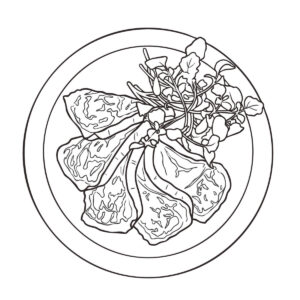
Yakitori (chicken skin) on a plate
-
Charcoal-grilled yakitori
-
-
Yakitori food stall on a winter night
-
-