Hiragana "Ru" Coloring Pages
 ~

About Hiragana "Ru"
"Ru" as in "Ruribitaki"
The character on this coloring page is the Hiragana "Ru".
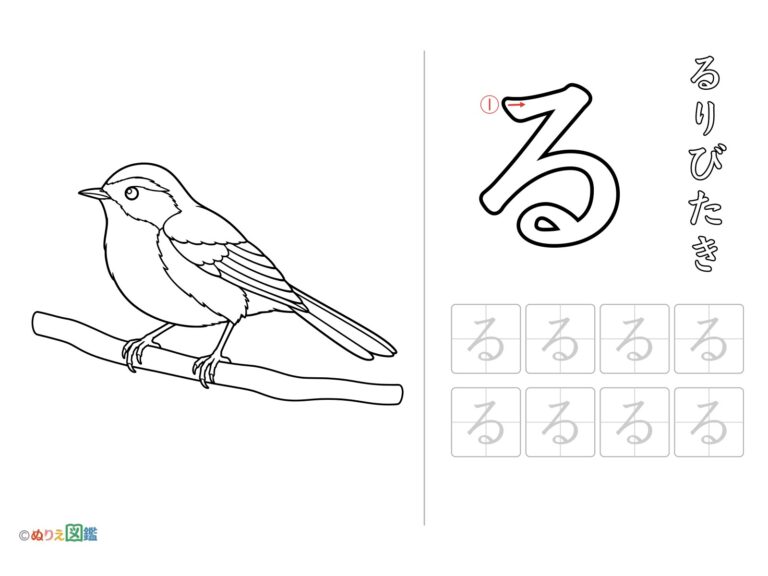
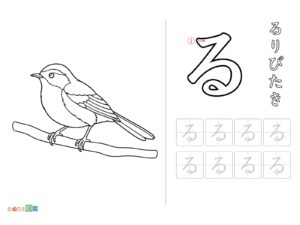
The word is "Ruribitaki" (Red-flanked Bluetail). The picture on the left of page 1 shows a male Ruribitaki perching on a tree branch.
You can see its thin beak, round eyes, and two feet gripping the branch tightly.
The Ruribitaki is a wild bird living in Japan that is about the same size as a sparrow.
Hiragana "Ru" came from the kanji "留"
Hiragana "Ru" got its current shape long ago when people wrote the kanji "留" in a simple, cursive way.
Katakana "ル" came from a different kanji, "流".
Even though they make the same sound, Hiragana and Katakana came from different kanji!
Tips for writing Hiragana "Ru"
Hiragana "Ru" has 1 stroke, so write it without lifting your pencil.
First, draw a short horizontal line at the top, then go diagonally down to the left.
From there, curve big to the right and down. Finally, make a small loop at the bottom and stop.
It looks a lot like "ろ", but Hiragana "Ru" has a small loop at the end, while "ろ" does not.
Try writing both characters side by side to see the difference!
Page 2 is full of words with "Ru"
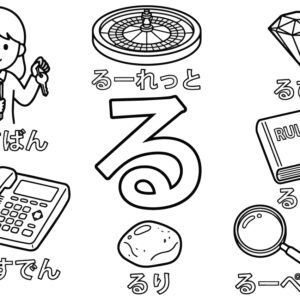
On the second coloring page, pictures of words starting with "Ru" line up around the big "Ru" in the middle.
You will find a spinning ruurettu (roulette), a blue gem called ruri (lapis lazuli), and a ruupe (magnifying glass) for looking at small things.
There is also a child doing rusuban (staying home alone) with a key.
Very few words start with "Ru"
Traditional Japanese words rarely start with "Ru".
That is why it can be tricky when you get "Ru" during a Shiritori word chain game!
Instead, there are many words with "Ru" in the middle or at the end, like "kuruma" (car), "saru" (monkey), and "hashiru" (run).
How many words starting with "Ru" can you think of?
How to enjoy the two coloring pages
On page 1, color the Ruribitaki and the big "Ru", and practice writing Hiragana "Ru" by tracing it.
Page 2 is a coloring page where you can color at your own pace while finding different "Ru" words.
If you color the ruri gem and the Ruribitaki's feathers in the same ruri-iro (lapis lazuli blue), you will see how the bird got its name!
How to Color Hiragana "Ru"
Color the Big Hiragana "Ru" with Your Favorite Color
Try coloring inside the big Hiragana "Ru" at the top right with any color you like.
Since it is made of just 1 stroke, try changing colors bit by bit from start to finish. It shows you the exact path of your stroke!
Matching the Red-flanked Bluetail with a Hiragana "Ru" that turns from blue to light blue looks very pretty, too.
Color the Red-flanked Bluetail in Blue and Orange
For a male Red-flanked Bluetail, color his head, back, wings, and tail in blue.
Leave his chest and belly white, and color just his sides in orange—that is the key trick!
He has a thin, white eyebrow-like line above his eye, so leave that uncolored too.
It looks great if you make his beak and feet dark brown or black, and the branch he sits on brown.
If you layer a little darker blue along the feather lines, his wings will stand out clearly.
Color the Shiny Things Beautifully on Page 2
On the second page, color the roulette wheel by alternating red and black, and color the outer rim brown.
For the lapis lazuli stone, color it dark blue and leave a few white spots. It will look like it is sparkling!
Color the magnifying glass lens light blue, and make the handle black or brown.
Trace Carefully, One by One
In the bottom-right boxes, there are 8 light gray Hiragana "Ru"s lined up.
Hold your pencil correctly and trace over the gray lines slowly without going outside.
Using the vertical and horizontal lines in the center of the box as your guide helps you balance the character.
For the small loop at the end, make it nice and round without squishing it.
Every time you finish one, compare it with the big Hiragana "Ru" sample!
Fun Facts About Hiragana "Ru"
"Ruri" is the name of a blue gemstone
The "ruri" in the Red-flanked Bluetail comes from a dark blue gemstone named ruri.
It is called this because the male's back is a bright blue, just like a ruri gemstone.
"Ruri-iro" (lapis lazuli color) is also a traditional name for a shade of blue that has been used in Japan for a very long time.
It takes time to turn blue
Female Red-flanked Bluetails have an olive-brown back, and only their tails are blue.
Young males look just like the females, but as they grow up, they slowly turn blue.
It is said that it takes a few years for a male to become bright blue all over.
Mountains in summer, towns in winter
During the summer, Red-flanked Bluetails raise their babies in high mountain forests.
When winter comes, they fly down to lower mountains and parks with lots of trees.
If you see a little blue bird sitting on a branch and twitching its tail in a winter park, it might be a Red-flanked Bluetail!
The name "Hitaki"
The Red-flanked Bluetail is a member of the Hitaki (flycatcher) family.
They got this name because their chirps, which sound like "hi-hi" and "ka-ka," are like the sounds made when striking flint stones together to make a fire.
Another bird in this family is the Daurian Redstart, which has a bright orange tummy.
Share These Hiragana "Ru" Coloring Pages


-
Tracing "Ru" (Red-flanked Bluetail)
-
Words Starting with "Ru"
-