Hiragana "Ge" Coloring Pages


About Hiragana "Ge"
"Ge" as in "Geta"
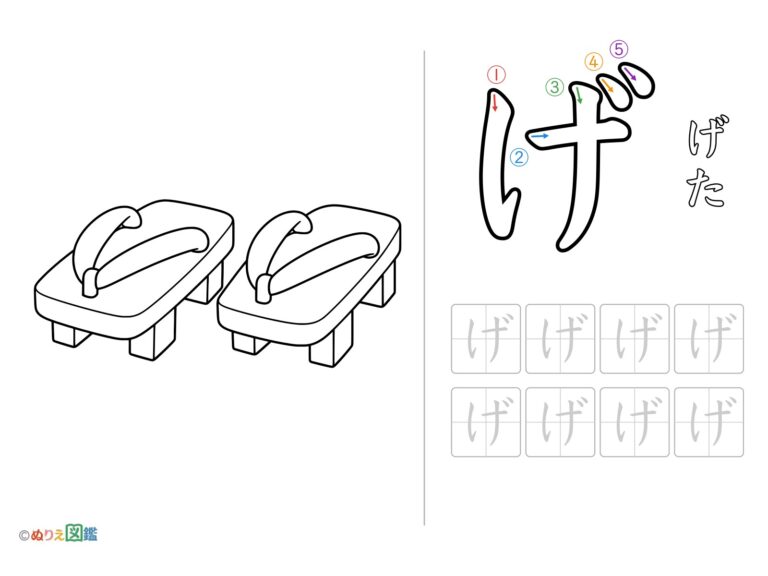
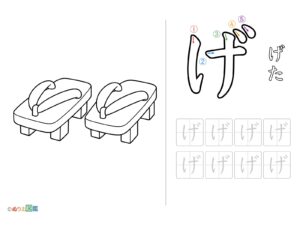
The character on this coloring page is the Hiragana "Ge".
The word is "Geta". The picture on the left of the first page shows a pair of geta, viewed from a slight angle.
Under the wooden base, there are two teeth, and on top, there is a thong for your toes.
Geta are traditional Japanese footwear from long ago.
Hiragana "Ge" came from "Ke"
Hiragana "Ge" is the character "Ke" with tenten (dots) added.
The original "Ke" got its current shape long ago when people simplified the kanji 「計」 as they wrote.
When you add the dots, the clear sound of "Ke" changes into the voiced sound of Hiragana "Ge".
Put your hand on your throat and say "Ke" and Hiragana "Ge" to compare them. Can you feel your throat vibrate when you say Hiragana "Ge"?
Tips for writing
The base character "Ke" takes 3 strokes to write.
For the 1st stroke, draw a straight line down on the left, and flick up to the right at the bottom.
For the 2nd stroke, draw a short horizontal line on the right.
For the 3rd stroke, draw a long line down from the top right through the 2nd stroke, sweeping down to the left at the end.
Finally, draw two dots on the upper right. The trick is to put them in the empty space to the right of the 3rd stroke.
Lots of words with Hiragana "Ge" on the second page
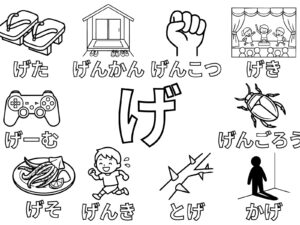
On the second coloring page, pictures of words with Hiragana "Ge" are set around a big Hiragana "Ge" in the middle.
At the top left, you can see the same geta as on the first page.
There are also pictures of a house entryway genkan, a tight fist genkotsu, a play on stage geki, and a diving beetle living in water gengorou.
Some words have Hiragana "Ge" at the end, like toge (thorn) and kage (shadow).
Let's play with words containing Hiragana "Ge"
Other words that start with Hiragana "Ge" are getsuyoubi (Monday), geshi (summer solstice), and geragera (giggle).
There are also many words with Hiragana "Ge" in the middle or at the end, like "hige" (beard), "matsuge" (eyelashes), and "nigeru" (run away).
Try looking for words with Hiragana "Ge" related to parts of your face with your family.
How to enjoy the two coloring pages
On the first coloring page, you can color the geta and the big Hiragana "Ge", then trace to practice writing Hiragana "Ge".
The second coloring page lets you take your time coloring while finding different words with Hiragana "Ge".
There is also a picture of a cheerful child running. Try coloring their smiling face with bright colors!
How to Color Hiragana "Ge"
Color the Big Hiragana "Ge" in Your Favorite Colors
Try coloring inside the lines of the big Hiragana "Ge" in the top right with any colors you like.
If you change colors for each stroke following the stroke order—like green for the 1st stroke, light green for the 2nd, and blue for the 3rd—it will be easier to remember how to write it.
If you make the tiny dots a different color to stand out, you can easily see how it is different from "ke."
Color the Geta Like Real Wood
If you color the base and teeth of the geta with light ochre or light brown, they will look just like real wood.
If you make the sides of the base a little darker brown, the geta will look nice and thick.
Using bright colors like red, navy blue, or purple for the straps will make the geta look super pretty.
It is also cute if you draw polka dots or stripes on the straps!
Focus on the Difference in Brightness for the 2nd Sheet
For the play stage on the 2nd sheet, make the curtains red and the floor brown to look like a real stage.
Color the diving beetle dark green or black, and color the edges yellow to make it look real.
If you leave the shadow black or dark gray and color around it with bright colors, the shadow will pop!
Trace Each Character Carefully One by One
In the boxes at the bottom right, there are 8 light gray Hiragana "Ge".
Hold your pencil correctly and trace over the gray lines slowly so you do not go outside the lines.
Using the vertical and horizontal lines in the center of the box as guides makes it easier to balance your character.
For the upward flick of the 1st stroke, make a small flick toward where the 2nd stroke starts.
Every time you write one, compare it with the large example Hiragana "Ge".
Fun Facts About Hiragana "Ge"
"Rain, Rain, Go Away, Make Tomorrow Fine Today"
There is a fun game where you wear a wooden clog, kick your leg up to send it flying, and guess tomorrow's weather by how it lands.
If it lands top-side up, it means sunny, and if it lands upside down, it means rainy.
Today, many kids play this game by kicking off their sneakers, too.
The Clack-Clack Sound
When you walk on a hard road in wooden clogs, they make a nice clack-clack sound.
The sound happens when the wooden teeth at the bottom hit the ground.
A lot of people wear summer kimonos and wooden clogs when they go to summer festivals and fireworks displays.
Clogs with Only One Tooth
Besides wooden clogs with two teeth, there are also clogs with only one tooth.
Tengu, the long-nosed goblins from old Japanese tales, are often shown wearing these one-toothed clogs.
Standing in a pair of one-toothed clogs is super tricky!
Diving Beetles Live in the Water
The diving beetle on the second page is an insect that lives in ponds and rice fields.
It sticks the end of its bottom out of the water to catch air, stores the air under its wings, and then dives back down.
It moves its back legs just like oars to swim smoothly around.
There used to be a lot of them long ago, but their numbers have dropped, so there are not many places where you can see them today.
Share These Hiragana "Ge" Coloring Pages


-
Tracing "げ" (Ge) (Geta)
-
Words starting with "Ge"
-