Red deadnettle Coloring Pages
 ~
~ 
About Red deadnettle
A plant that covers the ground in spring along with Henbit
Red deadnettle is a plant that grows in the corners of schoolyards, on the edges of fields, and along roadsides. From around February to May, it blooms with lots of tiny reddish-purple flowers.
In places where a lot of them grow, the ground looks almost reddish-brown. It often grows together with henbit, which we introduced before, and the two of them cover the ground in spring.
The leaves at the top turn reddish-purple
The main feature of this plant is the color of its leaves.
The leaves at the bottom are regular green, but the leaves near the top turn a reddish-purple color. What's more, the leaves get smaller as they go up, growing close together and overlapping.
Because of this, the top of the plant looks like a triangle shape. From far away, they look like a line of tiny reddish-brown mountains.
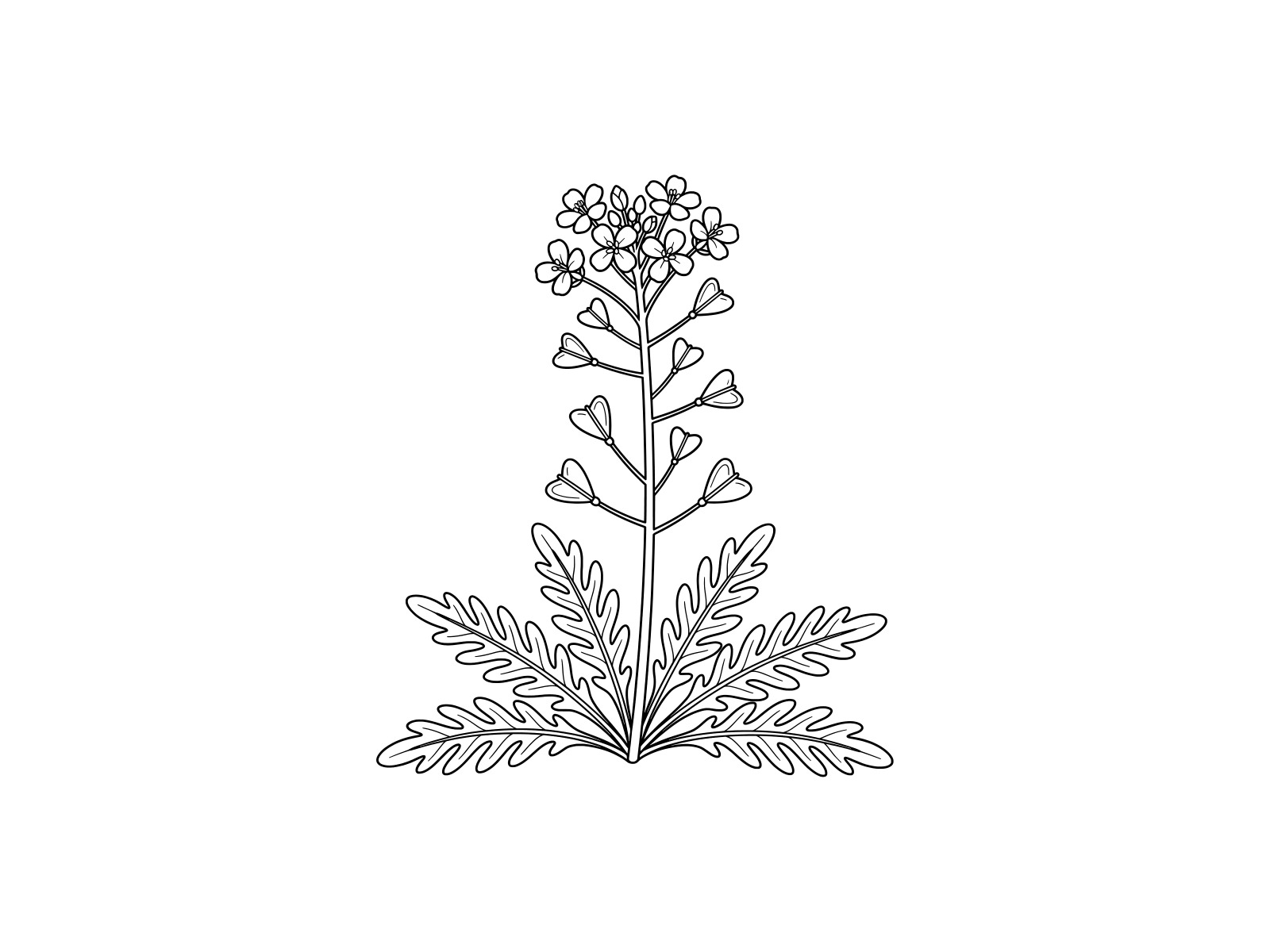
If you look closely at the surface of a leaf, you can see lots of wrinkles like crepe fabric. That's because the surface dips down along the leaf veins. In your coloring page, these wrinkles are drawn with lines, too.
The flower looks like a "dancer"
The "Odorikosou" part of its Japanese name means dancing girl plant. In Japan, there has long been a bigger plant called Odorikosou.
Its flowers grow in a circle. They look just like dancers wearing hats and dancing in a ring. That is how it got its name!
And this plant looks like that one, but it is much smaller. So people added "Hime" (meaning small and cute) to call it Red deadnettle.
The flowers look like lips! They peek out from between the leaves
The flowers are pale reddish-purple and about 1 centimeter long. They are lip-shaped flowers with a long tube that splits into top and bottom lips at the end.
The top lip bends forward like a helmet and has tiny hairs. The bottom lip splits into two parts and has dark spots on it.
The interesting part is how the flowers look. Red deadnettle flowers bloom so that they peek out gently from between the overlapping leaves. They never grow taller than the leaves!
How to tell it apart from Henbit
It looks a lot like henbit, but here are 3 ways to tell them apart.
First, look at the leaf stems. Every leaf on Red deadnettle has a stem. The top leaves on henbit do not have stems, and they wrap around the stem like a little dish.
Second, look at the leaf color. The top leaves of Red deadnettle turn reddish-purple. Henbit leaves stay green all the way.
Third, look at how the flowers grow. Red deadnettle flowers peek out from between the leaves. Henbit flowers stand straight up on their little leaf dishes.
They often grow side by side, so try to find both and compare them!
It came to Japan only about 130 years ago
Even though you can find this plant everywhere, it was not originally from Japan. It is a plant that came all the way from Europe.
Records show it was first found in Komaba, Tokyo, in 1893. From there, it spread all across Japan.
Since it is part of the mint family, its stem is square. It has short, downward-pointing hairs, so it feels rough if you slide your fingers along it.
How to Color Red deadnettle
Color the top leaves reddish-purple and the bottom leaves green
The most fun part of this coloring page is changing the leaf colors from top to bottom.
The big leaves at the bottom are green, and the overlapping leaves at the top are reddish-purple or reddish-brown. Just coloring them differently makes it look so much more like a Red deadnettle!
Instead of changing the color all at once, make the leaves in the middle look like a mix of green and red so the colors blend naturally.
Color carefully so you don't hide the leaf wrinkles
There are lines on the leaves that show textured wrinkles. If you color over them completely, the leaves will look flat.
The trick is to color one section at a time between the wrinkle lines and veins. If you change the darkness just a little for each section, the leaves will look bumpy!
To avoid covering the lines, start putting color from inside the lines.
The flowers are pale reddish-purple. Make the spots dark
The flower color is pale reddish-purple. Light pink with just a little bit of purple added is just right.
For the dark spots on the bottom lip, make them much darker than the rest. They are small, but they really make the flower come alive!
If you leave the hairs on the top lip uncolored and white, they will look soft and fluffy.
Add a little red over the green stems
The stems are green mixed with a bit of red. Try coloring them green first, then layer a light reddish-brown over the top.
Because it is in the mint family, the stem is square. There are two vertical lines drawn on it, so if you make one side darker than the other, it will look like a 3D square stick!
After coloring, go outside and compare it with henbit
When you finish coloring, take this picture outside. Look along the edges of fields and roadsides from February to May.
If you find a Red deadnettle, look nearby for henbit, too! They often grow right next to each other.
Look closely at the leaf stems to tell them apart. If it has a leaf stem, it is a Red deadnettle. If the leaves wrap around the main stem like little dishes, it is henbit!
Fun Facts About Red deadnettle
The "Dancers" Stand in a Circle Wearing Straw Hats
The original Japanese deadnettle, which gave Red deadnettle its Japanese name, has grown in Japan since long ago. It is much bigger than Red deadnettle.
Its flowers bloom in a round circle around the stem. Each small flower looks like a person wearing a traditional straw hat. People thought they looked like dancers dancing in a circle—and that is how it got its Japanese name.
Red deadnettle looks similar but is smaller, so it was called "princess." The original Japanese deadnettle grows along the edges of mountain forests, so you will not often find it in your schoolyard.
Red deadnettle and Henbit are in the Same Family
Red deadnettle and Henbit do not just look similar. They are in the very same genus—they are very close friends! That is why their flowers look almost identical.
They also grow in the same places, and you will very often find them growing together in groups side by side. Along the edges of spring fields, if you see a mix of reddish-brown patches and plants that look like stacked green plates, those are the two types.
The trick to telling them apart is the leaf stem. Once you remember this, you will know which is which right away!
Red deadnettle Came to Japan in 1893
Red deadnettle is native to Europe. It is not a plant that has been in Japan forever.
The very first record of it was in 1893. A plant scientist named Jinzo Matsumura found it in Komaba, Tokyo, and wrote a report about it.
In the 130 years since then, it has spread to fields and roadsides all over Japan. Today, it is so common that you might think it has always been here. But it is actually a pretty new neighbor!
It Loves Rich Soil
Red deadnettle is a plant that loves soil full of healthy food. That is why it grows especially well at the edges of fields and around cared-for flower beds.
In other words, places where lots of Red deadnettle grow have rich soil. By looking at the plants, you can tell how the soil is doing—you can read the ground just like a book!
Share These Red deadnettle Coloring Pages




-
Red deadnettle
-
Patch of red deadnettles

-