Katakana "Bu" Coloring Pages


About Katakana "Bu"
"Bu" as in "Buranko" (Swing)
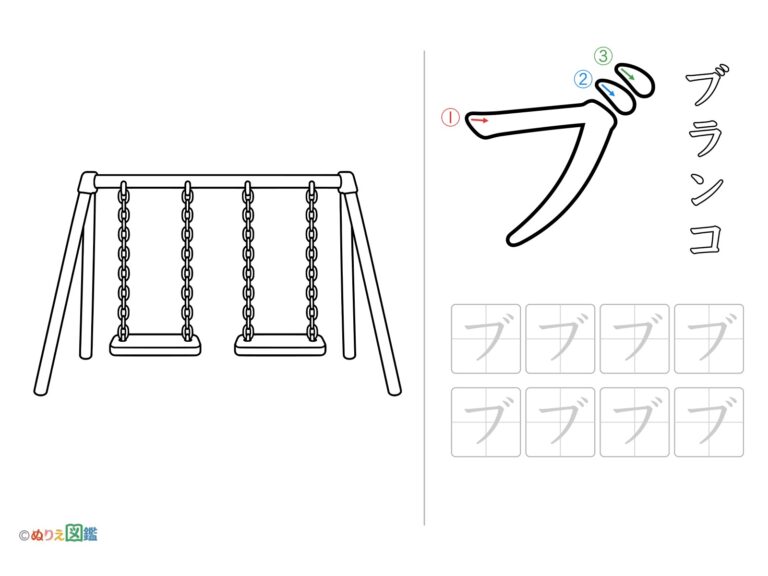
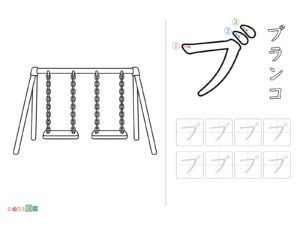
This coloring page lets you trace Katakana "Bu".
The picture on the left shows a park swing set from the front.
Two seats hang from the frame with chains.
The word for "swing set" is usually written in Katakana.
Katakana is often used for words from other countries, names of animals and plants, and sound or feeling words like "bow-wow" or "thump-thump".
Many other pieces of playground equipment, like seesaws and jungle gyms, are written in Katakana too!
The Kanji That Formed Katakana "Bu"
"Bu" is the Katakana character "Fu" with two little dots (dakuten) added to it.
The original "Fu" came from taking the first part of the Kanji "不".
It is said that long ago, monks created Katakana by taking parts of Kanji so they could quickly write down how to read books and scriptures written only in Kanji.
When you add the two little dots, the clear "fu" sound changes to the heavy Katakana "Bu" sound.
Tips for writing Katakana "Bu"
You write Katakana "Bu" in 3 strokes, adding 2 dots to the 1-stroke Katakana "Fu".
The letter Katakana "Fu" is written in just 1 stroke.
Draw a line from left to right, turn at the corner, and make a big sweep down to the left.
Draw the top line and the sweeping line all in 1 stroke without lifting your pencil.
If you curve the sweep gently down to the left, it will look super nice!
Finally, add 2 little dots above and to the right of the corner.
Write the dots a little bit away so they do not sit right on the top line.
Words that start with Katakana "Bu"
Besides ブランコ (swing), other words starting with Katakana "Bu" are ブドウ (grapes), ブタ (pig), ブーツ (boots), and ブラシ (brush).
Pigs are animals and grapes are fruits, so their names are often written in Katakana.
Katakana "Bu" also pops up in sound words like "bunbun" and "bukubuku."
"Bunbun" is the buzzing sound of a bee, and "bukubuku" is the sound of bubbles in water.
Try saying words with Katakana "Bu" while you swing!
How to Color Katakana "Bu"
Color the Big Katakana "Bu" with Your Favorite Colors
Try coloring inside the big Katakana "Bu" at the top right with any colors you like.
If you use a different color for the "Fu" part and the two dots, it is easy to see where the dots go.
It is also fun to match the swing set with colors like red, blue, or yellow, just like real playground equipment.
Color slowly near the edges so you do not go outside the lines, and fill in the middle with bold strokes.
Color the Swing Set with Bright Playground Colors
The frame of a park swing set is often painted in bright colors like red, blue, yellow, or green.
If you color the side posts and the top bar in the same color, it will look nice and neat.
Try coloring the chains with gray or silver.
The links of the chains are small, so sharpen your colored pencil and color them one by one with care.
If you use different colors for the left and right seats, you will make a fun swing set.
Coloring the ground with a light yellowish-brown gives it the feel of park dirt.
Trace the Letters Slowly with a Pencil
In the boxes at the bottom right, there are 8 light gray Katakana "Bu"s lined up.
Use a pencil instead of a crayon, and trace over the gray lines.
Use the dotted lines inside the boxes to help guide you.
Change direction sharply at the corner of "Fu" near the top right of the box.
Write each one carefully, and when you do a good job, show it to your family.
By the time you finish writing all 8, your hand will surely remember the shape.
Fun Facts About Katakana "Bu"
Swings Are a Springtime Word
In Katakana "Bu", words that show the season are called kigo.
The swing is a spring kigo.
It is said to come from an old custom in China, where people played on swings during spring events.
It feels so good to ride a swing on a warm spring day, doesn't it?
Where Did the Name "Buranko" Come From?
There are a few different ideas about where the word "buranko" came from, so no one knows for sure.
Some say it came from Portuguese, while others think it came from the swinging sound "bura-bura."
In Katakana "Bu", the old name "furakoko" is sometimes used.
Today, almost everyone calls it a "buranko."
The Magic of Swinging Speed
A swing moves back and forth just like a pendulum.
Whether you swing a little bit or a bit higher, the time it takes to go back and forth once does not really change.
The longer the chains on a swing are, the slower it swings.
Try comparing the swinging speeds of different swings at the park!
Share These Katakana "Bu" Coloring Pages


-
Tracing the letter "Bu" (Swing)
-