Giant anteater Coloring Pages
 ~

About Giant anteater
Living in the grasslands of South America
Giant anteaters are animals that live in the grasslands and forests of Central and South America.
Their bodies are about 1 meter long. If you include the tail, they are almost 2 meters long!
They are the biggest kind of anteater.
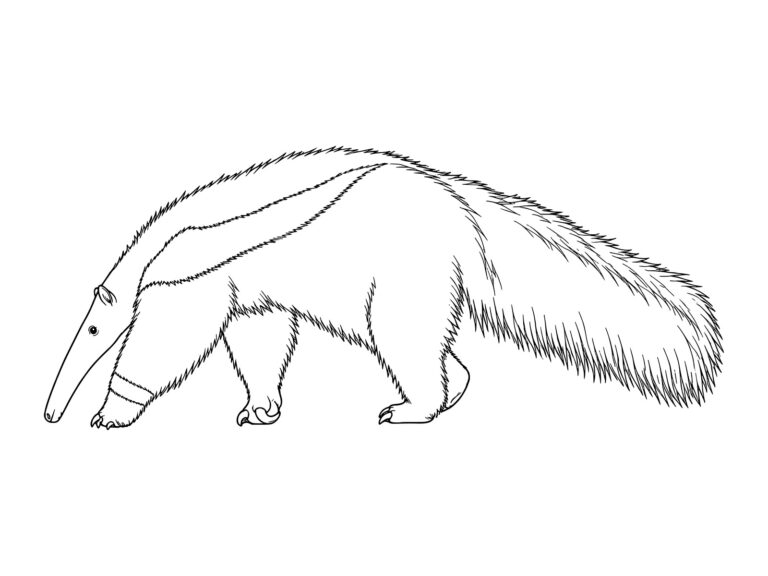
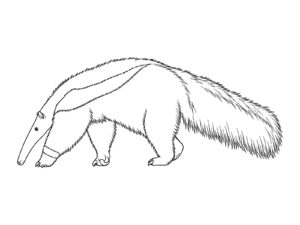
In the first coloring page, the Giant anteater is putting its nose close to the ground to look for food.
A super long mouth
The coolest feature of the Giant anteater is its long, thin mouth like a tube.
At the tip of the mouth, there is a tiny hole for an opening.
A Giant anteater has no teeth at all!
A long tongue that is 60 centimeters long
Inside the long, thin mouth, there is a long tongue that is about 60 centimeters long.
The tongue is sticky. When the Giant anteater sticks it into an ant or termite nest, lots of bugs stick to it.
It is said that they eat more than 30,000 ants and termites in just one day!
Black and white stripes on the shoulders
From the Giant anteater's shoulder to its back, there is a black stripe running sideways.
The edge of the stripe is lined with a white line.
The front legs are whitish, and there is a black stripe around the wrist.
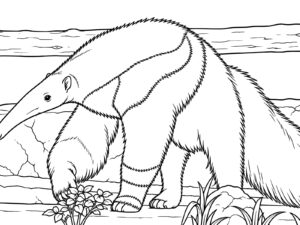
Try to find the shoulder stripe and the wrist stripe in the second coloring page!
Big claws and a broom-like tail
The front feet have big claws for breaking open ant nests.
When they walk, they bend their claws inward and walk on their knuckles.
They use their big, fluffy tail like a blanket by putting it over their body when they sleep.
Small eyes and ears
The Giant anteater's eyes and ears are small compared to its body.
Instead, its nose works really well! It uses its sense of smell to find ant nests underground.
In the first coloring page, it is putting its nose close to the ground, too.
Walking slowly, running fast
Usually, they walk around slowly.
But when there is danger, they can run faster than you might think!
They also use the big claws on their front feet to protect themselves.
Giant anteaters usually live all by themselves.
They are active both day and night. They walk around big grasslands looking for ant nests.
At the zoo, you can see them stick their long tongues into food boxes!
How to Color Giant anteater
Body in Gray and Black
The Giant anteater's body is gray and light brown.
Color the face and front legs in light gray. Color the belly and back part in dark gray or darkish brown.
Clear Shoulder Stripes
Color the stripe going from the shoulder to the back in black or dark gray. Keep the border line white.
If you color this clearly, it will look super cool and just like a Giant anteater!
Color the stripes on the wrists darkish, too.
Bushy Tail
Color the big tail in dark brown or dark gray.
Color with long lines along the fur to make it look nice and bushy.
Ground and Grass
On the second page, try coloring the ground light brown, the grass green, and the wooden fence in the back brown.
The first page has no background, so it could be fun to draw ant mounds or ants around it, too!
Face in Light Colors
Color the long, thin face in a light gray or beige that is lighter than the body.
Color the small eyes black. Leave a tiny white spot for light to make them look cute!
Try making the tip of the mouth a little darker.
Compare Colors on the 2 Pages
Try using slightly different shades of fur color on the first and second pages.
If you make the first page a bit lighter and the second page darker, they will look like different Giant anteaters!
The key is to color the shoulder stripes clearly on both pages.
Try coloring the big claws on the front feet in dark gray.
Fun Facts About Giant anteater
Only eating a little bit from each nest
The Giant anteater spends only about one minute eating at a single ant nest.
After eating a little bit, it moves on to another nest.
It doesn't destroy the whole nest, so the ants can grow back for the Giant anteater to eat again later.
Riding on mom's back
Giant anteater babies travel by riding on their mom's back.
People say the stripe pattern on the baby's back lines up with the mom's stripe, making the baby hard to spot!
Animals whose numbers are shrinking
Giant anteaters are animals whose numbers are dropping because their homes are disappearing.
They are cared for with great love and attention at zoos, too.
Knuckle-walking
Walking with claws bent inward is called knuckle-walking.
Gorillas and chimpanzees walk in a similar way, too.
They do this so their important claws don't get worn down on the ground.
Keeping a low body temperature
Giant anteaters have a lower body temperature than other mammals, and it is said they can live on just a little bit of energy.
Giant anteater babies are said to leave home and live on their own about 10 months after they are born.
Share These Giant anteater Coloring Pages


-
Giant anteater
-
Walking giant anteater
-