Diplodocus Coloring Pages
 ~

About Diplodocus
A Dinosaur with a Very Long Neck and Tail
Diplodocus was a huge dinosaur that walked on four legs, with a long neck and an even longer tail.
Scientists think it was about 25 meters long from the tip of its snout to the end of its tail.
That is almost as long as a 25-meter swimming pool!
It weighed about 12 to 15 tons, which is as heavy as 2 or 3 elephants put together.
A Small Head and Pillar-like Legs
Even though its body was huge, its head was very small.
The front of its mouth was wide and round, with thin, pencil-like teeth set only at the very front.
Its legs were thick like pillars, and its front legs were a little shorter than its back legs.
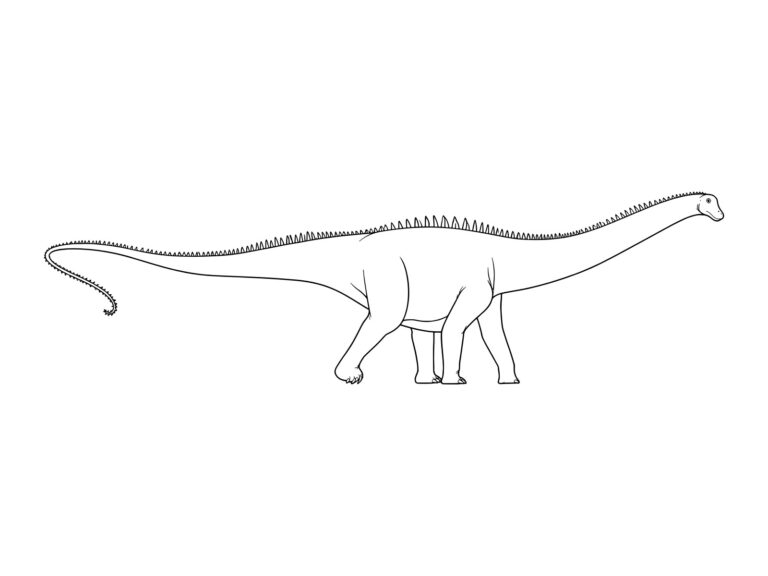
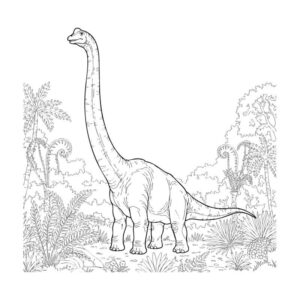
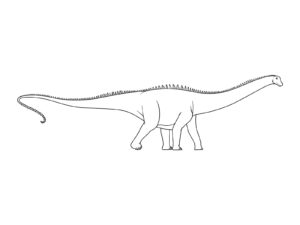
When you look at the first coloring page, you can see its long neck stretching forward and its long tail stretching back from its thick body.
It also had a single row of small, triangular spikes along its back, running all the way from its neck to the tip of its tail.
Its Name Means "Double Beam"
The name Diplodocus means "double beam."
It got this name because the little bones under its tail look like two rods extending forward and backward.
An American scientist named Marsh gave it this name in 1878.
Its tail was made of about 80 bones joined together, and it took up more than half of the dinosaur's whole body length!
North America in the Jurassic Period
Diplodocus lived in the Late Jurassic period, about 150 million years ago.
Its fossils were found in a rock layer called the Morrison Formation in the western United States.
Fossils of Stegosaurus with plates on its back, the meat-eating Allosaurus, and the long-necked Brachiosaurus were also found in the same rock layer.
Diplodocus ate plants, and scientists think it used its thin teeth like a comb to strip leaves right off the branches.
Walking by the River Together
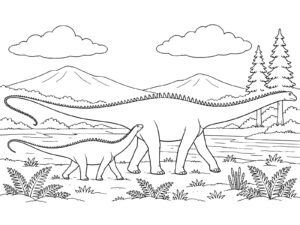
The second coloring page shows an adult and a young Diplodocus walking to the right across a plain near a river.
The young one is about half the size of the adult, raising its neck a little to look up at its parent.
The adult stretches its neck straight out as it walks toward a tall pine tree on the right to eat its leaves.
A river flows gently in the background with rolling mountains behind it, and ferns and horsetails grow around their feet.
How to Color Diplodocus
Color the spikes on the back a different color
The best way to spot Diplodocus is the row of little triangle spikes along its back.
If you color them a different color from its body, the long line from its neck to its tail will really stand out.
For example, try making the body gray or green, and the spikes orange or red.
There are lots of spikes, so sharpen your colored pencil and color them carefully one by one.
Connect the long neck and tail with one line
The neck and tail are super long, so try not to change colors as you color them in.
Make the back a dark color and the belly a light color. If you keep the same stripe of color going from the neck to the tip of the tail, it shows off how long it is.
The tip of the tail is thin like a whip. The secret is to relax your hand and color it gently.
Color the parent and baby in matching colors
On the second page, you will see a big adult and a small baby. Color them with similar colors so they look like a family.
It is also fun to change how dark the color is, like dark green for the adult and bright light-green for the baby.
Nobody really knows what color real dinosaurs were.
You can even add stripes or polka dots to make your very own Diplodocus!
Create a Jurassic plain with sky, rivers, and mountains
Color the sky light blue, the river dark blue, and the mountains pale purple.
Make the pine tree leaves dark green, and the small ferns and horsetails by their feet bright light-green. This makes things in the front look different from things in the back.
Color the ground light brown, and your plain for the two Diplodocus to walk on is all done!
Fun Facts About Diplodocus
Back spikes came from skin fossils
Old pictures of Diplodocus didn't show spikes on its back.
In the early 1990s, traces of tail skin were found along with fossils of a close relative of Diplodocus.
The skin showed a line of sharp, spike-like shapes.
Since then, experts think Diplodocus might have had spikes along its back, too.
However, we still don't know how far the spikes went.
Teeth kept growing back
Diplodocus had thin teeth that wore down quickly as it pulled off leaves.
Instead, new teeth were always ready behind the old ones. Experts think a new tooth grew in about every 35 days.
That is super fast, even for a dinosaur!
Babies had different mouth shapes than adults
One study looked closely at a baby Diplodocus skull.
It showed that the tip of a baby's mouth was not square like an adult's. It was a little pointed.
Its teeth also went much farther back in its mouth than an adult's.
Experts think babies might have picked out soft leaves to eat.
The parent and baby in the second coloring page might have eaten different foods, too!
Share These Diplodocus Coloring Pages


More Jurassic Period Coloring Pages
-
Diplodocus alone
-
A Diplodocus Parent and Child Taking a Walk
-
-