Kamuysaurus (Mukawaryu) Coloring Pages
 ~

About Kamuysaurus (Mukawaryu)
A Dinosaur From Hokkaido, Japan
The fossil of Kamuysaurus (Mukawaryu) was found in Mukawa Town, Hokkaido.
People also love to call it "Mukawaryu" after the name of the town.
Its scientific name is "Kamuysaurus japonicus." It means "Dragon God of Japan."
"Kamuy" means "god" in the language of the Ainu, the native people of Hokkaido.
In 2019, it was announced to the world as a brand-new dinosaur species!
A Plant-Eating Dinosaur With a Duck-like Mouth
Kamuysaurus (Mukawaryu) belongs to a group called hadrosaurs.
Dinosaurs in this group have a mouth with a wide, flat tip like a duck's bill.
That is why people sometimes call them "duck-billed dinosaurs."
They had many teeth deep in their mouth. Scientists think they used them to grind up tough plants.
Parasaurolophus, a dinosaur with a long tube-like crest on its head, is in the same group!
First Page: Walking on Four Legs
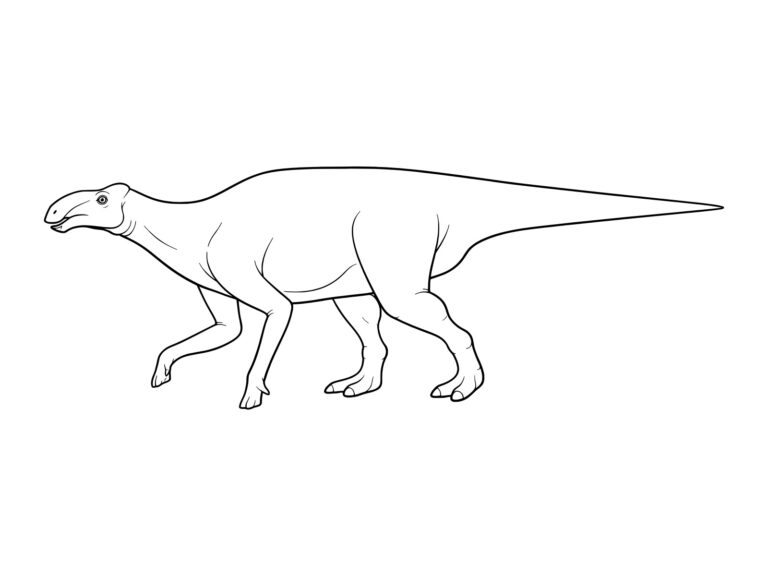
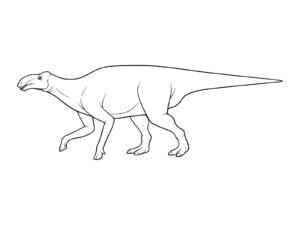
The first coloring page shows the full body of Kamuysaurus (Mukawaryu) from the side.
The small, low bump on top of its head is a crest.
No nose bones were found, but the shape of the skull suggests it had a thin, flat crest.
Its front legs are thin, and its back legs are big and thick!
Having especially slender front legs is one of the special features of Kamuysaurus (Mukawaryu).
Its long tail stretched straight back to help it balance.
Scientists think its body was about 8 meters long and weighed about 4 to 5 tons!
Second Page: Two Dinosaurs Walking on a Sandy Beach
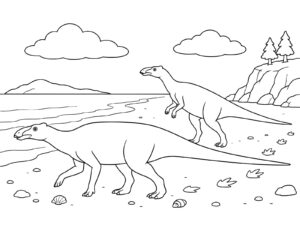
The second coloring page shows two Kamuysaurus (Mukawaryu) walking on a sandy beach by the sea.
The big one in front walks on four legs. The smaller one in back is standing on two legs and looking out at the sea!
Scientists think Kamuysaurus (Mukawaryu) usually walked on four legs, but could also stand on two legs sometimes.
You can see three-toed footprints dotted along the sand.
In the background, waves wash ashore. On the right, you can see a rocky cliff, two pine-like trees, and an island across the sea!
Long Ago, Hokkaido Was Under the Sea
Kamuysaurus (Mukawaryu) lived in the Late Cretaceous period, about 72 million years ago.
Its fossil was found in a rock layer that was at the bottom of the sea back then.
Kamuysaurus (Mukawaryu) lived near the beach. After it died, it might have been washed into the ocean and sunk to the seabed.
Many other sea creature fossils have been found around Mukawa Town, like long-necked plesiosaurs related to Futabasaurus and sea lizards called Mosasaurus!
How to Color Kamuysaurus (Mukawaryu)
Use different colors for the beak and crest
The best parts of Kamuysaurus (Mukawaryu) are its flat beak and the small crest on its head.
If you color them the same as the body, they will blend in.
Try using cream or yellowish-brown for the beak, and orange or red for the crest.
That small crest will really pop!
Dark on top, light on the tummy
For the body, make the back a dark color and the tummy a light color. This will make it look 3D!
No one knows the real colors of Kamuysaurus (Mukawaryu).
You can use green or brown to match the forests of Hokkaido. Or you can use bluish colors to match the sea.
If you change the shading a little bit between the thin front legs and thick back legs, you can easily see the difference.
Make the two look like a parent and child
On the second page, color the two dinos in different colors. That way, you can easily tell them apart!
Try using a dark color for the big one in front, and a nice bright color for the standing one in the back.
They will look like a parent and child, and you can make up a fun story!
Make a Hokkaido beach with the ocean and sand
For the sea, use dark blue for deep water and light blue near the shore. It will look like it goes on forever!
If you leave the wave lines white, they will look like splashing water.
Color the sandy beach light yellow or beige. Use a darker color inside the footprints to make them stand out.
Try coloring the cliffs gray or brown, the trees dark green, and the seashells pink or light purple.
When you color the sky, clouds, and island across the sea, long-ago Hokkaido is complete!
Fun Facts About Kamuysaurus (Mukawaryu)
A local fossil lover found it
In 2003, Yoshiyuki Horita, a fossil lover living in Mukawa Town's Hobetsu area, found tail bone fossils inside a chunk of rock.
The fossils were left with the town museum, but since they came from a rock layer under the sea, no one realized they were from a dinosaur for a while.
In 2011, researchers studied them and finally figured out they were dinosaur tail bones!
From the tip of the tail, the whole body appeared
The tail bones led deeper into the cliff.
So in 2013 and 2014, Hokkaido University and the town museum did a big excavation.
Then, bones from all over the body—from head to legs and tail—were found one after another!
Around 60% of the bones by count, and over 80% by weight were found. It is the largest complete dinosaur skeleton ever discovered in Japan.
Let's go see the real fossils
In April 2026, the Dinosaur Hall of the Hobetsu Dinosaur Museum opened in Mukawa Town.
Here, you can see the real complete skeleton fossil of Kamuysaurus (Mukawaryu).
You can also see a fully assembled skeleton at the Hokkaido University Museum in Sapporo.
If you visit Hokkaido, go meet Japan's dragon god!
Share These Kamuysaurus (Mukawaryu) Coloring Pages


More Cretaceous Period Coloring Pages
-
Kamuysaurus (Mukawaryu) Alone
-
Kamuysaurus walking on the beach
-
-