Mandarin duck Coloring Pages
 ~

About Mandarin duck
Members of the Duck Family Found in Japanese Ponds and Rivers
The Mandarin duck is a water bird that belongs to the duck family.
They are about 40 centimeters long, which is a bit small for a duck.
In the summer, they raise their chicks around rivers and lakes in the mountains.
From fall to winter, they gather in ponds and rivers surrounded by trees to live in flocks.
You might even spot them in park ponds during winter, so try looking for them!
Another bird you can see by the water in winter is the swan.
The Male Is Very Fancy
The male Mandarin duck has very flashy colors compared to other birds in Japan.
He has a red beak and a broad white stripe running from his eyes to the back of his head.
Fluffy orange feathers spread out from his cheeks down to his neck.
His most special feature is the standing orange feathers on his back.
These feathers look like ginkgo leaves, so they are called "ginkgo feathers."
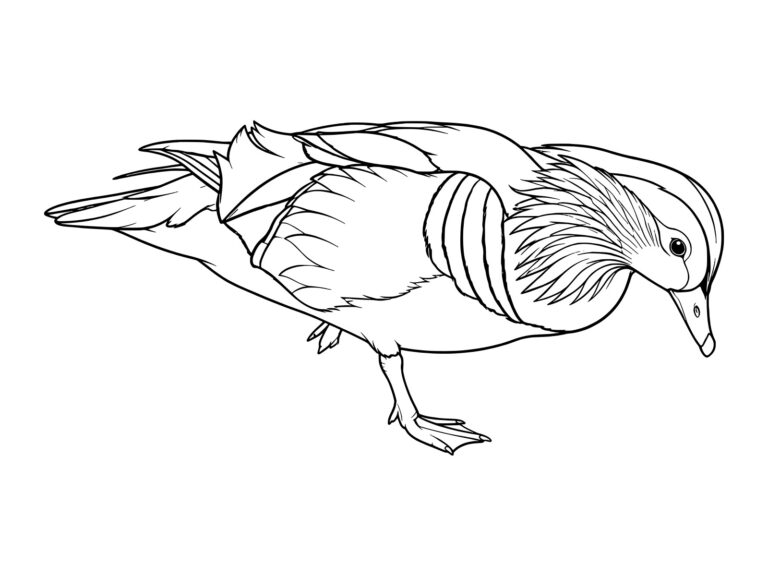
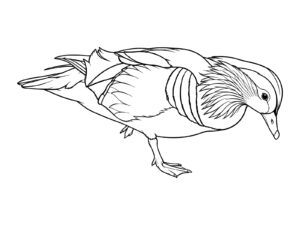
The first coloring page shows a male stretching his neck to look down at his feet.
You can clearly see the white stripe on his head and the shape of his ginkgo feathers.
The Female Is Known by the White Pattern Around Her Eyes
The female has much sober colors compared to the male.
Her body is grayish-brown, with white spots on her chest and sides.
Her eyes are outlined in white, with a white line stretching behind her head.
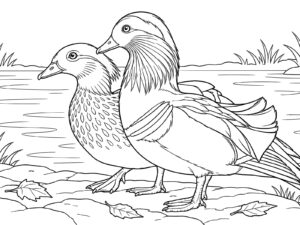
On the second coloring page, the female on the left and the male on the right stand side by side on the shore.
Compare the female's spot pattern with the male's ginkgo feathers!
Fallen leaves are scattered around their feet.
Swimming Side by Side in a Maple Pond
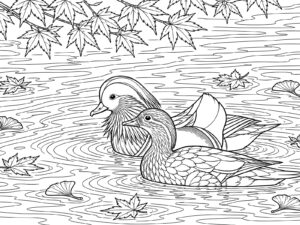
On the third page, the male and female are swimming side by side in a pond.
Branches of Japanese maple stretch from above, and maple and ginkgo leaves float on the water.
Ripples spread across the water as the two birds swim along.
Mandarin ducks can do more than just swim on water; they can also perch on tree branches!
It is quite rare for a duck to perch in a tree.
They have webbed feet between their toes, which help them kick through the water to swim.
Look for their webbed feet on the first and second coloring pages, too!
How to Color Mandarin duck
For the male, color each section clearly with bright colors
The male Mandarin duck has a lot of colors, so decide on the colors for each part before you start coloring.
Make the beak red, keep the white band on the head uncolored using the white paper, color the top of the head green or bluish-purple, and make the cheeks and neck orange.
Color the sail feathers a bright orange.
Make the chest dark purple or dark blue, and color the sides cream or yellow-ochre to make it look just like a real Mandarin duck.
If you leave the black and white stripes between the chest and sides crisp, your picture will look nice and sharp.
For the female, use soft grays and browns
Color the whole body of the female Mandarin duck with a grayish brown.
For the spots on her chest and sides, leave the middle of the spots white and color around them with brown to make the pattern pop.
Leave the white ring around her eye and the white line stretching to the back of her head uncolored.
When the female has plain colors, the male's bright colors next to her stand out even more.
Decorate the background with the colors of an autumn pond
Color the pond water in the 3rd picture with light blue or blue-green, and make it a little darker around the ripples.
If you color the maple leaves at the top red or orange, and the ginkgo leaves floating on the water yellow, it will look just like a pond in autumn or winter.
If you add just a little bit of the Mandarin duck's colors to the water around it, it will look like its reflection on the water.
Try coloring the ground along the shore in the 2nd picture with brown or dark brown, and make the fallen leaves red or yellow.
Fun Facts About Mandarin duck
The truth about "Mandarin duck couples"
When a married couple gets along really well, people in Japan call them a "Mandarin duck couple."
This phrase came from how male and female Mandarin ducks are usually seen swimming side by side.
But in reality, people say that Mandarin ducks often pair up with a different partner every year!
Plus, only the female keeps the eggs warm and raises the chicks.
Chicks jump out of tree holes
Mandarin ducks build their nests in holes in big trees near the water and lay their eggs there.
When the chicks hatch, their mother calls to them from below the tree.
Using her voice as a signal, the chicks jump out one after another from the high tree hole to leave the nest.
A chick's body is very light and soft, so they say it rarely gets hurt even when it hits the ground!
In summer, males look just like females
Even fancy males lose their colorful feathers after the chick-raising season ends and grow plain feathers that look just like a female's!
This look is called "eclipse."
When autumn comes, their feathers change again, and they go back to their fancy look with sail-shaped feathers.
Mandarin ducks love acorns, and in autumn, you might see them eating acorns in woods near the water.
In Japanese kanji characters, "Mandarin duck" is written as "鴛鴦." "鴛" stands for the male, and "鴦" stands for the female!
Share These Mandarin duck Coloring Pages


More Birds Coloring Pages
-
Male Mandarin Duck
-
Male and female lined up on the shore
-
-
Two birds swimming in a Japanese maple pond
-
-