Machu Picchu Coloring Pages
 ~

About Machu Picchu
A Stone City on top of a Mountain
Machu Picchu is a set of ancient ruins in Peru, South America.
It is high up in the Andes Mountains, about 2,400 meters above sea level.
People from the Inca Empire built this city more than 500 years ago.
You cannot see it from the valley below, so people also call it the City in the Sky.
It became a World Heritage site in 1983.
Forgotten for a Very Long Time
Machu Picchu was surrounded by steep mountains. Because of this, people from other countries did not find it, and it was never destroyed.
In 1911, an American named Hiram Bingham introduced it to the world.
Until then, it was a hidden city that only the local people knew about.
The Pointy Mountain Towering Behind
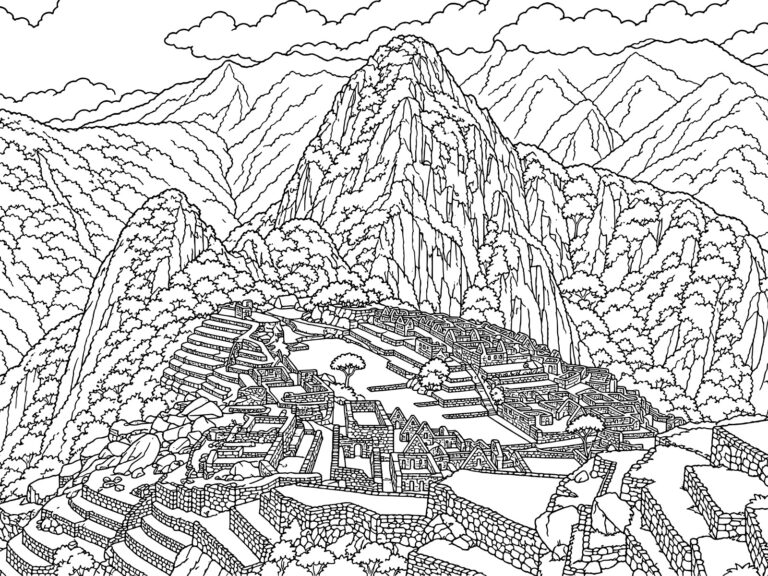
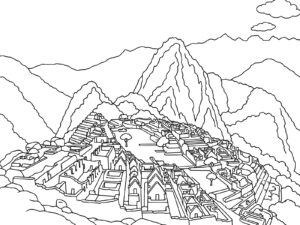
The first coloring page shows the ruins and the mountain towering behind them, called Huayna Picchu.
This pointy mountain shape is the most famous view in photos of Machu Picchu.
In the front, you can see many square stone walls of houses without roofs.
People think these houses had thatched roofs long ago.
Terraced Fields on the Mountain Slope
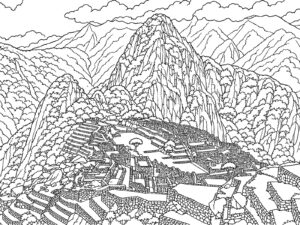
The second coloring page shows the whole view of the ruins, looking down from a high place.
On the mountain slope, you can see many layers of terraced fields.
They say the Inca people grew potatoes and corn here.
Try to find the green open square right in the middle of the ruins, too!
What Kind of Country Was the Inca Empire?
The Inca Empire ruled over a huge land along the Andes Mountains in South America.
Its capital was a town named Cusco in present-day Peru.
The Inca people built long roads through the mountains so they could travel everywhere in their country.
People think Machu Picchu was connected by these mountain roads, too.
Even today, some people walk along these paths for many days to reach Machu Picchu.
There are many mysterious places in the ruins, like the Temple of the Sun and a stone said to be a sundial.
There is still a lot we do not know about why it was built!
How to Color Machu Picchu
For the stone walls, mix gray and brown
For the stone walls of the ruins, try mixing gray and light brown.
If you change the color a little for each stone, they will look like real stacked stones!
Making the top of the wall lighter and the bottom a little darker makes it look 3D.
For the plaza and terraced fields, use bright green
Color the grass in the middle plaza and the terraced fields with yellow-green.
For the terraced fields, make the top of each step light and the walls of the steps dark green. This makes the step shapes stand out!
The mix of gray stones and yellow-green grass gives it that classic Machu Picchu look.
For the mountains, use dark green and blue-green
The mountain Huayna Picchu has lots of trees, so try coloring it dark green.
If you use blue-green or light blue for far-away mountains, they will really look far away!
Add some gray for the rocky parts, make the sky light blue, and leave the clouds white.
Use clouds and fog to show how high the mountains are
Machu Picchu is a place that often gets foggy and cloudy.
Leave the clouds at the top of the mountain white, and put light blue around them. They will look soft and fluffy!
The farther away a mountain is, the lighter you should color it. That way, the mountains look stacked one behind another.
If you add dark gray lines here and there on the rocks of Huayna Picchu, it will look like a steep mountain.
Color the terraced fields from the top step down so you do not make mistakes!
Fun Facts About Machu Picchu
Stone Walls Without Any Gaps
The Inca people were super good at shaving down stones to fit them together perfectly.
They say you cannot even fit a single hair between the big stones!
Thanks to that, these buildings have stayed strong for over 500 years, even in a place with lots of earthquakes.
A World Heritage Site for Both Nature and Culture
At Machu Picchu, people protect not just the ancient ruins, but also the nature in the mountains and forests around them.
That is why it was chosen as a Mixed Cultural and Natural Heritage site for having both culture and nature.
Try putting your completed page next to the coloring pages for the Pyramids and Sphinx of Giza or the Colosseum to compare old ruins from all around the world!
Llamas Live There Too
Sometimes, you can find animals called llamas inside the Machu Picchu ruins. They are part of the camel family!
Llamas are very important animals to the people living high in the Andes mountains because they carry heavy loads and give useful wool.
Seeing llamas walk peacefully on the grass around the ruins is a famous sight at Machu Picchu.
It would be fun to draw a llama in the open space on your coloring page, too!
Share These Machu Picchu Coloring Pages


More World Landmarks Coloring Pages
-
Machu Picchu and Huayna Picchu
-
Panoramic view of Machu Picchu
-
-