Kinkaku-ji (the Golden Pavilion) Coloring Pages
 ~
~ 
About Kinkaku-ji (the Golden Pavilion)
A Golden Building by the Pond
Kinkaku-ji (the Golden Pavilion) is a temple in Kyoto Prefecture. Its official name is Rokuon-ji. People call it "Kinkaku-ji (the Golden Pavilion)" because the golden building on its grounds is so famous.
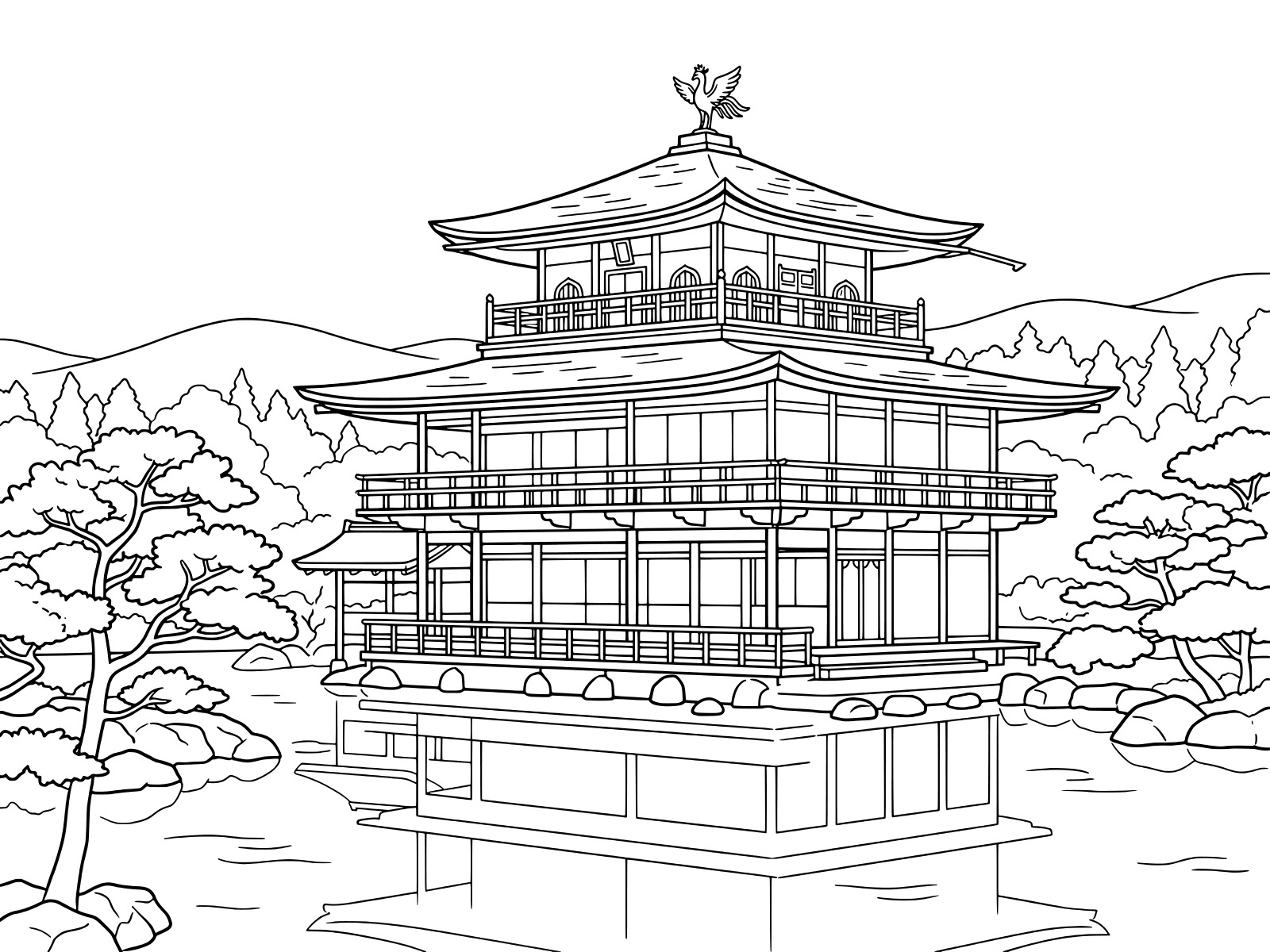
The real name of this building is the Shariden. A big pond named Kyoko-chi spreads out right in front of it. The view of Kinkaku-ji (the Golden Pavilion) showing on the water is very famous! It was also made a World Cultural Heritage Site in 1994.
Each of the Three Floors Is Different
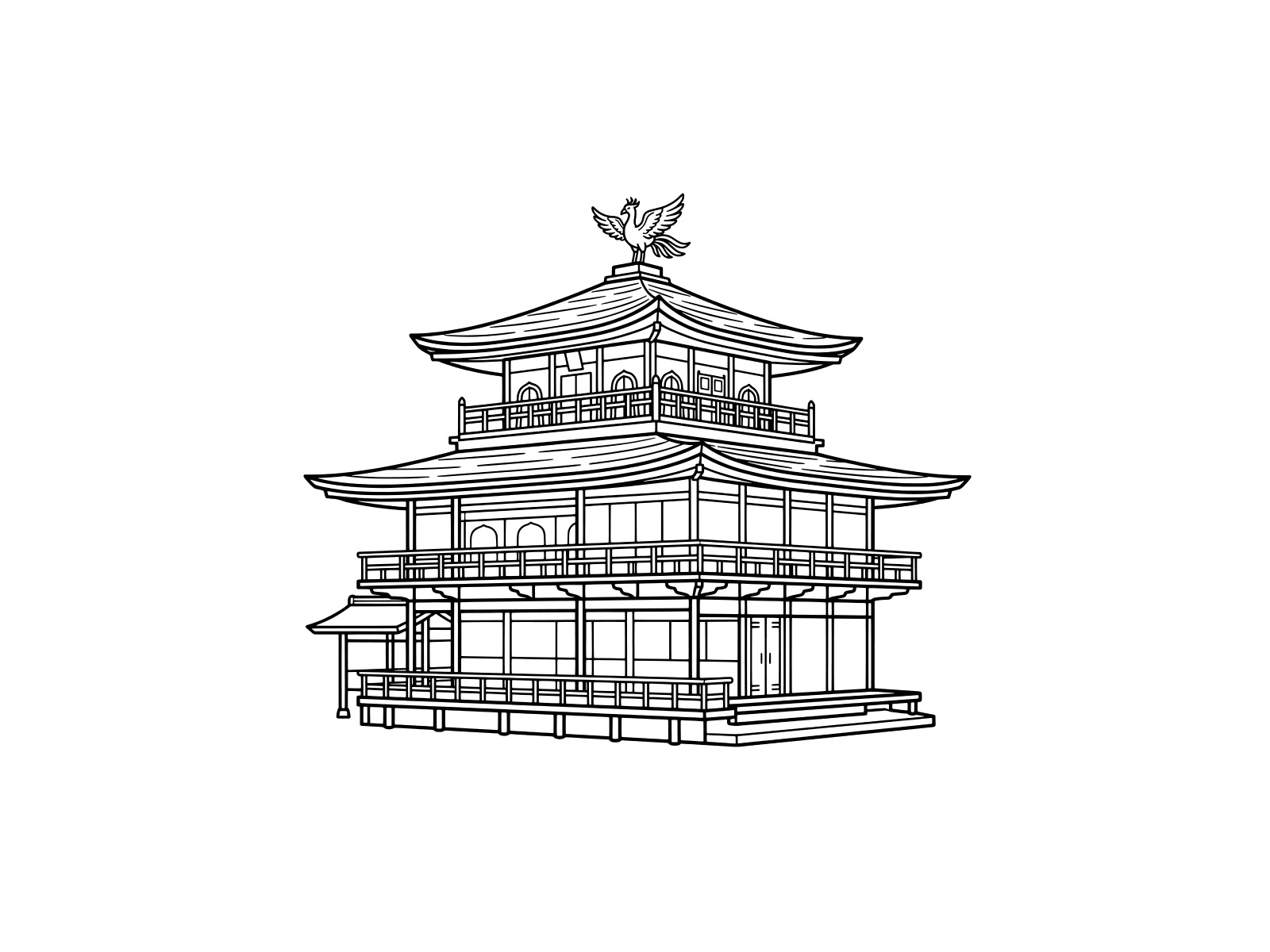
The best thing to see is that all three floors are built in different styles. You would never see this in a normal building!
- 1st floor|Built in the style of a noble's house. It has line-up pillars, white walls, and paper sliding doors.
- 2nd floor|Built in the style of a samurai's house. It has a row of windows with rounded, pointed tops.
- 3rd floor|Built in the style of a temple. It is the smallest floor, and it has handrails around it.
If you look up from the bottom, you can see how the style changes on each floor!
Gold Leaf Is Only on the 2nd and 3rd Floors
The gold shines only on the outside of the 2nd and 3rd floors. There is no gold leaf on the 1st floor. If you look closely at a photo, you can see that only the 1st floor has a whitish wood color.
The 3rd floor is special. It has gold leaf all over the inside too, not just the outside! The very top floor is built the grandest of all.
The Phoenix on the Roof
A statue of a bird with open wings stands at the very top of the roof. This is a Fenghuang (Phoenix), an imaginary bird that brings good luck. It is made of copper and shines in gold.
The roof itself is not made of tiles. Many thin wooden boards are layered together to make it. That is why you can see many fine lines across the roof.
Ashikaga Yoshimitsu Built It
The person who had Kinkaku-ji (the Golden Pavilion) built was Ashikaga Yoshimitsu. He was a shogun in the Muromachi period. He built a mountain villa here in 1397, and Kinkaku-ji (the Golden Pavilion) was finished in 1399.
After Yoshimitsu died, this villa became a temple. That means a building from over 600 years ago still stands in the exact same spot today!
It Burned Down Once and Was Rebuilt
Actually, the Kinkaku-ji (the Golden Pavilion) you see today was rebuilt after it completely burned down in a fire in 1950. It was rebuilt in 1955.
Then, from 1986 to the next year, big repair work was done to replace all the gold leaf. Its bright shine today came back during this time!
How to Color Kinkaku-ji (the Golden Pavilion)
Make Gold using "Ochre"
Don't worry if you don't have a gold colored pencil. If you color everything ochre first and then add brown to just one side, it will look just like gold!
The important trick is to leave the brightest spots as white paper. Make the areas under the roofs and under the verandas darker. The bigger the difference between light and dark spots, the more it looks like real metal!
Don't Color the First Floor
Here is an easy mistake to make! Gold leaf is not put on the first floor, so it looks closer to the real thing if you don't make it gold.
Try leaving the walls of the first floor white, and color only the pillars light brown. The top two floors are gold, and only the first floor is white and brown. If you can show this difference, it will look much more like Kinkaku-ji (the Golden Pavilion)!
The Roofs are Dark Brown
Because thin wooden boards are layered on the roofs, their color is dark brown or a grayish brown. Please don't make them gold!
There are fine sideways lines on the roofs. The trick is to not color over these lines, but color lightly between the lines. If you make the tips of the roofs (where they curve up) light, the shape will stand out nicely!
Don't Color the Pond Too Much
If you color the whole pond blue, the picture will look heavy. Try to color lightly with light blue using only sideways strokes.
The key is to make Kinkaku-ji (the Golden Pavilion) reflected in the water much lighter in color than the real one. If you color them with the same darkness, you won't be able to tell which one is real! Leaving the paper white along the wave lines will make the water look shiny.
Make the Pine Trees and Forest Lighter Farther Back
Use dark green for the pine trees in front, and light yellow-green for the forest in the back. Make it dark in front and light in the back. Just doing that creates depth!
Rocks will look real if you layer a little bit of brown over gray. Rather than making them all the same color, making just a few of them darker will look natural!
Fun Facts About Kinkaku-ji (the Golden Pavilion)
Only the Phoenix Survived the Fire
In 1950, Kinkaku-ji (the Golden Pavilion) burned down completely in a fire. However, only the phoenix on the roof survived.
It was just pure luck. Only a few days before the fire, the phoenix was taken down for repairs. If it hadn't been taken off, it would have burned up too.
200,000 Gold Leaves
During the repairs that started in 1986, 200,000 gold leaves were used.
The gold leaves used before then were very thin, so they peeled off over time in the strong sunlight. So, special gold leaves that were 5 times thicker than normal were made, and they put on two layers to make it strong. That is why its shine lasts for a long time now.
The Building's Name is "Shariden"
The real name of Kinkaku-ji (the Golden Pavilion) is Shariden. Shari means the bones of the Buddha. So, it means a building to keep them safe.
That is why the 3rd floor is built like a temple, and it was made as the most important place. It turned out there was a special reason why it shines in gold!
Upside-Down Kinkaku-ji (the Golden Pavilion)
On days with no wind, you can see a clear reflection of Kinkaku-ji (the Golden Pavilion) on the water of Kyoko-chi Pond. This is called the Upside-Down Kinkaku-ji (the Golden Pavilion).
There are big and small islands and rocks in the pond, and it is said that they were placed carefully so that Kinkaku-ji (the Golden Pavilion) looks the most beautiful in the water. The pond is part of the artwork too!
Share These Kinkaku-ji (the Golden Pavilion) Coloring Pages


More Castles, Shrines & Temples Coloring Pages
-

Matsumoto Castle
Difficulty:~ -

Nagoya Castle
Difficulty:~ -

Kiyomizu-dera Temple
Difficulty:~ -
The Great Buddha Hall of Todai-ji
Difficulty:~ -
Ginkaku-ji Temple
Difficulty:~ -

Five-storied pagoda of Toji Temple
Difficulty:~ -

Osaka Castle
Difficulty:~ -

The Great Torii of Itsukushima Shrine
Difficulty:~
-
Kinkaku-ji (the Golden Pavilion)
-
Kinkaku-ji and Kyoko-chi Pond
-
-
Kinkaku-ji Temple Adult
-