Great Buddha of Kamakura Coloring Pages
 ~
~ 
About Great Buddha of Kamakura
The Symbol of Kamakura
The Great Buddha of Kamakura is a big Buddha statue at a temple called Kotoku-in in Kamakura City, Kanagawa Prefecture.
Its official name is Amida Nyorai. This Buddha gently watches over the people around it.
It is the symbol of Kamakura, and almost everyone who visits Kamakura stops by to see it.
You might have seen it on a school trip or outing too!
11 Meters Tall, Weighing 121 Tons
In a sitting position, the Great Buddha of Kamakura is about 11.3 meters tall. If you count the base, it is over 13 meters tall!
It weighs about 121 tons. That is as heavy as about 100 cars!
It is made of a metal called bronze. It is the only Buddha statue in Kamakura that is a National Treasure.
Along with the Great Buddha at Todai-ji's Great Buddha Hall in Nara, it is very famous in Japan.
A Great Buddha Without a Roof
The main special thing about the Great Buddha of Kamakura is that it sits outside, not inside a building.
At first, it was inside a big hall. But typhoons and a big tsunami broke the hall. So for over 500 years, it has sat under the blue sky.
Because it has been out in the rain and wind, its body looks bluish-green.
This color comes from a protective layer on the copper called patina.
3 Coloring Pages
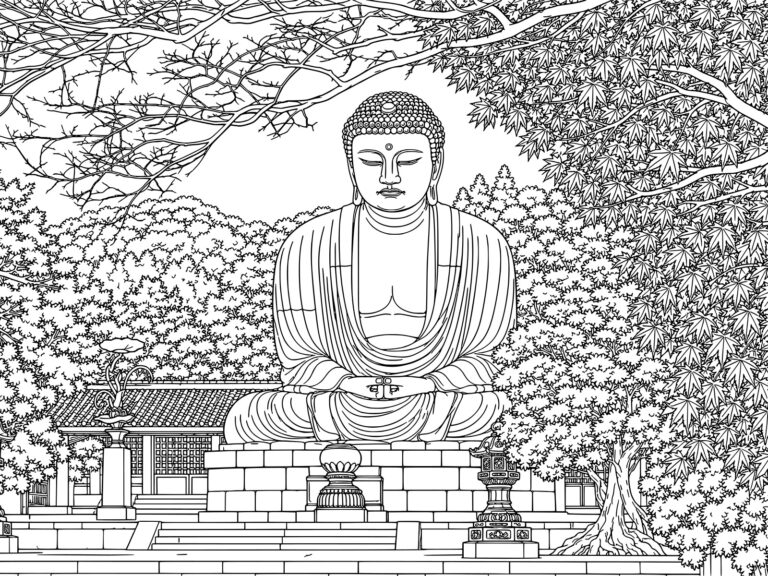
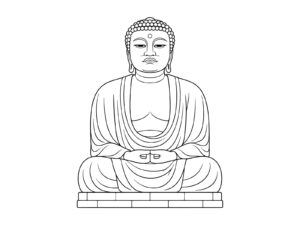
The 1st picture shows just the Great Buddha of Kamakura sitting on its stone base. You can clearly see the little curls on its head and its hands joined in front of its belly.
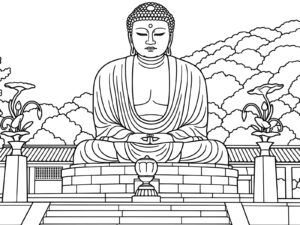
The 2nd picture shows the view of the temple grounds from the front. In front of the Great Buddha of Kamakura is an incense burner, with lotus flower decorations standing on the left and right.
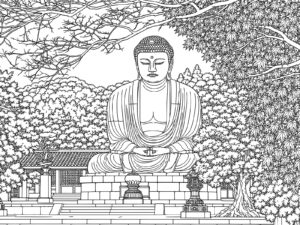
The 3rd picture is a detailed drawing of an autumn scene. You can look at the Great Buddha of Kamakura through the branches of red maple leaves.
Even the curls on the head of the Great Buddha of Kamakura are drawn one by one. Take your time and color it carefully!
Other Great Places in Kamakura
Kamakura has many other cool spots besides the Great Buddha of Kamakura. You can visit Tsurugaoka Hachimangu Shrine, Hasedera Temple, and Enoshima near the sea!
Kotoku-in, where you can find the Great Buddha of Kamakura, is a short walk from Hase Station on the Enoshima Electric Railway.
Riding the train through the old streets is a lot of fun, too.
If you like visiting temples, try coloring the Kiyomizu-dera coloring page, too!
How to Color Great Buddha of Kamakura
Color the Great Buddha of Kamakura in Patina Green
The real Great Buddha of Kamakura is a bluish-green color.
First, color it with light blue-green. Then, add a little dark green or gray on top in the shadow folds of its robes.
If you lightly layer some brown here and there, it will look just like real bronze that has aged for a very long time.
It is also fun to imagine what the Great Buddha of Kamakura looked like when it was newly built long ago by coloring it gold!
Keep a Gentle Expression on the Face
Color the face the same color as the body, but make it a little lighter.
Try not to make the area around the eyes and mouth too dark. That way, it will keep its peaceful expression.
If you make the little dot in the middle of its forehead a bit darker, it will really look like the Great Buddha of Kamakura!
The Base and Grounds are Gray Stone
Color the stone base and stone steps in gray.
If you change the shade of gray a little bit for each stone, it will look like stacked stones.
For the second coloring page, if you color the lotus flower decorations and the incense burner in the same patina green as the Great Buddha of Kamakura, everything will match nicely!
Color the Third Page with Autumn Leaves
For the Japanese maple leaves on the third coloring page, use red, orange, and yellow on different clusters of leaves.
When the patina green of the Great Buddha of Kamakura sits next to the red autumn leaves, it makes a very beautiful autumn scene.
Gently color the sky a light sky blue!
Color the Mountains Behind in Seasonal Colors
On the second coloring page, if you color the mountains behind the Great Buddha of Kamakura using green and yellow-green on different clusters, you get Kamakura in summer!
If you mix in red and yellow, it becomes autumn. If you add pink, it becomes a spring scene, too.
The trick is to use a slightly different green for the mountains so the patina green of the Great Buddha of Kamakura stands out!
Fun Facts About Great Buddha of Kamakura
You Can Go Inside the Great Buddha of Kamakura
You can actually go inside the body of the Great Buddha of Kamakura.
It is hollow inside, so you can see the marks from how it was made.
You can tell that it was built by pouring bronze into many separate parts and connecting them together.
More Than 770 Years Ago
They say people started making the Great Buddha of Kamakura in 1252.
That was during the Kamakura period, more than 770 years ago.
No one knows for sure who made it, so this Great Buddha of Kamakura has many mysteries.
The Straw Sandals of the Great Buddha of Kamakura
On the wall behind the Great Buddha of Kamakura, very big straw sandals are on display.
Children made them with a wish for the Great Buddha of Kamakura to walk all over the country and save people.
If you visit, try to look for them!
The Hand Shape Has a Meaning Too
The Great Buddha of Kamakura holds both hands in front of its stomach, making circles with its thumbs and index fingers.
This hand shape is called Johin, and it shows that the Buddha is calm and thinking deeply.
Buddha statues show different meanings with their hand shapes, so comparing it with other statues is fun too!
Share These Great Buddha of Kamakura Coloring Pages


More Castles, Shrines & Temples Coloring Pages
-
Great Buddha of Kamakura
-
Great Buddha of Kamakura viewed from the front
-
-
Autumn Leaves and the Great Buddha of Kamakura (Detailed)
-