Kumamoto Castle Coloring Pages
 ~

About Kumamoto Castle
Cool and all black, one of Japan's Three Great Castles
Kumamoto Castle is in Kumamoto City, Kumamoto Prefecture. It is the exact opposite of Himeji Castle's pure white look—it is a cool castle covered in black wooden boards! Along with Himeji Castle and Nagoya Castle, it is counted as one of Japan's Three Great Castles. A warlord named Kiyomasa Kato built it, and it was finished over 400 years ago in the year 1607. At that time, the town's name was also changed from "Kumamoto" (隈本) to "Kumamoto" (熊本).
The stone wall no one can climb: "Musha-gaeshi"
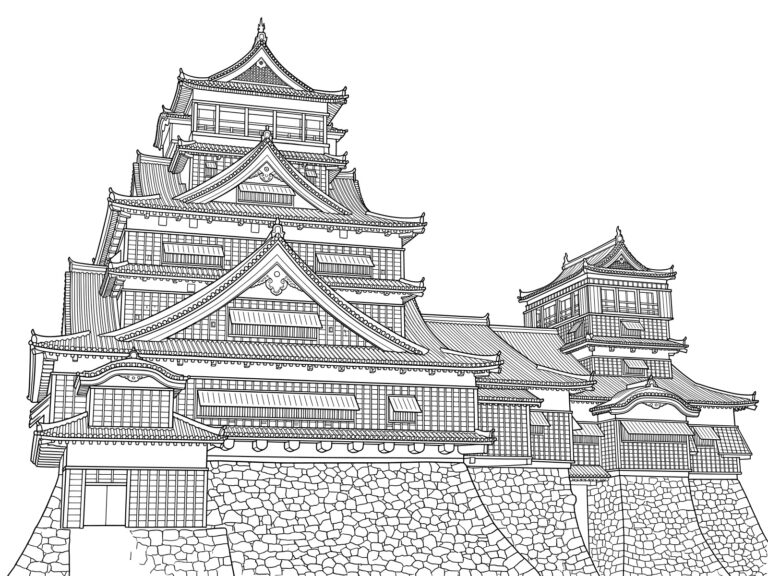
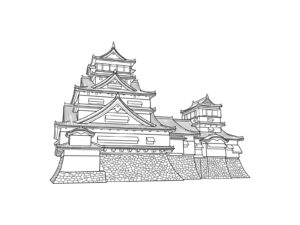
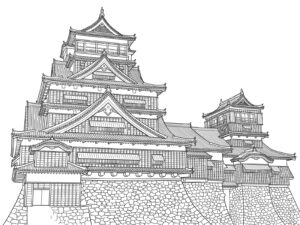
The most famous thing about Kumamoto Castle is these stone walls. The bottom starts as a gentle slope, but it gets steeper as it goes up, becoming almost totally vertical at the top! So even if enemies try to climb it, they get stuck halfway up and cannot get a grip anywhere. It is called "Musha-gaeshi" (Samurai Repeller) because it turns back enemy warriors. If you look closely at the shape of the stone wall in the coloring page, you can see how it bulges at the bottom and curves back at the top!
Two castle keeps side by side: Big and Small
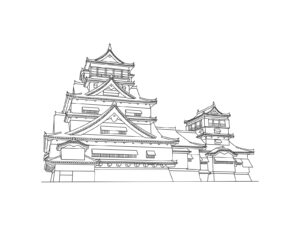
Kumamoto Castle does not have just one castle keep, but two! The big one on the left is the Main Keep, and the small one on the right is the Sub Keep. They are connected by a building with a low roof, so they are not standing far apart. From the outside, the Main Keep looks like it has three roof layers, but inside it actually has six floors plus a basement level!
The white boxes under the roof are "Ishi-otoshi"
Can you see the row of square, box-like bumps right under the lowest roof? These are called Ishi-otoshi (Stone Drops), and they have trapdoor holes in the floor inside. They were made to drop heavy stones on enemies climbing the wall, or to peek down at them. They are not just decorations—they are clever tricks for fighting!
Another name: "Ginkgo Castle"
Kumamoto Castle has another name: Ginkgo Castle. A giant ginkgo tree stands in the plaza in front of the castle keep, and that is where the name comes from. In autumn, the leaves turn bright yellow, and it looks so pretty next to the black castle!
A castle keep brought back to life after an earthquake
In the 2016 Kumamoto Earthquake, Kumamoto Castle was hit very hard, and its stone walls crumbled. People worked hard to fix it step by step, and repairing the castle keep was finally finished in March 2021! Fixes are still going on for other parts, like the watchtowers. Watching the castle slowly come back to life over a long time is truly special for the people of Kumamoto.
How to Color Kumamoto Castle
Between the Roofs: White on Top, Dark on the Bottom
The walls of Kumamoto Castle have two parts: white plaster on top, and dark wood panels on the bottom. So when you color the band between the roofs, leave the top half white, and color only the bottom half dark. That makes it look just like the real thing! If you color all of it black, it will just look like a black box.
Use Dark Blue-Gray for the Roofs, Not Black
The roof is made of tiles, so a slightly lighter blue-gray is perfect instead of plain black. If you make it all black, it blends in with the dark walls, and you cannot see the shape. Use gray for the roof and black for the lower half of the wall. This helps you see the beautiful curved lines of the roof! The little round dots along the edge of the roof are the ends of the tiles. Leave them white without coloring them.
Add a Bit of Brown to the Gray Stone Wall. Make Each Stone a Little Different!
Color the stone wall with gray mixed with a little bit of brown. If you use the same shade for everything, it will look flat. The trick is to change how dark or light you color the stones next to each other! You do not have to color every stone carefully. Just mix in a few darker stones here and there to make it look bumpy and real. Leave the lines between the stones white.
Be Brave and Leave the White Parts Alone!
It looks best if you leave these white: the drop-chutes for dropping stones, the white edges on the gables, and the white bands just under the roofs. Since this picture has a lot of dark colors, leaving the white parts plain makes the shapes pop out clearly. Before you pick up your colored pencils, decide which parts to color and which parts to leave white!
Fun Facts About Kumamoto Castle
Kanpyo in Walls, Taro Stems in Tatami Mats?
There is a story that Kumamoto Castle had kanpyo (dried gourd strips) mixed into its mud walls, and taro stems inside its tatami mats! People say this was so they could eat the walls and mats if they were trapped in the castle with no food. However, no proof has been found yet that this was really true. It is just known as a fun story!
120 Wells Inside the Castle
It is said that Kato Kiyomasa dug more than 120 wells inside the castle. Long ago, Kiyomasa was trapped in a castle during a war in another country, and he suffered a lot because he had no water. Because of that tough time, he wanted to make sure Kumamoto Castle would never run out of water. Some of these wells are still inside the castle today!
The Castle Tower Today Is the Second One
The castle tower you can see today is not the original one built by Kato Kiyomasa. Right before a battle called the Satsuma Rebellion started in 1877, a fire burned down both the main tower and the small tower. The castle tower you see today was rebuilt with reinforced concrete in 1960. The outside looks just like it did long ago, and the inside is now a museum!
Share These Kumamoto Castle Coloring Pages


More Castles, Shrines & Temples Coloring Pages
-
Kumamoto Castle
-
Kumamoto Castle: Stone Wall and Keep
-
-
Kumamoto Castle for Adults
-