Meiji Jingu Shrine Coloring Pages
 ~
~ 
About Meiji Jingu Shrine
The Shrine with the Most New Year Visitors in Japan
Meiji Jingu Shrine is a shrine located in Shibuya, Tokyo. When you get off at Harajuku Station, a deep forest stretches out right in front of you.
The shrine is dedicated to Emperor Meiji and his wife, Empress Shoken. After Emperor Meiji passed away, the shrine was built because people wished for it. The shrine's festivals then began on November 1, 1920.
During Hatsumode, the first shrine visit of the New Year, it has the number one most visitors in all of Japan every year. The long path to the shrine gets completely packed with people!
The Forest Was Made from Trees Collected All Over Japan
The forest around Meiji Jingu Shrine is about 700,000 square meters big. That is as huge as 15 Tokyo Dome stadiums!
Actually, this forest has not been here since ancient times. When the shrine was built, about 100,000 trees were sent from all over Japan. It is a man-made forest planted by people.
Many young volunteers from youth groups across the country gathered to help plant them. 100 years have passed since then, and it has grown so much that you cannot tell it apart from a real natural forest today!
The Biggest Wooden Torii Gate in Japan
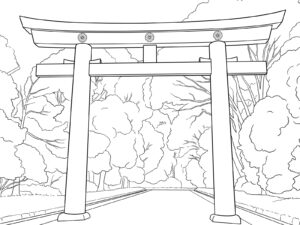
The Otorii standing along the path is the biggest wooden torii gate of its style in Japan.
It is 12 meters tall and about 17 meters wide. Each pillar is 1.2 meters thick, so an adult cannot even wrap their arms all the way around it!
It is not painted, so you can see the natural cypress wood grain. Right under the top crossbar, three golden chrysanthemum crests are lined up.
The Minami-Shinmon Gate That Survived Air Raids
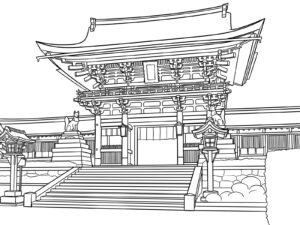
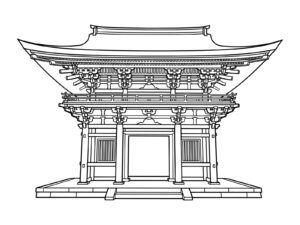
If you walk through the Otorii, you will see a two-story gate with a curved roof. This is the Minami-Shinmon Gate.
The main hall and worship hall were burned down in air raids in 1945. But this Minami-Shinmon Gate survived without burning! That is why it is a very important building that shows us how it looked when it was built in 1920.
In 2020, it became a national Important Cultural Property. The main hall and worship hall that burned down were rebuilt in 1958.
Two Camphor Trees in Front of the Worship Hall
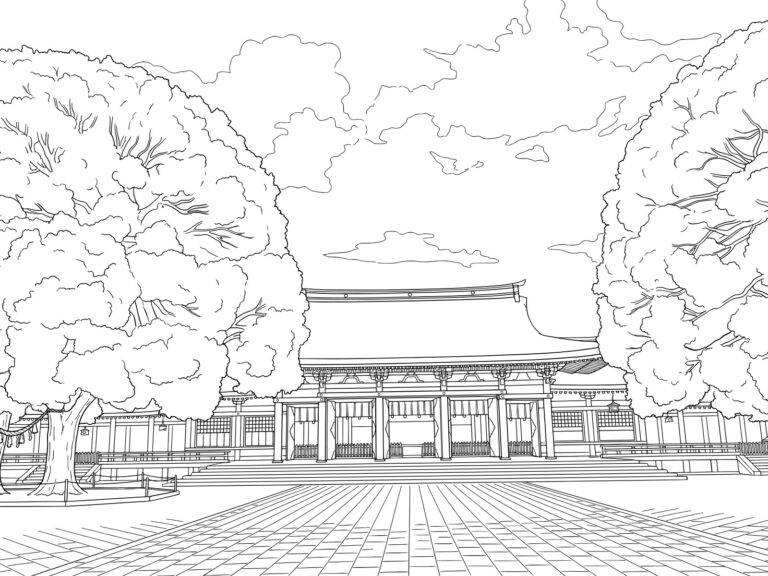
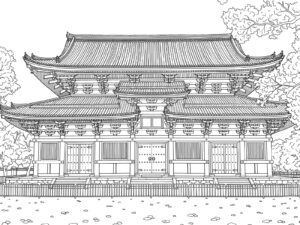
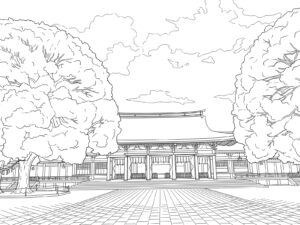
When you walk through the Minami-Shinmon Gate, you will see the Gehaiden across the wide stone courtyard. This is where you say your prayers.
In front of it on the left, two large camphor trees stand close together. They were planted in 1920 when the shrine was built, and they are called the Meoto Kusunoki (Married Couple Camphor Trees).
The two trees are joined by a sacred straw rope. Emperor Meiji and Empress Shoken got along very well, so people treasure these trees for bringing good luck in marriage and family happiness.
How to Color Meiji Jingu Shrine
Color the Otorii gate in plain wood colors
The Otorii gate is a plain wood torii gate with no paint on it. Don't color it vermilion red like Fushimi Inari Shrine.
If you mix light brown with just a little bit of gray, it will look like old wood exposed to rain and sun.
Try coloring the pillars by drawing lines from top to bottom. It will start to look like real wood grain.
Only color the three chrysanthemum crests on the top beam in gold or yellow. They will sparkle nicely in your picture.
Use many shades of green for the forest
The forest behind the Otorii gate is made of many different kinds of trees brought from all over Japan.
So, the trick is not to fill in the green with just one color. Try changing the colors for each bunch of trees using light green, deep green, and bluish-green.
If you color the front trees bright and the back trees dark, it will look like the path goes way back into the forest.
If you color the ground of the path whitish-gray or light beige, the forest green will really stand out.
The Minamashinmon Gate is dark brown and white
The pillars and walls of the Minamashinmon Gate are made of deep, dark brown wood.
The cool part is the tips of the wooden brackets lined up under the roof. On the real gate, only the tips are painted white.
If you color it so that white dots line up inside the dark brown, it will look super realistic.
The roof is covered with copper plates. It is brown when it is new, and turns into a bluish-green as time goes by. You can decide which color you want to use!
Make the sacred rope of Meoto Kusunoki stand out
In the picture of the Gehaiden, look for the shimenawa rope at the base of the left camphor tree.
Color the sacred rope a light ochre like straw, and leave the dangling zigzag paper strips white.
The leaves of camphor trees stay green all year long. Make the tops of the leaf bunches lighter and the bottoms darker to give them a nice round shape.
For the stone paving in front, if you change the shade of gray a little for each stone, it will look like a wide open plaza.
Fun Facts About Meiji Jingu Shrine
A forest built for 100 years in the future
The forest was made by Seiroku Honda and other scholars who studied trees and forests.
First, the scholars planted fast-growing needle-leaf trees alongside others. They planned it so broad-leaf trees like oak, chinquapin, and camphor would grow bigger later. They designed it so that about 100 years later, it would become a forest that keeps growing without any help from people.
Actually, Shigenobu Okuma, who was the Prime Minister at the time, wanted a cedar forest like the one at Ise Jingu Shrine. But the scholars went to talk to him directly. They explained that their plan was based on ancient forests that lasted for a very long time, and he agreed with them.
Returning fallen leaves to the forest
At Meiji Jingu Shrine, people sweep the paths and gather fallen leaves, but they do not throw them away as trash.
They put the collected leaves back into the forest. The leaves turn into soil and become food to help the trees grow again.
Other than that, people try not to touch the forest. They let the forest change all by itself. Just like the plan made 100 years ago, the forest is still growing today.
The wood for the Otorii gate came from a mountain in Taiwan
The first Otorii gate was made in 1920 using cypress wood from Mount Ali in Taiwan. But in 1966, lightning struck it and broke it.
People could not find another cypress tree that big in Japan. So a lumber seller from Tokyo went to Taiwan many times. At last, he found a cypress tree that was over 1,500 years old on Mount Tandai.
They cut down the tree, carried it over, and built the Otorii gate you see today on December 23, 1975. Each pillar comes from a tree that lived for 1,500 years!
Share These Meiji Jingu Shrine Coloring Pages


More Castles, Shrines & Temples Coloring Pages
-
South Shinmon Gate of Meiji Jingu Shrine
-
Grand Torii Gate of Meiji Jingu Shrine
-
-
Outer Worship Hall and Married Couple Camphor Trees (Detailed)
-