Ginkaku-ji Temple Coloring Pages
 ~


About Ginkaku-ji Temple
Not Silver, but Called "Ginkaku-ji Temple"
When you hear the name of Ginkaku-ji Temple in Sakyo Ward, Kyoto City, you might picture a shiny silver building. But when you actually visit, what stands there is a dark brown wooden building. It is completely different from Kinkaku-ji Temple, which shines in gold. Actually, no silver was put on this building from the very start. The biggest mystery of this temple is why it is called Ginkaku-ji Temple even though it is not silver!
The Real Name Is "Jisho-ji". Built by Yoshimasa Ashikaga
Ginkaku-ji Temple is like a nickname, and its official name is Higashiyama Jisho-ji. It was built by Yoshimasa Ashikaga, the eighth shogun of the Muromachi Shogunate. Yoshimasa loved beautiful things like paintings, gardens, and the tea ceremony much more than politics. In 1482, he started building a villa at the foot of Higashiyama in present-day Kyoto, and lived there surrounded only by the things he loved. The culture of this period left behind by Yoshimasa is called Higashiyama Culture.
A Single Phoenix Standing on the Roof
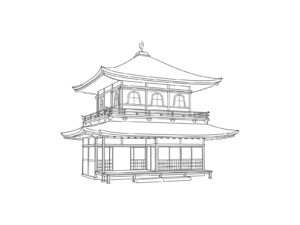
Look closely at the top of the coloring page. Can you see a small bird standing and facing this way? This is a statue of an imaginary bird called a phoenix, and it is made of bronze. The roof is built with many thin wooden boards layered together, called shingled roofing, and not a single roof tile is used. That is why the roof looks smooth and forms a soft curve.
A Home Below, a Temple Hall Above. Different Styles for the First and Second Floors
This building has two stories, but the first floor and second floor are built in completely different styles. The first floor is called Shinkuden, and it looks like a regular home with a row of paper sliding doors. The second floor is called Choonkaku, and this part is built like a temple hall. The windows lined up on the front of the second floor, shaped like bells with pointed tops, are called Kato-mado windows. This window shape is often used in Zen temples.
"Kogetsudai", the White Sand Mountain, and "Ginshadan" with Wave Patterns
Right next to Ginkaku, there is Kogetsudai, white sand piled up like Mount Fuji, and Ginshadan, a wide area of sand with lines. Both are made of sand, and the temple staff care for them gently so they do not collapse even when it rains. It is said they took this shape in the late Edo period, so they were not there yet when Yoshimasa was alive.
It Is Also a World Heritage Site
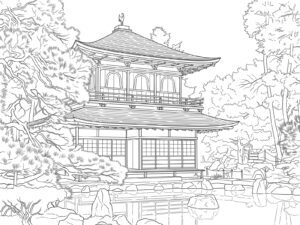
Ginkaku-ji Temple was registered as a World Heritage Site in 1994 as one of the "Historic Monuments of Ancient Kyoto". Among the buildings, two of them, the Ginkaku (Kannon-den) and Togudo, are National Treasures. The area around them has a moss-covered garden and a pond named Kinkyo-chi, and the sight of Ginkaku reflected on the water is very pretty. If you ever go to Kyoto, be sure to take a look at the real thing!
How to Color Ginkaku-ji Temple
Use dark brown or a brownish black for the wooden parts
The name has "Ginkaku" (silver) in it, but you do not need to color it silver or gray. The wooden posts and wall boards have turned dark over many long years. So, dark brown, or a little bit of black layered over brown, is just right! The second floor is darker than the first floor. So, if you make the second floor dark and the first floor light, your picture will look just like a real photo of Ginkaku-ji Temple!
The roof is not made of tiles, so do not make it bluish-gray
When you think of a temple roof, you might think of bluish-gray. But the roof of Ginkaku-ji Temple is made by layering thin wooden boards! So, a brownish-gray or a light brown will look much closer to the real thing. The roof is the biggest part of the picture. If you color it lightly and smoothly without pressing too hard, it will look super pretty!
Leave the inside of the arched windows white
The windows lined up on the front of the second floor with pointed tops are shoji paper screens. It looks best if you do not color them and leave them white! If you color the wooden parts around them with a dark brown, the white windows will stand out, and your picture will look amazing even from far away! Do the same for the shoji on the first floor. Leave them white, and just color the wooden panels at the bottom with brown.
Leave the pond uncolored, or use a very light sky blue
For the pond in the front of the picture with a background, leave it white, or just add a soft layer of light sky blue. If you color it too dark, you will not be able to see the shape of Ginkaku-ji Temple reflected in the water! For the reflection in the water, use a slightly lighter color than the building. This will make it look like the water is gently rippling! For the stepping stones, mix a little brown into your gray and change how dark you color each stone to make them look real.
Fun Facts About Ginkaku-ji Temple
Silver was never added from the start
You might have heard the story, "It used to be covered in silver, but it peeled off." But that is actually not true! A scientific study in 2007 proved that no silver was added from the time it was built. They did not find even a tiny trace of silver.
It was called "Ginkaku-ji Temple" starting in the Edo period
When Yoshimasa was alive, this building was not called Ginkaku. The name Ginkaku-ji Temple started being used in the Edo period, and it showed up in a book called "Rakuyo Meisho-shu" published in 1658. As people called it that alongside Kinkaku, the name spread before anyone knew it!
The very first four-and-a-half mat room is at this temple
Inside Togu-do, which stands next to Ginkaku, there is a four-and-a-half mat room called Dojinsai. It was a room where Yoshimasa read and wrote. It had built-in desks and display shelves that became the base for alcoves. People say this became the original model for today's Japanese-style rooms. Isn't it amazing that the start of the four-and-a-half mat room you often see today was at this temple more than 500 years ago?
Share These Ginkaku-ji Temple Coloring Pages


More Castles, Shrines & Temples Coloring Pages
-
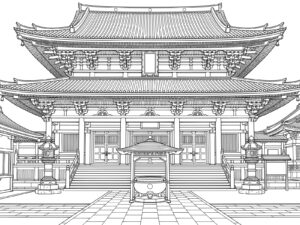
Kawasaki Daishi Temple
Difficulty:~ -
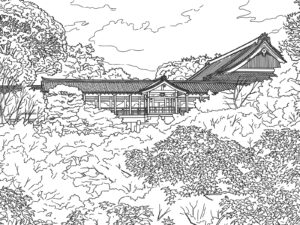
Tsutenkyo Bridge at Tofukuji Temple
Difficulty:~ -
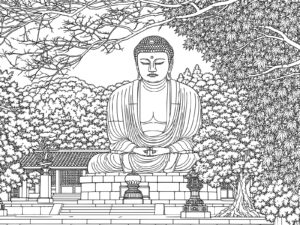
Great Buddha of Kamakura
Difficulty:~ -
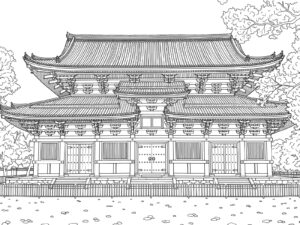
Kondo (Main Hall) of Toji Temple
Difficulty:~ -
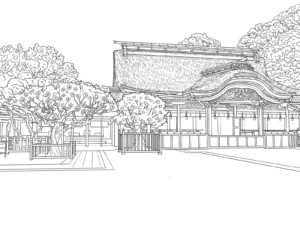
Dazaifu Tenmangu Shrine
Difficulty:~ -
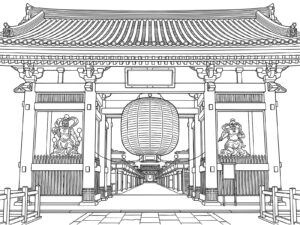
Kaminarimon Gate at Senso-ji
Difficulty:~ -
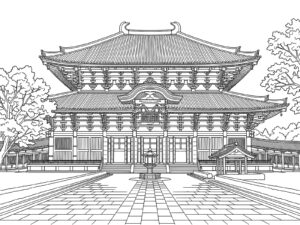
The Great Buddha Hall of Todai-ji
Difficulty:~ -
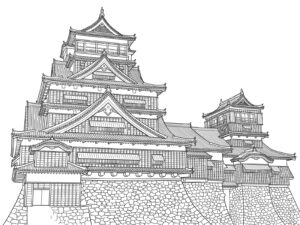
Kumamoto Castle
Difficulty:~
-
Ginkaku-ji Temple
-
Ginkaku-ji Temple Kinkyo-chi Pond

-
-
Ginkaku-ji Temple Adult
-