Horyu-ji Temple Coloring Pages
 ~

About Horyu-ji Temple
The Oldest Wooden Buildings in the World
Horyu-ji Temple is a temple in Ikaruga Town, Nara Prefecture.
People say that Prince Shotoku and Empress Suiko built it around the year 607.
It caught fire after that, and experts think people rebuilt it a short time later.
Even so, its Kondo main hall and Five-Story Pagoda standing today are among the oldest wooden buildings in the world.
It is amazing that they have stood strong against rain, wind, and earthquakes for over 1,300 years!
One of Japan's Very First World Heritage Sites
In 1993, Horyu-ji Temple became a World Heritage Site as part of the "Buddhist Monuments in the Horyu-ji Temple Area."
Himeji Castle, Yakushima, and Shirakami-Sanchi became World Heritage Sites in the same year, making them all Japan's very first World Heritage Sites.
The Three-Story Pagoda at Hokki-ji Temple nearby is also part of this World Heritage Site.
The Five-Story Pagoda with Five Roofs
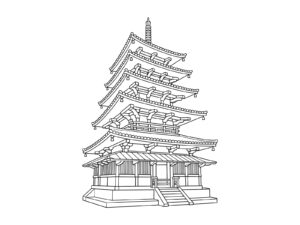
The first coloring page shows the Five-Story Pagoda of Horyu-ji Temple.
It has five roofs stacked up, and they get smaller as they go higher.
The top roof is about half the size of the bottom roof.
At the very top, there is a tall decoration called a sorin, which has nine rings in a row.
The extra small roof under the bottom roof is called a mokoshi.
The Kondo Main Hall Standing Next to the Five-Story Pagoda
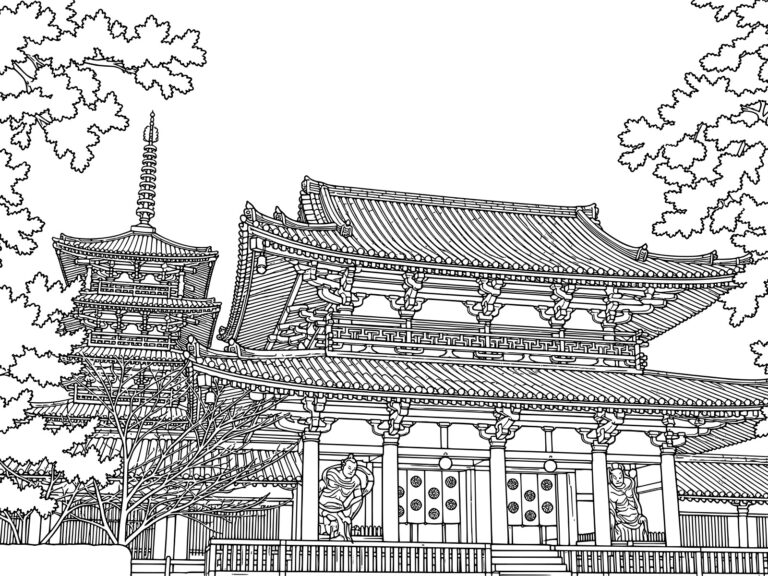
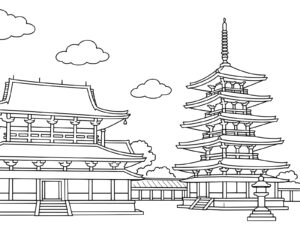
The second page shows the Kondo main hall and the Five-Story Pagoda standing side by side.
The Kondo main hall houses sacred Buddhist statues, making it the most important hall at Horyu-ji Temple.
It has two stacked roofs, with a mokoshi roof under them too.
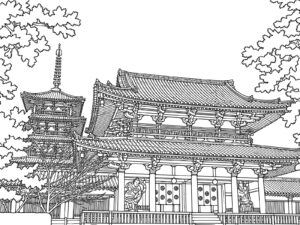
The third page shows the Kondo main hall and Five-Story Pagoda seen through pine branches.
Try to find the interlocking wooden parts under the eaves called kumimono, and the railing patterns called manji-kuzushi!
Prince Shotoku and the Village of Ikaruga
Ikaruga, where Horyu-ji Temple stands, is the place where Prince Shotoku used to live.
Prince Shotoku is famous for cherishing Buddhism and organizing Japan's government system.
Around Horyu-ji Temple, you can find several temples connected to the prince, along with peaceful views of old Nara.
Compare the Five-Story Pagoda on the first, second, and third coloring pages to see it from far away, up close, and through tree branches.
Even though it is the same pagoda, it looks different depending on where you stand.
Maybe people long ago looked up at the pagoda just like you!
How to Color Horyu-ji Temple
Use dark brown and reddish brown for old wood
The pillars and eaves of Horyu-ji Temple are a dark brown wood color from many, many years passing.
After you color them dark brown, add some reddish brown here and there. This makes the old wood look warm!
Leave plenty of white on the walls so the color stands out against the pillars.
Layer grays for the roofs
Try coloring the roof tiles with gray and dark gray.
If you make the edges of the roof a little darker, the curving roof shape really shows up.
Color the 5 roofs a little lighter from bottom to top, and the pagoda will look extra tall!
We recommend coloring the finial at the very top with dark green or gold.
Bright Nara scenery with the sky and pine trees
Color the sky light blue, leave the clouds white, and just trace the edges in light gray.
On the 3rd page, layer dark green and yellow-green on the pine needles to make them look full of life!
It looks great to color the round patterns on the white cloth over the main hall doors with purple or navy blue.
Place your work next to the To-ji Temple Five-Story Pagoda coloring page and compare the shapes of the five-story pagodas!
White sand ground and stone bases
Try coloring the stone bases under the halls and pagoda with light gray or cream.
The ground on the 2nd page is white sand, so you barely need to color it! Just put a little light gray in the shadows.
For the stone steps, make the top surface bright and the front side a little darker on each step. That makes the shape of the steps super easy to see!
Fun Facts About Horyu-ji Temple
Is the middle of the pillar bulging?
If you look closely at the pillars of Horyu-ji Temple, you will see that some bulge a little in the middle.
This shape is sometimes called entasis, and people say it looks like the pillars of ancient temples in far-off countries.
We do not know for sure if the exact same shape made its way to Japan.
The Five-Story Pagoda is strong against earthquakes
In the middle of the Five-Story Pagoda, one thick pillar called a shinbashira goes all the way from the top to the bottom.
When an earthquake shakes the building, each floor sways separately to make the shaking smaller.
It is said that this idea was also used to design TOKYO SKYTREE.
Enjoy Japan's old temples in Nara along with the coloring page of Todai-ji Temple's Great Buddha Hall!
The wisdom of carpenters from 1,300 years ago
The carpenters who built Horyu-ji Temple joined pieces of wood together without using almost any nails.
This technique is still passed down today by skilled temple carpenters.
They keep protecting the buildings by fixing only the broken parts while taking good care of the old wood.
Share These Horyu-ji Temple Coloring Pages


More Castles, Shrines & Temples Coloring Pages
-
Kaminarimon Gate at Senso-ji
Difficulty:~ -
Dazaifu Tenmangu Shrine
Difficulty:~ -
Five-storied pagoda of Toji Temple
Difficulty:~ -
Kawasaki Daishi Temple
Difficulty:~ -
Kondo (Main Hall) of Toji Temple
Difficulty:~ -
Kinkaku-ji (the Golden Pavilion)
Difficulty:~ -
Fushimi Inari Taisha Shrine
Difficulty:~ -
Shuri Castle
Difficulty:~
-
Five-story Pagoda of Horyu-ji Temple
-
Kondo Main Hall and Five-Story Pagoda
-
-
Pine branches, Main Hall, and Five-story Pagoda
-
-