Kaminarimon Gate at Senso-ji Coloring Pages
 ~


About Kaminarimon Gate at Senso-ji
A Gate at the Entrance to Senso-ji
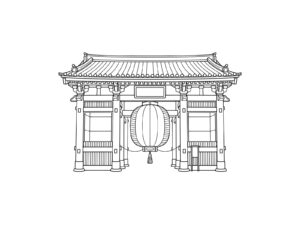
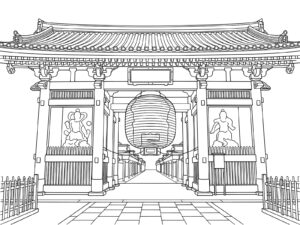
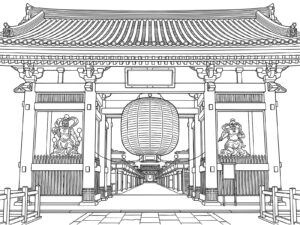
Kaminarimon Gate at Senso-ji is the entrance gate to Senso-ji Temple in Taito City, Tokyo. You can say it is the most famous gate in Tokyo!
Actually, "Kaminarimon" is just a nickname. The real name is Furaijinmon. That is because the wind god and the thunder god stand on the left and right sides of the gate. You can find this official name written on the back of the giant lantern.
A Huge Lantern Weighing 700 Kilograms
The bright red giant lantern hanging in the middle of the gate is the best part to see. You will be amazed when you hear how big it is!
It is 3.9 meters tall, 3.3 meters wide, and weighs about 700 kilograms. That is as heavy as about 10 adults! It is made by putting traditional Japanese paper over a bamboo frame. They make a brand-new one about once every 10 years. The lantern you see today is the 6th one, made in 2020.
The Wind God and Thunder God Are There
If you look closely at the left and right of the gate, you will see a big statue on each side.
The one on your right is the wind god, and the one on your left is the thunder god. The wind god holds a big bag filled with wind. The thunder god carries a ring of drums on his back. Both are gods of the weather. People put them there to pray for healthy crops to grow.
The Current Gate Was Built in 1960
Kaminarimon Gate at Senso-ji has a long history, but it burned down in fires many times. After it burned down near the end of the Edo period, there was no gate for more than 90 years!
The gate standing today was rebuilt in 1960. Konosuke Matsushita, the founder of Panasonic, donated money to rebuild it to say thank you for getting better from an illness. That is why his name is written on the lantern!
Nakamise Street Is Just Beyond the Gate
When you walk through Kaminarimon Gate at Senso-ji, you will see many shops lined up on both sides of a straight street. This is Nakamise Street.
It is about 250 meters long. There are nearly 90 shops selling souvenirs and Japanese sweets, and it is always full of people. It is said to be one of the oldest shopping streets in Japan.
2.8 Million People Visit for Hatsumode
Senso-ji is also famous for Hatsumode, the first shrine or temple visit of the New Year. About 2.8 million people visit during the first three days of the year! That is the 4th highest number in all of Japan.
The temple itself has a very long history. People say it started all the way back in the year 628. That makes it the oldest temple in Tokyo.
How to Color Kaminarimon Gate at Senso-ji
Write Your Own Words on the Lantern
The lantern on this coloring page is left blank. That means you can write "Kaminarimon" yourself!
You can write it in black just like the real one, or put in any words you like. It will also look pretty if you color it plain red without writing anything. Leaving the lines of the lantern frame white helps it look round and full!
Put Down Orange Before Red
The real lantern and pillars are a vermilion red. If you use only one red pencil, it can look a bit heavy.
Try coloring a light layer of orange first, then put red on top. Making the bottom of the lantern a little darker makes it look nice and round. For the pillars, try adding a little dark brown only on the side that is in the shade.
Color the Roof Gray and Leave the Round Tiles White
The roof is made of tiles, so it is a bluish gray. The difference between the roof and the red pillars is the coolest part of Kaminarimon Gate at Senso-ji!
If you leave each of the round roof tiles white at the edge of the roof, it will look just like the real thing. Color the flat parts of the roof by moving your colored pencil along its curved shape.
Use Green and White for the Wind God and Thunder God
The statues on the left and right are old statues made of wood and copper, so staying away from bright colors makes them look closer to the real thing.
A greenish gray or a light brown works great! When you use calmer colors compared to the red pillars around them, it makes the statues look like they are set back inside.
Keep Nakamise Small and Light
Make sure to color Nakamise Street, seen behind Kaminarimon Gate at Senso-ji, lighter than the front.
Making the colors softer as you go deeper makes the street look like it goes on into the distance. Color the gate in front dark, and the back light. Just doing that adds great depth!
Fun Facts About Kaminarimon Gate at Senso-ji
It Didn't Have a Gate for Over 90 Years
Kaminarimon Gate at Senso-ji is the face of Asakusa today, but there was a long time when the gate wasn't there at all.
After it burned down in a fire in 1865, it was not rebuilt for a very long time. The next gate was built in 1960. That means Asakusa had no Kaminarimon Gate at Senso-ji for 95 whole years! It is hard to imagine if you only know how it looks today.
The Lantern Is Made New Every 10 Years
Because the giant lantern is made of Japanese paper, rain and wind can damage it. That is why it is rebuilt into a brand-new one about once every 10 years.
Craftspeople in Kyoto make the lantern. They weave bamboo to make the frame and paste Japanese paper onto it. The one hanging right now is the 6th generation, and it was just made new in 2020.
It Folds Up During Typhoons
The giant lantern has a secret that not many people know. It can be folded up from the bottom to make it smaller.
When a typhoon comes or when portable shrines pass under it during the Sanja Matsuri festival, the lantern folds up and gets pulled up high. Even though it weighs 700 kilograms, it is built to shrink just like an accordion!
It Has a Different Name on the Back
The front of the lantern says "Kaminarimon", but the back says "Furaijinmon". This is actually its official name!
When you walk under it and look back, you can read it. When you visit Asakusa, turn around and check it out!
Share These Kaminarimon Gate at Senso-ji Coloring Pages


More Castles, Shrines & Temples Coloring Pages
-
Kondo (Main Hall) of Toji Temple
Difficulty:~ -
Shuri Castle
Difficulty:~ -
Tsuruga Castle
Difficulty:~ -
Yomeimon Gate at Nikko Toshogu
Difficulty:~ -
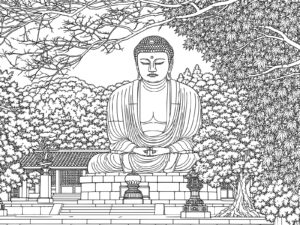
Great Buddha of Kamakura
Difficulty:~ -
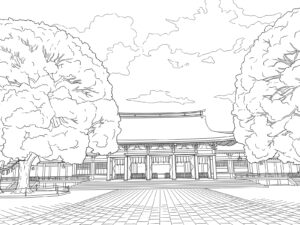
Meiji Jingu Shrine
Difficulty:~ -
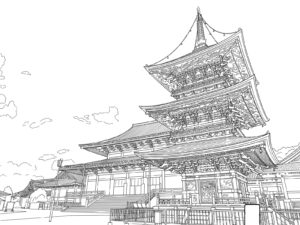
Naritasan Shinshoji Temple
Difficulty:~ -
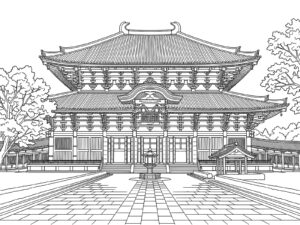
The Great Buddha Hall of Todai-ji
Difficulty:~
-
Kaminarimon Gate at Senso-ji
-
Kaminarimon Gate and Nakamise Shopping Street at Senso-ji Temple
-
-
Kaminarimon Gate of Sensoji Temple Adult
-