Pine cricket Coloring Pages

About Pine cricket
The First Insect in the "Insect Voices" Song
Pine cricket is a cricket relative that sings in the grass on autumn nights.
Have you ever heard the song that goes, "Oh, listen to the Pine cricket, chinchiro chinchiro chinchirorin"? Pine cricket is the very first insect in the school song "Insect Voices," which people have sung since the Meiji period.
Other insects in this song are bell crickets, crickets, kutsuwamushi, and umaoi.
A Light Brown Body About 2 Centimeters Long
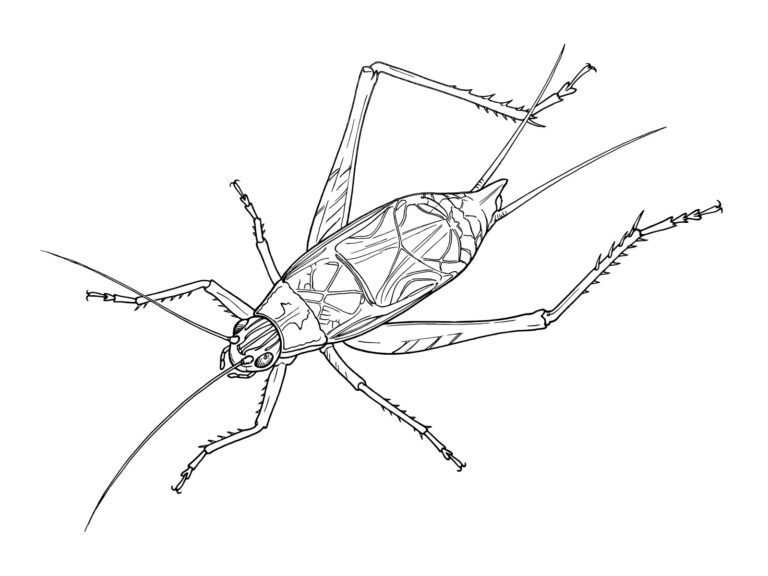
Pine cricket's body is about 2 centimeters long. That is one size bigger than a bell cricket.
Its body is light brown with tiny black dots here and there. When it is in dead grass, it is so hard to find you might not know where it is!
It has a small head, and its thread-like antennae are more than twice as long as its body. Its back legs have thick thighs, so it can jump really far.
The Male's Wings Are Like Musical Instruments
Only the males sing. On the male's back are wide wings with squiggly lines running through them.
These lines help make sounds. The male lifts his wings and rubs the left and right wings together to sing.
The female's wings are narrower than the male's. She also has a long tube at the end of her bottom for laying eggs. So, you can tell if it is a male or a female just by looking at its back.
Living in Japanese Silver Grass Fields
Pine cricket lives in sunny fields covered with tall plants like Japanese silver grass. You can find them on riverbanks, grassy spots near the sea, and slopes along train tracks.
They live in Honshu (south of Niigata Prefecture), Shikoku, and Kyushu. Grown-ups sing from mid-August to around November.
Their voices ring out far and wide. But they often sing on dead grass at the base of plants, so it is very hard to spot them.
How to Tell it Apart from a Bell Cricket
Pine cricket and the bell cricket are both cricket relatives that sing in autumn, and their names sound a bit similar.
But they look totally different! The bell cricket has a blackish body shaped like a watermelon seed. Pine cricket is light brown and one size bigger.
Their voices are different, too. The bell cricket sings with a clear "rin, rin" sound. Pine cricket sings with a short, high-pitched voice. Put the two coloring pages side by side and compare their color differences!
How to Color Pine cricket
Start with Light Brown for the Body
The Pine cricket's body is light brown. First, color the whole body lightly with beige or yellow-ocher. Then, add darker brown little by little over it.
If you use dark brown right away, it will look like a dark cricket!
To finish, add little dark brown dots here and there. This makes a spotty pattern just like a real Pine cricket!
Color the Wings so They Look See-Through
The wings on a male's back are thin and a little see-through.
The trick is to not color the spaces between the lines with all the same color! If you switch between light brown and cream color for each section, it will look like you can see the tummy under the wings.
If you make the color a little darker near the lines, the wings will look nice and smooth!
Make the Ends of the Legs and Antennae Darker
For the legs, try using light brown at the top and dark brown as you go down to the tips.
For the thick thighs on the back legs, make the middle bright and the edges a little darker. That makes them look nice and round!
The long antennae are hard to color inside the thin lines. Just tracing the lines with a brown colored pencil works great!
Color Between the Lines on Raised Wings
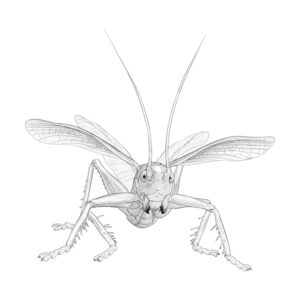
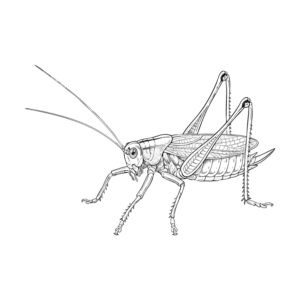
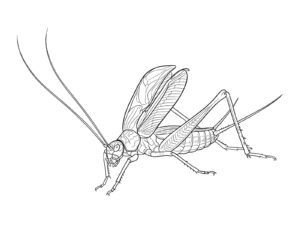
The picture from the side shows a male raising its wings to sing.
The raised wings are a light, see-through brown. Color the little sections between the lines one by one, using cream and light brown.
Make the spot where the two wings overlap just a little darker. That makes it easy to see there are two wings!
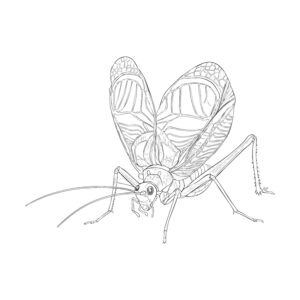
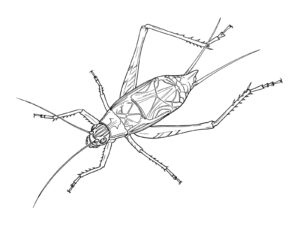
If you color it alongside the top-view picture, you can compare how the same wings look when folded and when raised!
Color the Female's Egg-Laying Tube Dark Brown
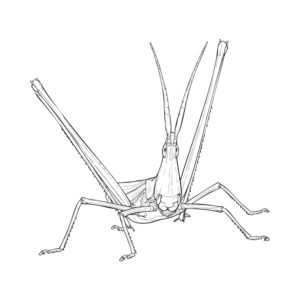
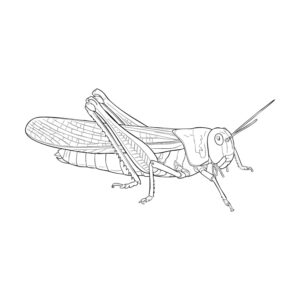
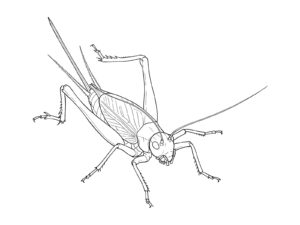
The third page is the female. See the straight egg-laying tube sticking out from her bottom?
The tip of the egg-laying tube is darker. Use light brown at the start and dark brown toward the tip. This will make the thin tube stand out clearly!
A female's wings are thinner than a male's and have lines like a net. Compare her next to the male on the first page to see how their wing shapes are different!
Fun Facts About Pine cricket
In the past, did it have the same name as the bell cricket?
Pine cricket and bell cricket show up in stories and poems from a long time ago.
But some people say that the old "Pine cricket" was actually today's bell cricket, and the old "bell cricket" was today's Pine cricket!
We do not know for sure which name went to which bug. That shows how much people have loved both bugs for a very long time!
Does its real voice sound like "Chin-chiro-rin"?
In songs, it sings "Chin-chiro-rin," but the real Pine cricket has a sharp and loud voice.
Some people hear it as "Pih, piriri!" If it sings near your house, it can be so noisy you cannot sleep!
On an autumn night, listen closely in a field of tall grass to hear how it sounds to you.
It can easily climb glass
At the ends of a Pine cricket's legs, there is a soft part like a suction cup.
Thanks to this, it can climb smooth plastic or glass walls without slipping!
If you keep one in a bug cage, you can watch it walk right up the walls. Be sure to close the lid tight so it does not escape!
Share These Pine cricket Coloring Pages


-
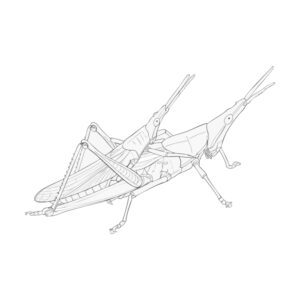
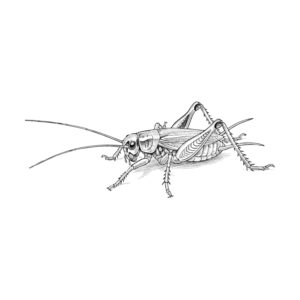
Pine cricket (seen from above)
-
Pine cricket (singing with raised wings)
-
-
Female pine cricket (with ovipositor)
-