Maitake mushroom Coloring Pages

About Maitake mushroom
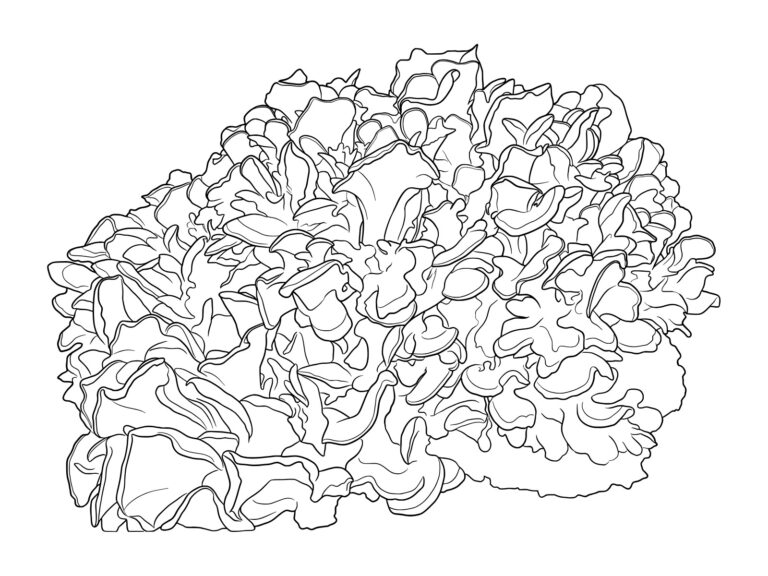
Dozens of wavy caps
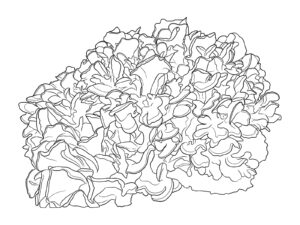
The Maitake mushroom is a mushroom with dozens of thin, wavy caps overlapping to form a big clump.
The caps look like spatulas or folding fans, and the edges wave like ocean waves.
Their colors range from gray to dark brown. Big ones can grow to more than 30 centimeters wide!
No gills under the caps
Under the caps of shiitake and shimeji mushrooms, you can see thin gills lined up.
But the Maitake mushroom has no gills under its caps! Instead, it is packed with tiny little holes.
The underside of the cap is whitish in color.
A few stories behind its name
There are a few stories about how the Maitake mushroom got its Japanese name.
One story says people were so happy to find it that they danced for joy.
Another story says the wavy caps look like they are dancing.
In the mountains, it grows at the base of big trees like Japanese oak in autumn.
Niigata makes more than 60 percent
People learned how to grow the Maitake mushroom in the 1970s. That is when it started showing up in stores.
Today, almost all of them are grown through block cultivation, using blocks made of sawdust.
A 2025 study shows that Niigata Prefecture grows more than 60 percent of the nation's total.
It is great for tempura, stir-fries, and hot pots. Line it up next to another autumn mushroom, the Matsutake mushroom, to compare their shapes!
One cluster in one pack
Maitake mushrooms in stores are often sold as one whole cluster inside a pack.
When you cook, tear it apart from the base with your hands into smaller pieces. You can easily divide it without using a knife!
When you tear it apart, you will see white, thread-like stems that hold the caps together.
Most of the time, you do not wash the Maitake mushroom. Just wipe off any dirt gently before cooking.
Famous for its smell and crunch
The Maitake mushroom is a mushroom known for its great smell and nice, crunchy texture.
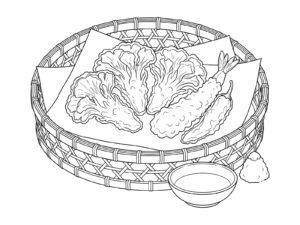
When you make tempura with it, the batter clings to the wavy caps and fries up super crispy!
It is also an ingredient in Akita Prefecture's famous Kiritanpo hot pot.
It tastes amazing in stir-fries, miso soup, and cooked rice dishes too!
How to Color Maitake mushroom
Darken the edges of the caps
The caps of the Maitake mushroom are greyish brown.
For each cap, try making the edges dark brown and the bases light brown.
The edges have thin, stripe-like patterns, so making those parts a little darker gives them a nice fluttery look.
Darken the overlapping parts in the back a little
Because many caps overlap, darken the caps in the back a little and color the caps in the front bright to make it look 3D.
Where you can see the undersides of the caps, color them white or cream.
The trick is not to fill everything with the same brown, but to change the color a little bit for each cap.
Tempura has golden batter
For the tempura picture, try coloring the batter light yellow and ochre.
If you make just the edges of the bumpy batter a little darker, it will look nice and crispy.
Color the shrimp tail red, the shishito pepper green, and the basket a light bamboo ochre. Make the tempura dipping sauce dark brown.
Stripes on the edges of the caps
The edges of the caps of the Maitake mushroom have stripe-like patterns with different colors.
The parts close to the edges are often whitish, and the inner parts are dark brown.
If you leave the edges white and color the inner parts brown for each cap, it will look much more like a real Maitake mushroom.
It takes time, but if you color each cap carefully, it will turn out very pretty.
Fun Facts About Maitake mushroom
It Makes Meat Tender
Maitake mushroom has a special enzyme that breaks down protein.
So, if you leave it with meat for a little while, the meat gets nice and soft.
Some people use it when preparing steak or fried chicken!
It Used to Be Called the "Phantom Mushroom"
Before people learned how to grow it, Maitake mushroom was a super rare mushroom that you could only find in the mountains.
It was so hard to find that people called it the "Phantom Mushroom."
Even today, wild Maitake mushroom picked in the mountains is very rare!
A Mushroom Friend Without Gills
There are other mushrooms besides Maitake mushroom that have tiny holes lined up under their caps instead of gills.
In mushroom picture books, they sometimes group mushrooms by whether they have gills or holes.
When you buy mushrooms at the store, try looking under their caps to compare them!
Don't Put It Raw in Egg Custard
The power of Maitake mushroom to break down protein also affects egg dishes.
If you put raw Maitake mushroom in savory egg custard, the egg might not set.
When you add it, it is a good idea to cook it quickly first!
Maitake Mushroom Comes in More Than One Color
Besides the grayish-brown ones, there are also white Maitake mushroom.
White Maitake mushroom does not turn soup broth dark when you cook with it!
Share These Maitake mushroom Coloring Pages


-
Maitake mushroom
-
Maitake tempura
-