Napa Cabbage Coloring Pages
 ~

About Napa Cabbage
A vegetable that you just need for winter hot pots
Napa Cabbage gets delicious in the cold winterWinter vegetablesIt's
Hot potWhen you put Napa Cabbage in, it gets nice and soft, and it soaks up a lot of delicious soup flavor!
It is a winter dinner table favorite, used in pickles, stir-fries, and soups.
Napa Cabbage is a vegetable related to cabbage andDaikon RadishSame asBrassicaceae (Mustard Family)is in the same family as
When it hits the cold, Napa Cabbage stores sweetness inside its body so it will not freeze, so winter Napa Cabbage becomes sweet.
The leaves overlap and form a ball
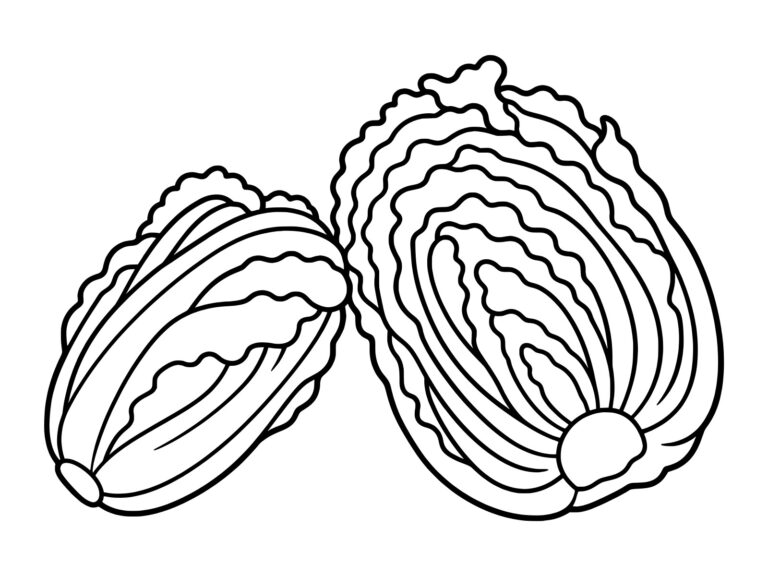
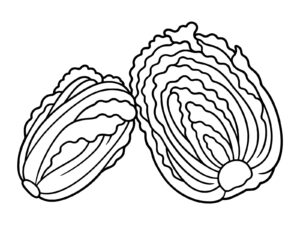
Here is your first Napa Cabbage coloring page:A whole Napa CabbageandNapa Cabbage cut in half lengthwiseIt's
Napa Cabbage grows heavy heads made of many leaves wrapped tightly over and over toward the inside.
When you look at the cut end, the leaves are layered on top of each other, making it look like a stripe pattern.
The outer leaves are green. As you go closer to the inside, they turn yellowish because they do not get any sunlight.
The thick white part at the base of the leaf has a nice, crunchy texture!
Grows big in the winter field
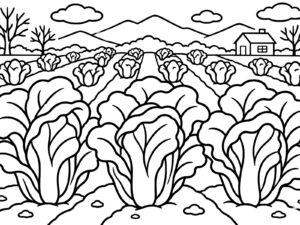
The second coloring page shows Napa Cabbage growing in a winter field.
The Napa Cabbage in front spreads its large outer leaves to protect the round center.
Rows of Napa Cabbage stretch all the way into the background of the field, and you can see mountains and houses far away.
Napa Cabbage is planted from seeds or young plants in autumn, and you harvest it in winter.
Napa Cabbage hot pot to enjoy with your family
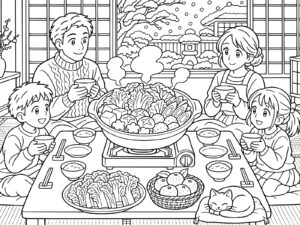
The 3rd one shows a family of 4 on a winter nightNapa Cabbage Hot Potis the part that goes around the .
Inside the clay pot, besides the Napa Cabbage, you can also see tofu and shiitake mushrooms with cross cuts in them!
Everyone is holding a warm bowl with both hands and smiling.
On the tableMandarin OrangeThere is a basket of Napa Cabbages, and a cat is curled up on a cushion.
Outside the window, it's a snowy garden where you can see trees and stone lanterns covered in snow!
Try picking one by its weight and how the cut end looks!
When you pick out a whole Napa Cabbage at the store, try holding itIt feels nice and heavyare recommended.
It is a sign that the leaves are packed tightly together with no gaps.
When Napa Cabbage is cut in half, fresh ones have a flat cut surface and the middle doesn't stick out.
The center bulges because the inner leaves keep growing even after the Napa Cabbage is cut!
How to Color Napa Cabbage
Softly blend where the white and light green meet
Napa Cabbage leaves are white at the base and green at the tips.
Leave the paper white for the base, and make the color slowly darker from light green to green as you move toward the tips.
Do not draw a sharp line between the colors. Layer the light green softly to blend them, and it will look like a real Napa Cabbage.
You can trace the wavy edges of the leaves with a slightly darker green.
Green on the outside, yellow on the inside for the cut surface
For the cut surface of a halved Napa Cabbage, make the outer leaves green and use yellow or cream color as you go inside.
If you change the color a little for each leaf, everyone can see how the leaves layer together.
The core in the middle looks great in light yellow.
Warm room colors
If you color the clay pot in the 3rd coloring page dark brown or blackish brown, the white and green of the Napa Cabbage will stand out nicely.
Leave the tofu white, color the shiitake mushrooms brown, and keep the steam white without coloring it.
Color the family's clothes in warm colors like red or orange to create a cozy winter night.
For the snowy garden outside the window, add just a little light blue or gray to show how warm the room is.
Napa Cabbage in the field: include the colors of the soil and sky
For the soil in the field on the 2nd coloring page, mix dark brown and light brown.
Color the far-away mountains light blue or purple, and the Napa Cabbage in front dark green to give your picture depth.
Try coloring the bare tree brown and the house roof any color you like, such as red or blue.
Fun Facts About Napa Cabbage
It became popular in Japan surprisingly recently!
Napa Cabbage is a vegetable that came to Japan from China.
It was brought to Japan in the Meiji period, but at first, it was hard to get seeds from it here.
It is said that people who went to China during the war learned how yummy Napa Cabbage was and tried hard to grow it in Japan too.
That is how it began growing in Japanese fields and spread all over the country from the Taisho period to the early Showa period.
The outer leaves are like a blanket to protect the head
In the field, Napa Cabbage uses its big outer leaves to protect the center head from the cold.
In very cold places, people sometimes tie the top of the leaves with a string to wrap the head.
This protects the head from frost and cold winds!
Great for more than just hot pot!
Napa Cabbage is put into Japanese hot pot, and sometimes into sukiyaki too.
In Korea, a nearby country, people make kimchi with Napa Cabbage.
You can enjoy dishes from different countries with just one vegetable!
The yellow inner leaves are yummy raw too!
The yellow leaves inside the Napa Cabbage are soft and sweet, so they taste great raw in salads.
The outer leaves are perfect for hot pots and soups!
Share These Napa Cabbage Coloring Pages


More Vegetables Coloring Pages
-
Chinese Cabbage and Cut Surface
-
Napa cabbage in a winter field
-
-
Napa cabbage hot pot with family
-
-