Daikon Radish Coloring Pages
 ~

About Daikon Radish
Vegetables that get tasty in winter
Daikon Radish is a winter vegetable that people in Japan have eaten for a long time.
It has been with us for so long that it even appears in the "Kojiki," one of Japan's oldest books.
You can find it in stores all year round now, but it tastes best during its season in cold winter.
When it gets cold, Daikon Radish stores up sweetness to protect itself, so it becomes sweet and yummy.
You can eat it in many ways, like putting it in oden, grating it, or cooking it in stews.
It is a vegetable you can eat completely, from the leaves to the tip of the root.
White roots and green leaves
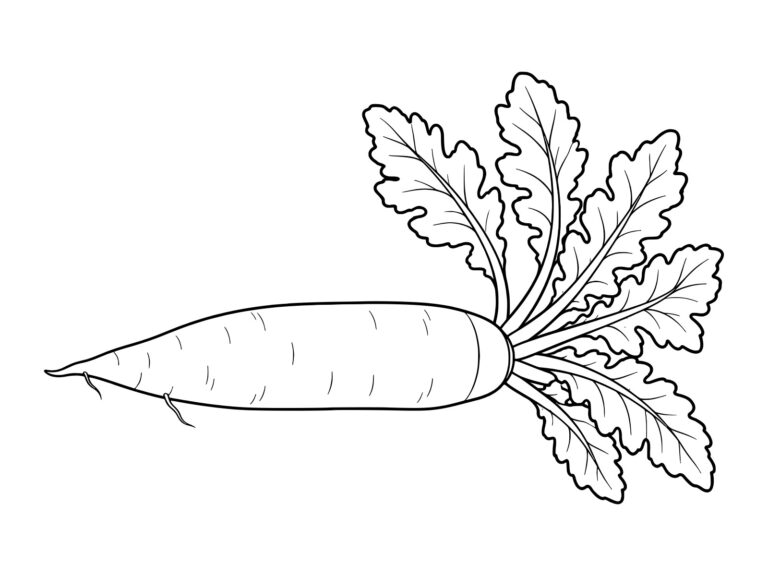
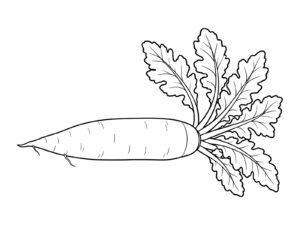
The 1st coloring page shows a Daikon Radish pulled from the field and laid on its side.
The thick, white part you usually eat grows under the ground.
A Daikon Radish with a green top is called a Aokubi Daikon.
The part above the ground turns green when the sun shines on it.
This Aokubi Daikon is the most grown kind in Japan.
On top of its head, big, jagged leaves spread out thickly.
Just like carrots and burdock roots, it is a vegetable grown to eat its big root.
Heave-ho! Pulling up a Daikon Radish
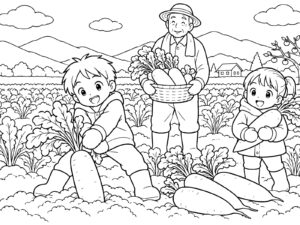
The 2nd coloring page shows children pulling up Daikon Radish in a winter field.
The boy plant his feet, holds the base of the leaves with both hands, and tries to pull it out.
The girl looks happy hugging a big, freshly pulled Daikon Radish in her arms.
In the back, grandpa is holding a basket with Daikon Radish inside.
Far away, you can see mountains, houses, and a persimmon tree too.
Daikon Radish grows deep in the ground, so the trick is to pull it straight up.
Dried Daikon Radish under winter eaves
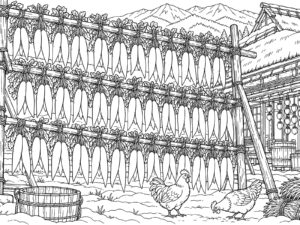
The 3rd coloring page shows many Daikon Radish being dried in a farmhouse yard.
Daikon Radish tied in pairs are lined up on a rack made of bamboo and logs.
When you dry them in the cold winter wind, the water leaves them, and they become soft.
Pickles made from Daikon Radish dried like this are called takuan.
In the yard, there are chickens, wooden tubs, and bundles of straw, showing a winter scene of an old farmhouse.
You can also see snow-covered mountains.
How to Color Daikon Radish
Tips to make white Daikon Radish look white
Daikon Radish roots look pretty when you leave a lot of the paper white.
If you add a little light gray or light blue along the bottom edge, it will start to look like a round cylinder shape.
Color the top part light yellow-green, and blend it softly into the white area.
If you color the tiny root whiskers light brown, it looks just like it was freshly pulled from the dirt!
You can trace the thin lines on the side of the root with a slightly darker gray.
For the leaves, layer yellow-green and green
For the leaves of the Daikon Radish, first color the whole thing yellow-green, then add dark green at the base and edges of the leaves.
If you leave the center vein of the leaf whitish or light yellow-green, the leaf shape will stand out clearly.
Where lots of leaves overlap, make the leaves underneath darker so you can tell which ones are in front and back.
Colors for winter fields and farmers
For the field dirt in the 2nd page, mix and color with dark brown and light brown.
It is fun to color the child's jacket and mittens with cheerful, favorite colors like red, yellow, or blue!
For the dried Daikon Radish in the 3rd page, mix in a little cream color or light brown to give it a soft, dried look.
Use ochre for the bamboo rack, dark brown for the logs, and light blue for the distant mountains to add depth.
Coloring the dried persimmons under the eaves orange makes a nice accent for the winter scene.
Fun Facts About Daikon Radish
"Suzushiro" of the Seven Spring Herbs
Do you know about Nanakusa-gayu (Seven Herb Porridge) that people eat on January 7th after New Year's?
One of those seven herbs, "suzushiro," is actually Daikon Radish!
"Suzuna" is a turnip, and both of them are part of the seven herbs.
The World's Best Daikon Radish is in Japan
Japan has many different shapes of Daikon Radish.
The Sakurajima Daikon Radish from Kagoshima Prefecture is round, and it is said to be the heaviest Daikon Radish in the world.
Big ones can weigh about 30 kilograms!
The Moriguchi Daikon Radish grown in Aichi and Gifu Prefectures is long and thin, and it is said to be the longest Daikon Radish in the world.
The Shogoin Daikon Radish from Kyoto is a round and soft Daikon Radish.
The Top is Sweet, and the Tip is Spicy
Even in a single Daikon Radish, the taste is different depending on the part.
The top part near the leaves is sweet, and it gets spicier towards the tip.
So, it is said that the top part is good for salads, the middle part is great for stews, and the tip is best for spicy grated Daikon Radish.
The leaves are full of nutrition too, so don't throw them away! Stir-fry them and enjoy!
Share These Daikon Radish Coloring Pages


More Vegetables Coloring Pages
-
Daikon radish
-
Harvesting Japanese Radishes from the Winter Field
-
-
Dried Daikon Radish at a Farm
-
-