Rice harvesting Coloring Pages
 ~
~ 
About Rice harvesting
Important autumn work: Rice harvesting
Rice harvesting is the job of cutting down the rice plants grown in the fields to gather the rice.
The rice plants planted in spring grow quickly all through summer. When autumn comes, the heads of rice are full of rice grains.
As they ripen, the heavy heads of rice bend down, and the whole field shines a bright golden color.
Rice harvesting usually happens around September to October.
3 Coloring pages
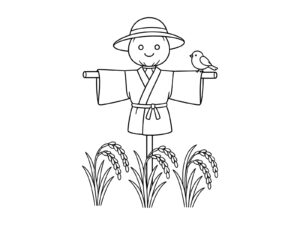
The 1st page shows a scarecrow with its arms wide open. A sparrow is sitting on its hand, and ripe heads of rice are swaying at its feet.
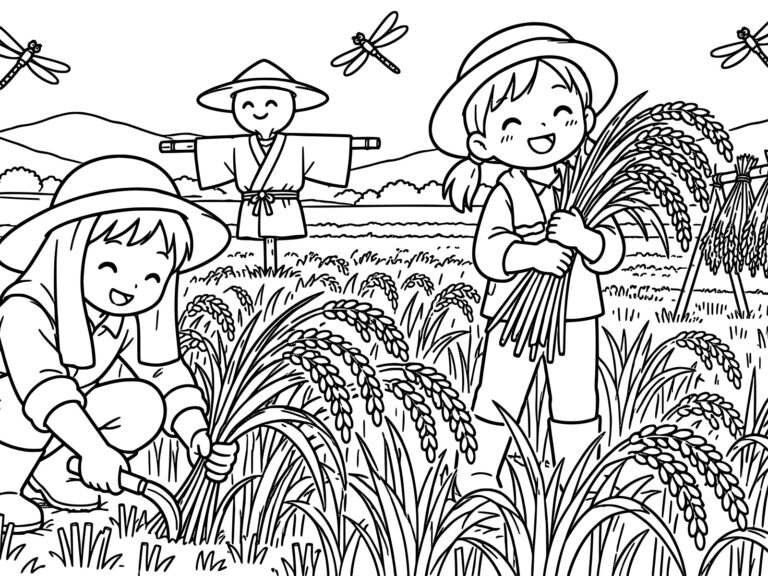
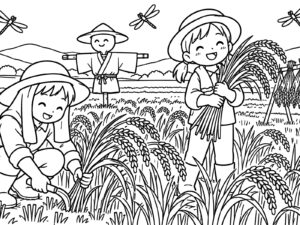
The 2nd page shows a rice field where children are Rice harvesting. You can see a child cutting rice with a small sickle and a child smiling while holding a bundle of cut rice.
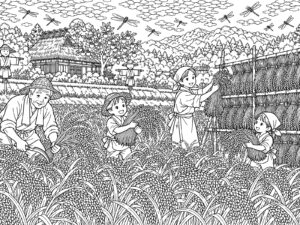
The 3rd page is a detailed drawing of a country mountain scene in autumn, where a whole family works together on Rice harvesting.
Try to find the thatched-roof house, the persimmon tree, and all the red dragonflies, too!
Drying in the sun on Hazakake racks
Sometimes, people hang the cut rice on Hazakake racks made of wood or bamboo so the sun and wind can dry them.
When dried slowly like this, people say the goodness from the straw moves into the rice grains, making them less likely to crack.
On the right side of the 2nd and 3rd pages, you can see Hazakake racks hung with long rows of rice bundles.
Most rice is dried with machines today, but Hazakake racks are still loved as a special sight of autumn rice fields.
Rice harvesting events at school and kindergarten
You might get to try everything from rice planting to Rice harvesting at your school or kindergarten.
You cut and dry the rice you grew yourselves, and finally, you get to eat it as cooked rice!
Other fun autumn harvest events include sweet potato digging and chestnut gathering.
In modern rice fields, a working vehicle called a combine harvester can do everything at once, from cutting the rice to taking off the husks.
Let's eat fresh rice
Rice that is harvested in the autumn of that year is called Shinmai, or fresh rice.
Fresh rice has a lot of moisture. It is shiny, soft, and smells wonderful when cooked!
When you see rice labeled "Shinmai" at the store in autumn, try to think about Rice harvesting.
As you color the coloring page, imagine the long journey it takes to make delicious rice.
How to Color Rice harvesting
Color the rice ears yellow and ochre
For the ripe rice ears, color them yellow first. Then, add a little ochre around the edges of the grains.
If you change the shade little by little for each grain, they will look plump and full.
For the leaves, mix yellow-green and light brown to make autumn rice plants.
Have fun coloring the scarecrow with your favorite colors
Try using colors that stand out against the yellow rice field for the scarecrow's clothes, like red, blue, or purple.
Color the straw hat ochre and the bamboo pole light brown to make it look real.
Color the sparrow on its hand brown and white.
Color the sky in autumn blue
Color the sky in the 2nd and 3rd coloring pages light blue to make a clear autumn sky.
If you leave the cirrocumulus clouds white on the 3rd page, the blue sky will stand out.
For the red dragonfly, color its body red and its wings light blue so the wings look clear.
You can also check out the red dragonfly coloring page to see the detailed colors!
Make it look like autumn with mountains and persimmon trees
For the mountains in the back of the 3rd page, mix red, orange, yellow, and green to show the autumn leaves.
Color the persimmons orange. Color the thatched roof ochre and brown along the lines of the straw.
If you color everyone's clothes in different colors, it will look like a lively scene of Rice harvesting.
Color the sickle silver and brown
For the small sickle held by the child on the 2nd page, color the blade silver or gray, and the handle brown.
Real sickles have sharp blades, so be sure to use them safely with an adult when doing Rice harvesting.
Fun Facts About Rice harvesting
The character for "Rice" and the number 88
If you look closely at the Kanji character for "Rice" (米), it looks like the numbers 8, 10, and 8 put together.
Some people say it became this character because it takes 88 steps of hard work to make rice.
That shows just how many people put care into growing rice.
Let's eat every single grain of rice without leaving any behind!
How the scarecrow got its name
Scarecrows stand in the fields to protect the rice plants from birds like sparrows.
Long ago, people burned strong-smelling things and put them on sticks. The smell chased away birds and wild animals.
It is said that the name came from "kagashi," which means "to make it smell."
From just one grain of seed
Just one grain of seed rice planted in the spring grows into a tall rice plant with many grains in autumn.
They say that one single rice plant gives us about one whole bowl of rice!
Rice is born in the rice field
Rice is grown in rice fields filled with water.
The water in the field protects the rice plants from hot and cold weather, and keeps weeds from growing.
Before Rice harvesting, people drain the water to dry out the soil in the field.
Share These Rice harvesting Coloring Pages


More Autumn Events Coloring Pages
-
Scarecrow and ears of rice
-
Everyone harvesting rice
-
-
Rice Harvesting in Satoyama (Detailed)
-