Kagami mochi Coloring Pages
 ~
~ 

About Kagami mochi
Round rice cakes for the New Year
Kagami mochi is a pair of round rice cakes, one big and one small, stacked together for the New Year.
You put it in special places like the alcove, the home altar, or the kitchen.
At the very top, you put a citrus fruit called a daidai, and you place it all on a wooden stand called a sanpo.
People believe that a deity named Toshigami-sama comes to your home for the New Year to bring good luck.
Kagami mochi is the special place where Toshigami-sama stays.
Why is it called a "mirror" rice cake?
A long time ago, mirrors were round.
Mirrors were very important tools for the gods, so people compared the round rice cakes to mirrors and started calling them "Kagami mochi."
Why are two cakes stacked together? Some say they show the sun and the moon, while others say they mean stacking up good years.
What the Kagami mochi decorations mean
Each decoration on the Kagami mochi has a happy meaning.
The daidai fruit means your family will thrive for generations.
The fern leaf called urajiro has a white back. It stands for a long life until your hair turns white.
The folded white paper strips called shide show that this is a clean, holy place for the gods.
The red border on the paper underneath keeps away bad luck.
The paper fan is added to wish for lasting good fortune for your family.
Three coloring pages
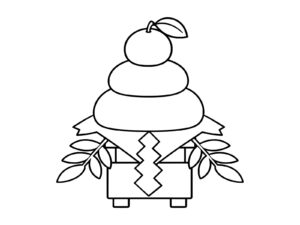
The 1st picture shows a big Kagami mochi. The lines are thick, so it is easy to color even for little kids.
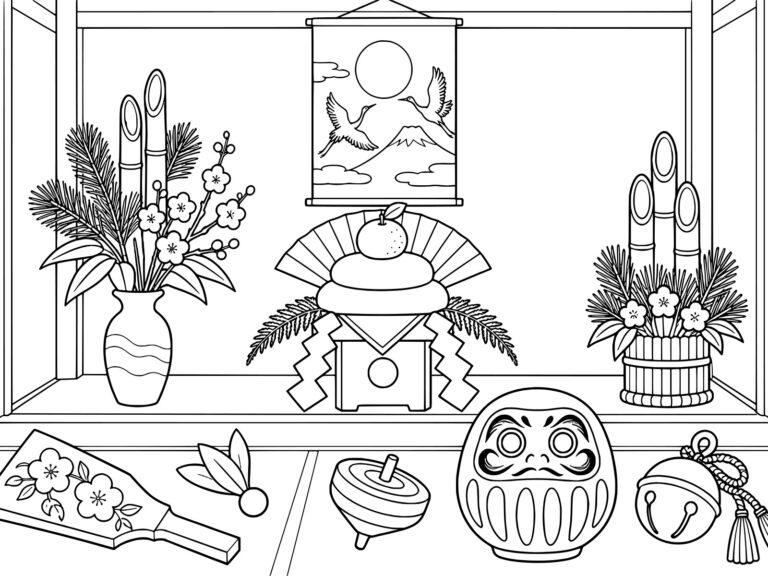
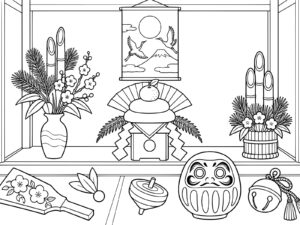
The 2nd picture shows a New Year alcove. You can see a scroll with the sunrise and cranes, along with pine, bamboo, and plum decorations, a wooden paddle, a spinning top, and a Daruma doll around the Kagami mochi.
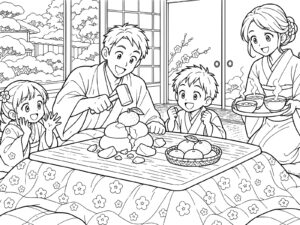
The 3rd picture shows the family breaking the rice cakes to eat sweet bean soup during Kagami-biraki in January.
For more New Year fun, we also have coloring pages for Kadomatsu and Daruma!
Getting ready for the New Year
At the end of the year, people do a big cleanup to make the house nice and neat. Then they put up Kadomatsu, straw ropes, and Kagami mochi.
In the past, families and neighbors gathered to pound rice cakes using a wooden mallet and mortar to make Kagami mochi.
Today, many families buy Kagami mochi in plastic packs, but the meaning is still the same.
Try setting one up with your family to wish for a happy new year!
How to Color Kagami mochi
Tips to make white rice cakes look white
Since rice cakes are white, you can leave them uncolored.
If you add a little pale cream or light gray to the bottom of the rice cakes or where the two layers overlap, they will look nice and plump!
Celebrate with New Year colors
Color the bitter orange orange and its leaf green.
Make the wooden stand light brown or wood color, and color the border of the paper underneath red to give it a true New Year feel.
Leave the zig-zag paper strips white!
Use Japanese colors for the alcove
On the second page, try coloring the sunrise on the hanging scroll red, the cranes white, black, and red, and the pine, bamboo, and plum blossom green and pink.
Color the Daruma doll red, and use your favorite bright colors for the wooden paddle!
The room for Kagami mochi breaking day
On the third page, it is fun to color each flower pattern on the kotatsu blanket in different colors!
If you leave the snow outside the window white and color the sky light blue, it will look like a cozy winter morning.
Color the sweet red bean soup red-bean brown and keep the rice cakes white!
Add a background to the simple first page
The first page has no background, so draw a big red or gold circle behind the Kagami mochi to look like a sunrise for good luck!
If you draw pine needles or plum blossoms around it, you will get your very own New Year picture.
You can also use it as a sketch for your New Year's cards!
Colors for the items
Color the wooden mallet on the third page brown, the tray dark brown or red, and the mandarin orange on the kotatsu orange.
Fun Facts About Kagami mochi
At Kagami-biraki, we break the mochi to eat it
Around January 11th, when New Year's is over, we take down the Kagami mochi we put on display and eat it. This is called Kagami-biraki.
We eat the mochi where the gods stayed and wish for good health for the year.
At this time, "cutting" it with a knife or blade is said to bring bad luck.
So, we hit it with a wooden mallet to break it! We also avoid the word "break" and say "open" instead.
When do you display it?
It is best to put up your Kagami mochi around December 28th.
This is because 8 is a lucky number that means spreading out for a prosperous future.
People often avoid the 29th because "9" sounds like the word for "hardship".
Kagami mochi is different in every region
How you decorate Kagami mochi depends on the region.
Instead of a daidai citrus fruit on top, some places use a mandarin orange or a yuzu.
In some places, people stack three layers of mochi, or decorate with dried persimmons, kelp, or shrimp.
Shrimp is used with a wish to live a long life until your back is bent!
When you eat mochi
Mochi stretches a lot, so it can easily get stuck in your throat.
Cut it into small pieces, chew it well, and eat slowly.
When young children eat it, an adult should always be with them.
Share These Kagami mochi Coloring Pages


More Winter Events Coloring Pages

-
Kagamimochi
-
New Year's Tokonoma
-
-
Kagami Biraki with family
-