Blue whale Coloring Pages

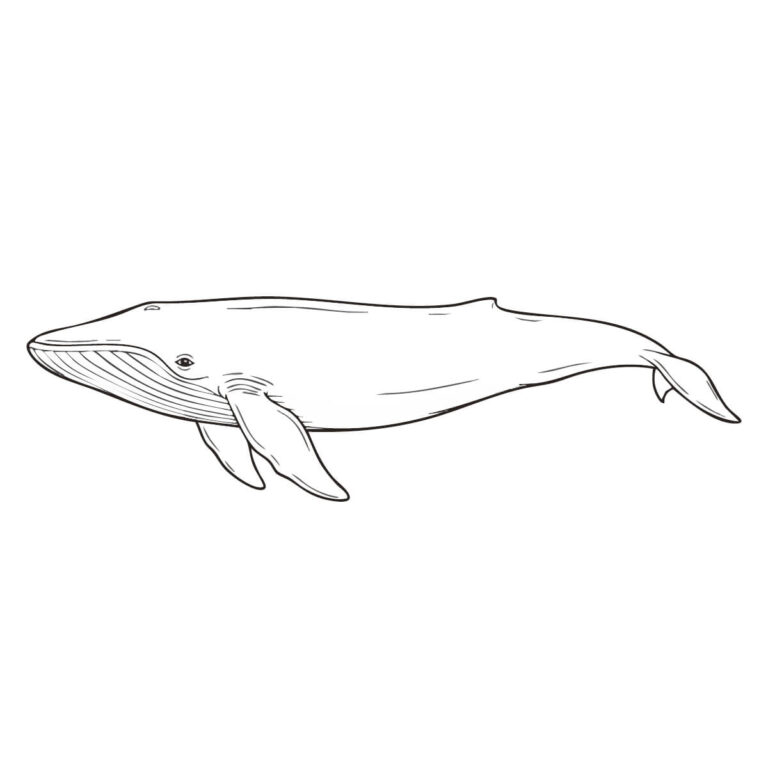

About Blue whale
The biggest animal in Earth's history
The Blue whale is thought to be the biggest animal ever to appear on Earth. The large ones can be about 30 meters long and weigh over 100 tons!
30 meters is long enough to fit a whole school swimming pool inside. 100 tons is about as heavy as 20 elephants. People say the Blue whale is actually heavier than even the biggest dinosaurs!
The Name Comes from "White" and "Throat Grooves"
When you write Blue whale in kanji, it is 白長須鯨. It is a long name, but it is easy to understand if you break it into 3 parts.
First is "Siro" (White). They say it got this name because its body looks shiny and whitish when it comes up from under the sea.
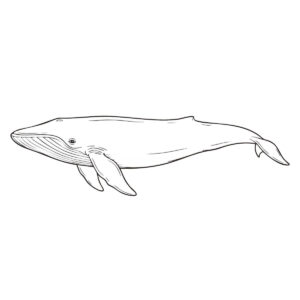
Next is "Nagasu" (Long stripe). Can you see the many long stripes running down from its throat to its belly? These are folds called une, and because these une are long, it was named "Nagasu". In the coloring page, they are drawn as lines under its chin, too.
Even though it's so big, the Blue whale eats tiny shrimp!
Even with such a huge body, the Blue whale eats small shrimp-like creatures called krill that are only a few centimeters long. Isn't that surprising?
It opens its big mouth wide to swallow krill together with seawater, and then uses the baleen plates in its mouth to filter the water out and keep only the krill. At this time, the grooves on its throat stretch out big like an accordion so it can hold a lot of seawater.
On days when it eats a lot, it can eat up to 6 tons in a single day!
Its heart weighs 180 kg
In 2014, a Blue whale washed up on the coast of Canada, and its heart was taken out and preserved just as it was. It is the only specimen like it in the world.
The weight measured at that time was 180 kilograms. A heart as heavy as about three adults pumps blood through that giant body. They say it was about the same size as a small car.
They make the loudest voice in the world
The Blue whale is said to be one of the loudest animals on Earth. They talk to their friends using low sounds that human ears can hardly hear.
If the ocean conditions are good, it is believed that their voices can reach as far as 1,600 kilometers away. They can stay in touch with friends who are even farther away than Tokyo is from Okinawa!
Even a baby is 7 meters long when it's born!
A baby Blue whale is already about 7 meters long when it is born. It is hard to imagine a baby as big as the width of your classroom, isn't it?
They drink their mother's milk and grow bigger very quickly. They are thought to live for about 80 to 90 years, so they live as long as humans do.
It almost disappeared once. Now, little by little
A long time ago, a lot of Blue whales were caught for their oil and meat, so their numbers dropped greatly. Hunting them was banned worldwide in 1966, and now their numbers are finally increasing little by little.
Even so, there are still only very few compared to before they were caught. They are still protected around the world today as animals in danger of extinction.
How to Color Blue whale
The back is bluish gray, and the belly is pale
The body of a Blue whale is bluish gray. It has "white" in its Japanese name, but it is not completely white!
Try coloring the back with a bluish gray, and make it lighter as you go toward the belly. You can even leave the bottom part white. Rubbing and blending the edges makes it look like it is swimming in the water!
Try adding spotted patterns to the body
Light gray and white spotted patterns are scattered across the body of a Blue whale. These patterns are different for every single whale. Researchers even use them to tell each whale apart!
If you softly layer light circles of different sizes on the back, it will look just like the real thing. It is fun to give it your very own pattern and name your whale!
Color the throat grooves lightly so the lines stay clear
There are long vertical lines running from under the jaw down to the throat. These are the grooves. If you color over them hard with a dark color, the lines will disappear completely!
Color them gently with a light color so you can still see the lines. If you change the shade a little bit every other line, the bumpy folds will pop out and look 3D!
The body is long, so change the colors bit by bit
The best feature of the Blue whale is its super long body! If you color it the same shade from head to tail, it will look flat.
If you change the colors slowly—like making the head dark and the tail light—its long body will look very pretty! Using three colors like blue, light blue, and gray is a great idea, too.
You can even draw little krill around it
If the background looks a bit empty, try drawing lots of tiny krill around your whale! These tiny shrimp that are only a few centimeters long are the food for this giant whale. It makes a fun picture that shows the difference in size right away!
Fun Facts About Blue whale
The "700-kilogram heart" is actually a mistake
On the internet, you might see that a Blue whale's heart weighs 700 kilograms or even 1 ton. But that is not true.
A real heart weighed in Canada in 2014 was 180 kilograms. Of course, it is still the biggest heart of any animal, but it was not as huge as the rumors said. It shows us that you do not know the real numbers until you actually weigh it.
"Nagasu" means the grooves on its throat
Whales in the fin whale family have long grooves from under their jaw down to their belly. A Blue whale has 55 to 88 of these grooves.
When it eats, these grooves stretch out like an accordion, and its throat puffs up like a balloon. That way, it can scoop up tens of tons of seawater in just one big mouthful!
They live as long as humans
A Blue whale can live for about 80 to 90 years. A baby whale born today might still be swimming in the same ocean when you grow up and become a grandparent!
Let's compare it with a humpback whale
Even though they are both huge whales, a humpback whale looks very different. A humpback whale has giant flippers that are one-third the length of its body, and it has bumpy knobs on its head.
On the other hand, a Blue whale has short, slim flippers, and its whole body is smooth and streamlined. Its dorsal fin is also very small and sits way back near its tail. Place the two coloring pages side by side and try to find all the differences!
Share These Blue whale Coloring Pages


More Dolphins & Whales Coloring Pages
-
Blue whale
-