Katakana "Ni" Coloring Pages


About Katakana "Ni"
“Ni” as in “Niwatori” (Chicken)
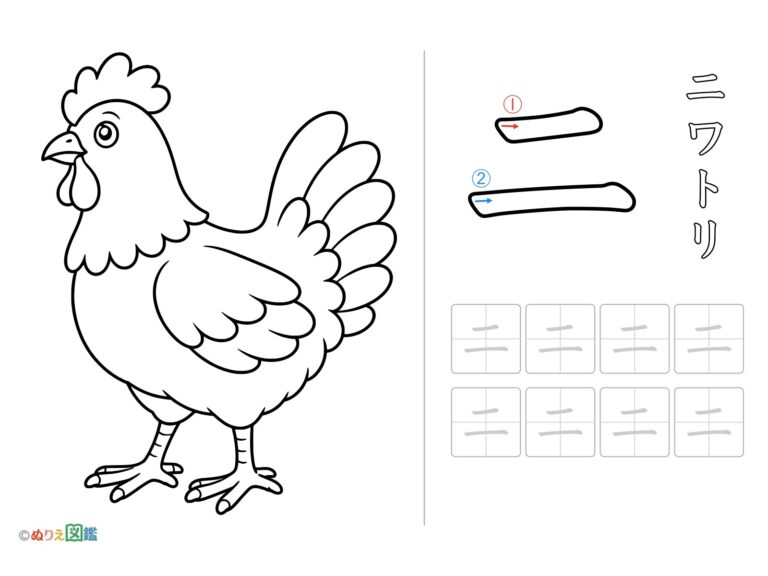
This coloring page is for learning the Katakana "Ni".
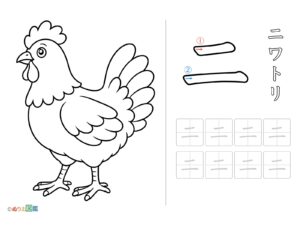
The word is "Niwatori" (rooster). On the left, there is 1 rooster facing sideways.
Look for the red comb on top of its head, the wattle hanging under its beak, its 2 legs, and its fluffy tail feathers.
Roosters are familiar birds to us that lay the eggs we eat.
Names of Living Things Are Written in Katakana
"Niwatori" is a word that has been used in Japan for a long time.
It is said to have gotten this name from the meaning birds in the garden.
In guidebooks and books like the Nurie Zukan, names of animals and plants are often written in Katakana.
Katakana is also often used for words from other countries and for animal sounds like "kokekokko" (cock-a-doodle-doo).
Katakana "Ni" came from the character "仁"
Katakana "Ni" was made from the right side of the kanji 「仁」.
The right side of 「仁」 has the same shape as the number 「二」.
That is why Katakana "Ni" and the kanji 「二」 look so much alike!
The hiragana "ni" came from the same kanji 「仁」, too.
How to write Katakana "Ni"
You write Katakana "Ni" with 2 strokes.
The 1st stroke is the short line across the top. The 2nd stroke is the long line across the bottom.
Write both lines from left to right, and make sure to stop cleanly at the end.
Make the top line a little shorter and leave a small space between the 2 lines to make it look nice and neat!
Let's find words that start with Katakana "Ni"!
Words starting with Katakana "Ni" include carrots, garlic, rainbow trout, and knitwear.
There are a lot of names for vegetables and fish.
Let's look for more living things starting with Katakana "Ni", like "rooster"!
Let’s look at the rooster’s body
Chickens have sharp claws on their feet to scratch the ground and look for food.
They have three toes facing forward and one facing backward.
Chickens do not have teeth, so the food they eat is crushed inside a part of their tummy called the gizzard.
Because of this, they sometimes swallow small stones and sand.
Try counting the toes on Katakana "Ni"'s chicken coloring page, too!
How to Color Katakana "Ni"
Color the Big Katakana "Ni" with 2 Colors
Color the big Katakana "Ni" at the top right with your favorite colors!
If you use different colors for the first stroke and the second stroke, it is easy to see that it has 2 strokes.
It is also fun to color the top stroke red and the bottom stroke yellow to match the rooster!
A Rooster Has a White Body and a Red Comb
For the rooster's body, you can leave it white. Or you can use light yellow or light gray to add shadows.
If you want to make a brown rooster, color it with brown or reddish brown!
If you color the comb and the wattle red, it will look super real.
Color the beak and legs yellow or orange.
If you color the tail feathers black or dark green and draw lines along the feathers, they will look nice and fluffy!
Look at the Different Lengths When You Trace
In the bottom right boxes, there are 8 light gray Katakana "Ni" lined up.
Use a pencil to trace them carefully, one by one!
If you draw one line above and one line below the middle line of the box, it will look neat and balanced.
Look closely and draw so the top line is short and the bottom line is long!
Color Along the Feathers
When you color the rooster's body, move your colored pencil from the head to the back, following the direction of the feathers!
If you add a darker color to the wing, you can tell the body and the wing apart.
Color around the eye red or orange, and make the eye itself black!
Fun Facts About Katakana "Ni"
Chicken Ancestors
People say that the ancestor of the chicken is a bird called the Red Junglefowl that lives in the forests of Southeast Asia.
Humans started keeping them a very long time ago, and they became the chickens we see today.
Chickens cannot fly high in the sky, but they can flap their wings and fly up a little bit.
Sounds Differ in Every Country
In Japan, we write the sound a chicken makes as "Kokekokko."
In English, it is written like "Cock-a-doodle-doo."
Isn't it neat how the same sound can be heard differently in each country?
The ones that crow loudly in the morning are mostly the roosters (male chickens).
Crests Show Males and Females
Male chickens often have larger crests (combs) and longer tail feathers.
Hens (female chickens) lay eggs, and those that lay often can lay about one egg a day.
The Bird of the Zodiac
The bird in the Japanese zodiac is the chicken.
In Kanji, it is written as "酉," and in the Year of the Bird, many New Year's cards with chicken pictures are made.
Since long ago, they have lived close to humans as the bird that lets us know morning has come.
Share These Katakana "Ni" Coloring Pages


-
Tracing "ニ" (Chicken)
-