Japanese carpenter ant Coloring Pages


About Japanese carpenter ant
The biggest kind of ant in Japan
The Japanese carpenter ant is a big black ant that you can often find in sunny spots, like parks, schoolyards, and along the roadside.
Worker ants are about 7 to 12 millimeters long, making them the biggest ant species living in Japan.
They live in huge underground nests that can sometimes be more than 1 meter deep.
If you see a black ant walking quickly across the ground during the warm seasons, it might be a Japanese carpenter ant!
Its body is divided into 3 parts
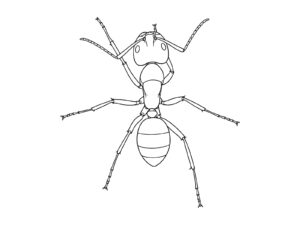
A Japanese carpenter ant's body is divided into 3 parts: the head, thorax, and abdomen.
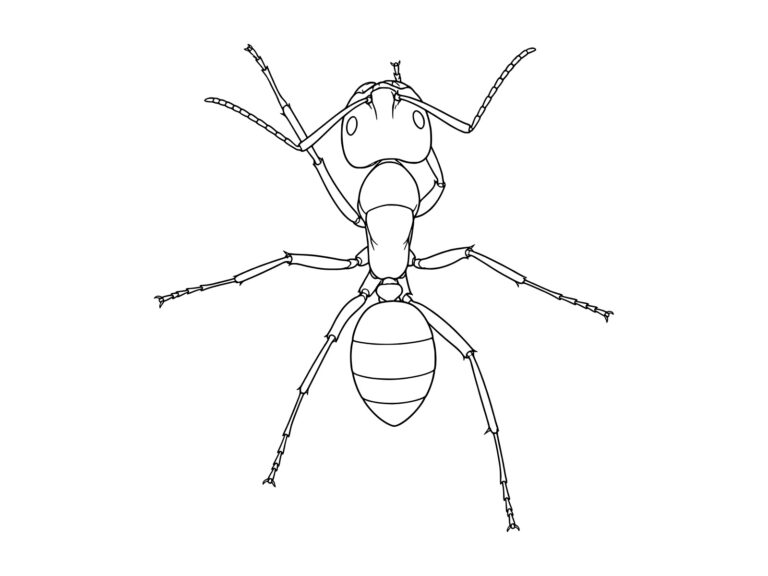
Try to find the 3 parts in the first coloring page that shows the view from above.
Between the thorax and abdomen, there is a small bump called a petiole.
Thanks to this bump, a Japanese carpenter ant can bend its abdomen freely.
Its six legs all come out from its chest
Ants are insects, so they have 6 legs.
All 6 legs come out from the chest.
Not even one leg comes from the head or the tummy.
Try tracing each leg on the coloring page with your finger to check where it comes from!
There are little claws at the tips of their legs, so they can even climb walls and tree trunks.
Antennae that bend into a "J" shape
A Japanese carpenter ant's antennae bend in the middle like an elbow, just like the letter "L".
Japanese carpenter ants use these antennae to smell things and touch things to learn about what is around them.
When friends meet, they touch antennae to check if they belong to the same nest.
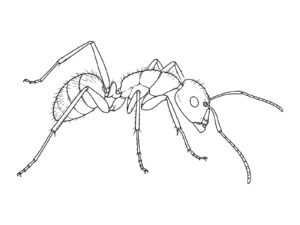
In the second side-view coloring page, you can see how the antennae bend and how big their jaws are.
Queen ants and worker ants
In a Japanese carpenter ant nest, there is 1 queen ant who lays eggs.
The worker ants that gather food and look after the larvae are all female.
This coloring page shows a worker ant without wings.
Around May to June, new queen ants and male ants with wings fly up into the sky from the nest.
Look at it from two sides, above and from the side
The first sheet shows how it looks from right above, and the second sheet shows it from the side.
When you look from above, you can clearly see its body split into 3 parts and how its 6 legs spread out.
When you look from the side, you can see the round bump on its back and the shape of the little bump on its waist.
How to Color Japanese carpenter ant
Color the black body using dark and light shades
The Japanese carpenter ant's body is black, but if you color it solid black, you won't be able to see the parts of its body.
We recommend using dark gray or dark brown to color the head, thorax, and abdomen in slightly different colors.
If you leave the shiny parts white, its body will look shiny and smooth!
Make the abdomen look a little golden
The Japanese carpenter ant has fine, golden-colored hairs on its abdomen.
If you color the stripes on the abdomen by taking turns with gray and light yellowish-brown, it will look just like the real thing!
Try tracing the hairs on the abdomen in the second coloring page one by one with a yellowish-brown colored pencil.
Use a sharpened colored pencil for the legs and antennae
If you sharpen the tip of your colored pencil, it is easier to color the thin legs and antennae without going outside the lines.
If you color the legs a dark brown that is a little lighter than the body, they will be easy to tell apart from the body.
It also looks pretty if you color the tiny joints at the tips of the legs reddish-brown!
You can add the ground, too
This coloring page is a picture like an encyclopedia without a background.
When you finish coloring, it is fun to draw dirt, tiny stones, and the hole to the nest around it all by yourself!
Don't forget the eyes and jaws
Color the small eyes on the left and right sides of the head black, and leave a tiny white dot in them.
If you color the jagged mandibles reddish-brown, they will be easy to tell apart from the head.
It also looks pretty if you leave the fine hairs on the back in the second picture white without coloring them!
Fun Facts About Japanese carpenter ant
The queen Japanese carpenter ant lives a very long time
The queen Japanese carpenter ant can live for more than 10 years.
That is a very long life for an insect.
The queen Japanese carpenter ant is about 17 millimeters long. She is much bigger than the worker ants.
Ants are relatives of bees and wasps
Ants are actually relatives of bees and wasps.
They both have a very thin waist between their middle and bottom parts.
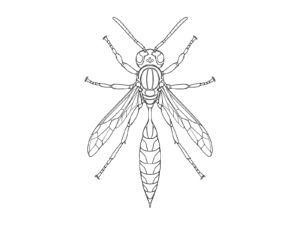
If you look at male ants or queen ants with wings, you can easily see how they look like bees and wasps.
Getting sweet juice from aphids
The Japanese carpenter ant often gathers around aphids on plants and trees.
They do this to get the sweet juice that aphids squeeze out from their bottoms.
In return, the ants chase away ladybugs that come to eat the aphids.
The inside of the nest is divided into rooms
In the nest underground, many rooms are connected by hallways.
Each room has its own job, like an egg room, a baby room, or a food storage room.
Super strong ants
Ants can hold food much heavier than their own bodies in their jaws and carry it.
When food is really big, they work together with their friends to carry it to the nest.
Share These Japanese carpenter ant Coloring Pages


More Bees & Ants Coloring Pages
-
Japanese Carpenter Ant (from above)
-
Japanese carpenter ant (side view)
-