Paper wasp Coloring Pages


About Paper wasp
Long back legs gave it its name
The Paper wasp is a bug you can see in gardens, parks, and under eaves of houses.
Just like its name says, its legs are long, and it is famous for letting its back legs dangle when it flies.
It looks like a hornet, but its body is much thinner, and it flies slowly and gently.
More than 10 kinds of Paper wasp live in Japan.
The first page is the Mumon-hoso Paper wasp
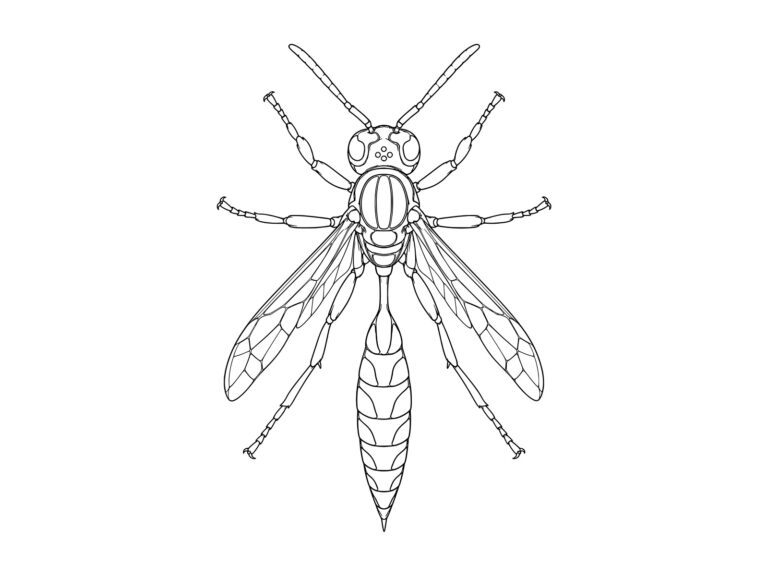
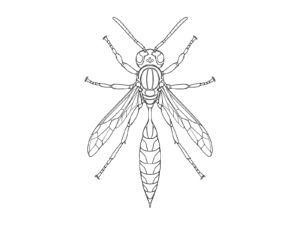
The first coloring page, showing it from above, is a kind called the Mumon-hoso Paper wasp.
Its body is about 15 to 20 mm long, and just like its name says, its body is very long and thin.
Look for its waist between its chest and belly, which stretches out like a thin handle.
On top of its head, besides its 2 big eyes, it has 3 tiny eyes lined up.
The second page is the Yellow-legged Paper wasp
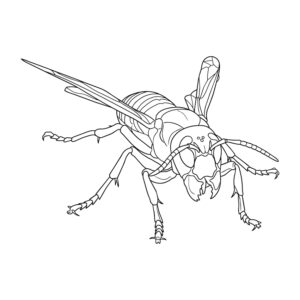
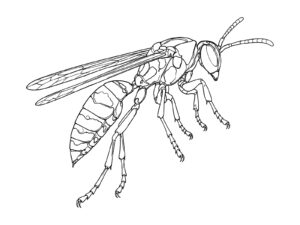
The second coloring page, showing it from the side, is the Yellow-legged Paper wasp.
Its body is about 20 to 26 mm long, and it is the biggest kind of Paper wasp in Japan.
Its black body has lots of bright yellow patterns on it.
If you compare it to the bug on the first page, its body is thicker and sturdier!
Let's look at its body
Since the wasp is an insect, it has 6 legs, and they all grow from its chest.
It has 4 wings: one big front wing and one small back wing on each side.
Inside the wings, there are lines called wing veins that hold up the thin wings.
When it stops flying, it folds its wings up long and thin.
Making a nest like a lotus seed pod
The Paper wasp chews on tree bark and mixes it with spit to make a paper-like nest.
The nest is shaped like a lotus seed pod, with six-sided rooms lined up facing down.
Unlike hornet nests, it has no cover around the outside, so you can see all the rooms!
Look at the feelers and jaws too
The 2 feelers growing from its head are important parts for smelling and touching things.
In its mouth, it has strong big jaws to scrape tree bark and chew up food.
Try to find its big jaws and long back legs on the second coloring page from the side!
The Paper wasp is active from spring to fall, and you will see the most of them in summer.
How to Color Paper wasp
The Paper wasp is yellow and brown
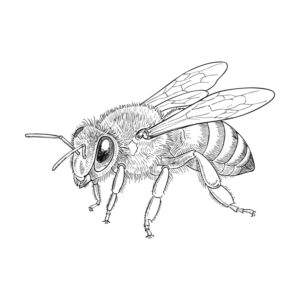
The first Paper wasp is a yellow and reddish-brown bee.
For the stripes on its back, color them with brown and yellow one after another.
For its belly, color each part with yellow patterns and brown to make stripes.
We recommend yellow for the legs and orange for the feelers.
The Paper wasp is black and yellow
The second Paper wasp is a black and dark yellow bee.
Color inside the lines yellow, and color around them black or dark brown to make a clear pattern.
Color the legs yellow, and make just the parts near the body dark.
The tips of the feelers are orange.
Color the wings lightly to look clear
The wings of the Paper wasp are clear and brownish.
Color them gently without pushing hard, using light brown or light orange.
If you make the color a little darker along the wing lines, they will look clear.
Leave some white on the big eyes
Color the big eyes brown and leave a little bit of white so they look shiny.
Don't forget to color the 3 tiny eyes on top of the head, too.
Compare the 2 bees as you color
The 1st picture and 2nd picture are different kinds of bees.
If you use more brown for the 1st picture and more black for the 2nd picture, you can really see the difference.
For the tips of the legs on both bees, try changing the color slowly from yellow to orange.
Fun Facts About Paper wasp
Only Females Have Stings
The sting on a bee's bottom was originally a tube used to lay eggs.
That is why only females have a sting, and males cannot sting you.
Paper wasps are gentle insects, but if you get close to their nest, they might sting to protect it.
If you find a nest, stay away and tell a grown-up!
Making Meatballs from Caterpillars
Grown-up Paper wasps lick sweet nectar from flowers.
To feed their larvae, they catch caterpillars and hairy caterpillars, chew them up with their jaws, and turn them into meatballs.
Because they catch many insects that eat leaves, they are helpful bugs for gardens and farms!
Only the Queen Survives the Winter
When late autumn comes, worker wasps and male wasps die.
Only the new queen Paper wasp spends the winter hiding under tree bark.
When spring comes, the queen starts building a new nest all by herself!
Some Kinds Build Nests Under Leaves
The Slender Paper wasp builds long, thin nests under leaves in the woods.
The Yellow-legged Paper wasp often builds large nests under the eaves of houses or on tree branches.
Share These Paper wasp Coloring Pages


-
Ropalidia fasciata (from above)
-
Yellow-legged paper wasp (side view)
-