Hagoita Coloring Pages
 ~

About Hagoita
New Year’s Play: Hanetsuki
Hagoita are wooden paddles used to play hanetsuki at New Year's.
Hanetsuki is a game where you hit a shuttlecock back and forth with your Hagoita, trying not to let it drop.
The shuttlecock is made of bird feathers stuck into a hard black seed from a soapberry tree.
Long ago, there was a fun rule: if you dropped the shuttlecock, someone drew black ink circles or X's on your face!
Bouncing Away Bad Things
Hagoita have long been thought of as lucky charms to bounce away bad things.
The soapberry seed of the shuttlecock is written in Japanese characters that mean "a child will not fall ill."
Also, a flying shuttlecock looks like a dragonfly. Since dragonflies eat mosquitoes, people wished, "May you stay healthy without getting bitten by mosquitoes."
Because of this, it is a custom to give a Hagoita to a baby girl for her very first New Year's.
Hagoita Made for Display
Besides the paddles used for playing, there are also Hagoita made just for display.
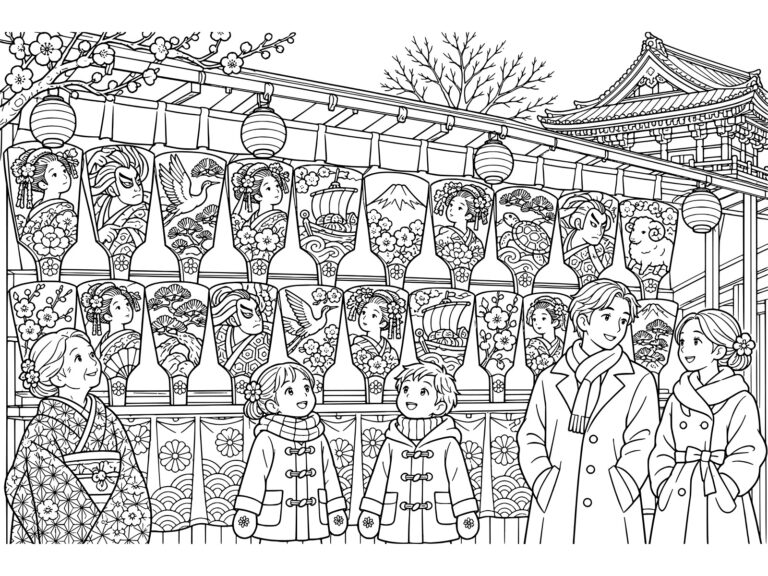
Oshie Hagoita, which have puffy pictures made by stuffing cotton inside fabric, became popular in the Edo period.
They are decorated with shiny cloth to show women in kimonos, Kabuki actors, or the animal for that year's zodiac.
At Sensoji Temple in Tokyo, a Hagoita Fair is held every year from December 17th to 19th, where many Hagoita are lined up for sale.
3 Coloring Pages
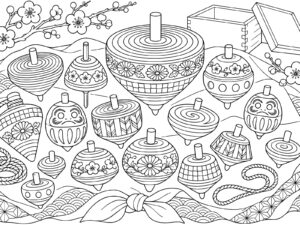
There are 3 coloring pages.
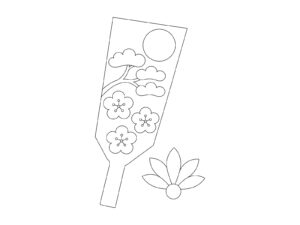
The 1st page shows a Hagoita with plum and pine pictures, along with a shuttlecock.
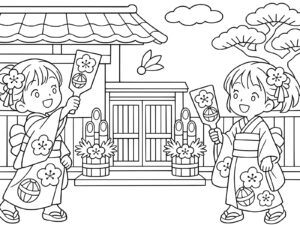
The 2nd page shows 2 girls in kimonos playing hanetsuki.
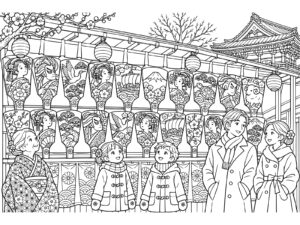
The 3rd page is a detailed coloring page of the Hagoita Fair, with rows and rows of beautiful oshie Hagoita.
Enjoy the New Year's mood together with our New Year and Kadomatsu coloring pages!
Decorate with Hagoita
At New Year's, some families display Hagoita in their entryway or alcove.
Displaying them alongside Kadomatsu or Kagami Mochi really brings out the New Year's feeling.
People usually put up Hagoita around the middle of December and keep them out until around January 15th.
It would be wonderful to color this coloring page and put it on your wall, too!
It is also fun for the whole family to color different Hagoita pictures and line them up on display.
How to Color Hagoita
Hagoita: Wooden Colors and Picture Colors
Color the border and handle of the Hagoita with light brown or ochre to make them look like wood.
For the picture on the front, color the plum blossoms red or pink, the pine trees green, and the sunrise red or orange. This makes it feel just like New Year's!
If you color the background behind the picture gold or yellow, your Hagoita will look very fancy.
Shuttlecocks: Make Them Colorful
Color the shuttlecock ball black or dark brown. Make the feathers bright and colorful by painting each one a different color, like red, yellow, green, and blue!
If you leave a tiny spot of white light on top of the ball, it will look shiny just like a real seed.
Kimono: Start with the Big Patterns
For the girl's kimono in the second page, color the main background first. Then, use different colors for the plum blossom and Temari ball patterns.
If you pick a different color for the sash than the kimono, it will really pop!
Try thinking of fun combinations, like a gold sash on a red kimono, or a pink sash on a light blue kimono.
Hagoita Market: One Hagoita at a Time
For the Hagoita market in the third page, color each Hagoita one by one using different color combinations.
If you use plenty of red, purple, and gold for the raised cloth pictures on the kimono, it will look super gorgeous!
Coloring the lanterns and stall roofs will show how lively the market is, too.
Lanterns and Sky at the Hagoita Market
Color the lanterns in the third page with light yellow or orange to make them look like they are glowing.
If you color the sky behind the stalls in light blue or an evening-like light orange, the Hagoita will stand out nicely.
If you color the people's clothes a bit darker than the Hagoita, the Hagoita will become the main star!
Fun Facts About Hagoita
How Hanetsuki Started
People say the game that became Hanetsuki was already played in the Muromachi period.
Back then, Hagoita were called "Kogiita."
At first, it was a game for adults, but it slowly became a New Year's game for children.
You Can Play by Yourself, Too
There are two ways to play Hanetsuki: "Oibane," where two people hit the shuttlecock back and forth, and "Agebane," where you count how many times you can hit it by yourself.
You can practice Agebane all by yourself.
Try competing with your family to see how many times you can keep it going!
The Shape of Hagoita
Hagoita have a thin handle at the bottom and a wide rectangle shape at the top.
People draw pictures or put padded cloth art on the wide part so they can enjoy them as decorations.
If you color this coloring page and cut it out, you can make your own paper Hagoita decoration!
Counting Songs for Hanetsuki
A long time ago, people sang counting songs like "Hitome, futame, miyakoshi, yomego..." while playing Hanetsuki.
If you hit the shuttlecock to the song, you can keep a nice rhythm.
Different places had all kinds of different songs.
Share These Hagoita Coloring Pages


More Winter Events Coloring Pages
-
Hagoita and shuttlecock
-
Girl playing Hanetsuki
-
-
Hagoita Market
-
-