Bonfire Coloring Pages
 ~

About Bonfire
Gather Fallen Leaves and Make a Bonfire
From late autumn to early winter, many leaves fall to the ground.
In the past, people often gathered fallen leaves in gardens or along roads with bamboo brooms to make a Bonfire.
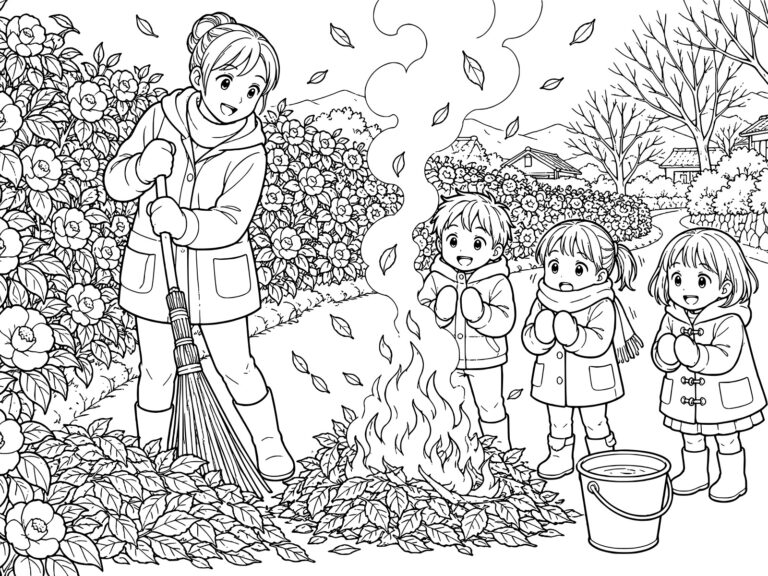
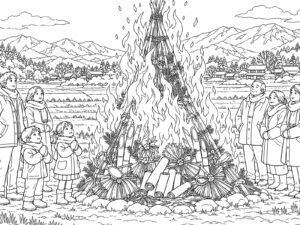
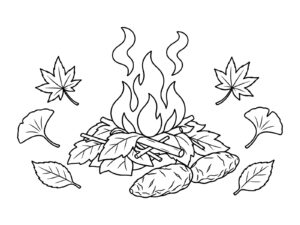
The 1st coloring page shows a Bonfire with twigs and thin firewood stacked on top of a pile of gathered fallen leaves, with flickering flames rising up.
All around, fallen leaves of maple, ginkgo, and cherry blossom trees are scattered.
If you like playing with fallen leaves, enjoy the coloring page in Playing with Fallen Leaves too!
Speaking of a Bonfire, It's Baked Sweet Potatoes!
When you think of fun things to do with a Bonfire, it's baked sweet potatoes!
If you wrap sweet potatoes in aluminum foil and put them inside a Bonfire, you get warm, fluffy baked sweet potatoes.
Next to the Bonfire in the 1st page, 3 sweet potatoes are placed before baking.
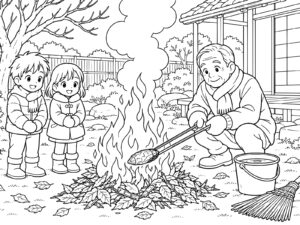
In the 2nd coloring page, a grandfather is taking a sweet potato out of the fire using long fire tongs.
The children are waiting excitedly a little bit away for them to bake.
You can also find coloring pages of baked sweet potatoes in the Baked Sweet Potato article!
The Nursery Rhyme "Takibi" and the Corner of the Hedge
The most famous song about a Bonfire is the nursery rhyme "Takibi" (The Bonfire).
The poem was written by Seika Tatsumi, and the music was composed by Shigeru Watanabe.
When Seika Tatsumi lived in Kamitakada, Nakano Ward, Tokyo, he took walks around the neighborhood almost every day.
It is said that the burning leaves around houses with hedges he saw along the way became the idea for this song.
The song features the corner of a hedge, sasanqua flowers, and a cold north wind.
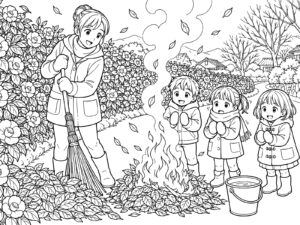
The 3rd coloring page shows a Bonfire scene at the corner of a sasanqua hedge, just like in this song!
Sasanqua Is a Flower That Blooms in Early Winter
Sasanqua is a tree in the camellia family.
It blooms with white, pink, or red flowers from late autumn to early winter.
Its leaves are deep green and feature a shiny surface.
Because it blooms in the cold season, it is a flower that makes you feel winter, just like a Bonfire or a cold wintry wind.
If you want to know more about sasanqua, check out the Sasanqua article too!
Always Enjoy a Bonfire with an Adult
Never make a Bonfire by yourself without adults.
Today, burning trash outdoors is basically prohibited by law.
Small fallen leaf Bonfires are an exception, but depending on the town you live in, local rules may ask you not to do it, or the smoke might bother your neighbors.
When you make a Bonfire, always do it with an adult, at a place where it is allowed, and after preparing a bucket of water.
In the 2nd and 3rd coloring pages, you can see a water bucket placed next to the Bonfire!
How to Color Bonfire
Make the middle of the flame bright
If you color the middle of the Bonfire flame a bright yellow and make the outside orange and red, it will look just like the real thing!
First, color the whole thing light yellow. Then, add orange to the outer edges and layer red at the bottom of the flame.
The trick for the tips of the flame is to press lightly with your colored pencil so it softly fades away.
Make the smoke soft with light gray
For the swirling smoke, don't color it all in! Gently color just around the edges with light gray or light blue.
If you leave the middle white, it will look like it is softly floating up into the sky.
When you color the sky light blue, leave a little space around the smoke to make it stand out!
Make the sweet potatoes shiny with reddish-purple
On the first page, try coloring the sweet potato skin reddish-purple.
If you leave a little white streak in the middle, it will look like shiny skin!
On the second page, for the sweet potato held by the tongs, color the burnt spots dark brown to make it look freshly baked and yummy.
Add winter colors with fallen leaves and sasanqua flowers
For the fallen leaves, color the maple leaves red, the ginkgo leaves yellow, and the cherry leaves reddish-brown or orange to make the ground look colorful and fun!
For the sasanqua flowers, you can use pink, red, or white. Mixing a few colors looks pretty, too.
Color the leaves dark green and leave a thin white line in the middle of each leaf to make them look shiny.
Color the water in the bucket light blue and compare it to the warm colors of the Bonfire!
Fun Facts About Bonfire
The "Bonfire" Song Was Stopped During the War
The children's song "Bonfire" was first played on a radio show for kids in December 1941, over 80 years ago.
However, the Pacific War started just the day before.
People said, "A bonfire will be a marker for enemy planes," and "Fallen leaves are important fuel," so they stopped playing it right away.
It became famous only after the war ended, when it played on the radio again in 1949.
A Bucket and an Adult in the Textbook Picture
Eventually, "Bonfire" appeared in elementary school music textbooks.
But firefighters were worried and said, "A song that encourages bonfires might not be good for fire safety."
So, they decided to draw a watching adult and a bucket of water in the textbook picture.
That is the same reason there is a bucket next to the Bonfire in this coloring page.
Baked Sweet Potatoes Get Sweeter When You Cook Them Slowly
Sweet potatoes have something inside that turns starch into sweet sugar.
This works best at around 70 degrees Celsius (158 degrees Fahrenheit).
When you bake them slowly in the ashes of a Bonfire, they stay at that temperature longer, making them super sweet.
It is so neat that baking them slowly makes them sweeter than heating them up quickly!
Sasanqua Petals Fall One by One
Sasanquas and camellias look very similar, but their flowers fall differently.
Camellia flowers often drop off all at once, but sasanqua petals fall one by one.
If you see petals scattered under a sasanqua hedge, that is your clue!
Share These Bonfire Coloring Pages


More Winter Events Coloring Pages
-
Bonfire of fallen leaves and sweet potatoes
-
Roasting sweet potatoes over a garden bonfire
-
-
Bonfire by a sasanqua hedge
-
-