Osechi (Japanese New Year Food) Coloring Pages
 ~

About Osechi (Japanese New Year Food)
Special Food You Eat at New Year's
Osechi (Japanese New Year Food) is a special feast that families eat together at New Year's.
Long ago, food offered to the gods on special seasonal days called "Seki" was named "Osechiku".
Over time, people started calling the food for New Year's—the most important time of the year—Osechi (Japanese New Year Food).
It is said that people make it before the year ends. That way, they do not have to cook over a hot stove during the first three days of New Year's!
Stacking Them in Jubako Boxes
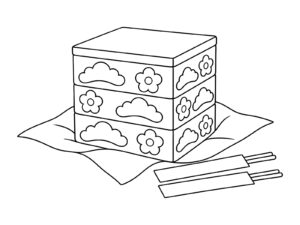
The first picture shows the jubako boxes used to hold Osechi (Japanese New Year Food).
Three boxes are stacked up with a lid right on top.
They are stacked with a special wish: "May good luck pile up for you!"
A furoshiki wrapping cloth is spread underneath. Next to it are iwai-bashi, special chopsticks used for New Year's celebrations.
Every Food Has a Wish
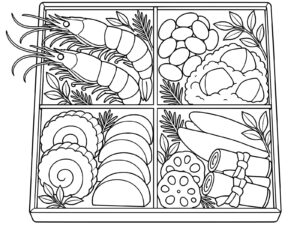
The second picture shows Osechi (Japanese New Year Food) packed in a jubako box, seen from straight above.
Curved shrimp mean a wish to live a long life until your back curves too.
Kuromame (black soybeans) mean a wish to work hard and stay healthy.
Golden kuri kinton (sweet chestnut paste) means a wish to always have enough money.
Rolled datemaki (sweet omelet) looks like a scroll, so it means a wish to do well in school.
Lotus root with holes means a wish to see clearly into the future.
Kombumaki (kelp rolls) sound like the word for "happy", and grainy kazunoko (herring roe) means a wish to be blessed with many children and grandchildren.
Half-moon shaped kamaboko (fish cake) is said to look like the rising sun.
The Dining Table on New Year's Morning
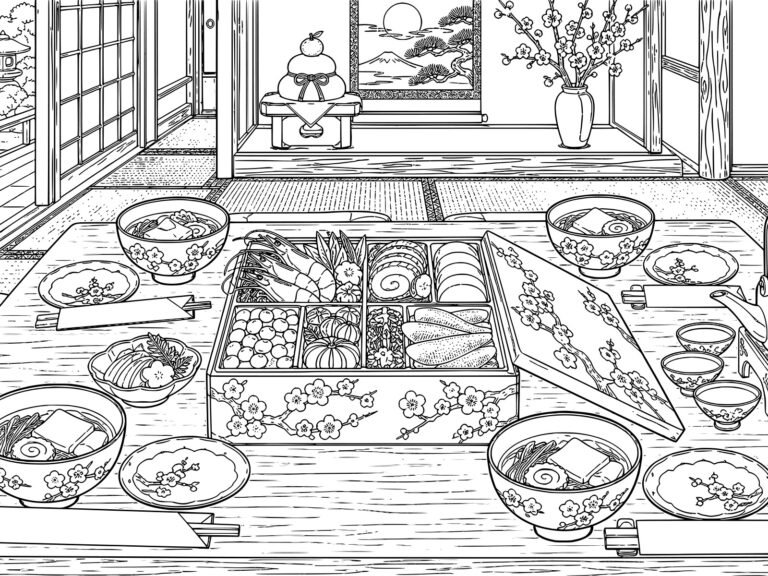
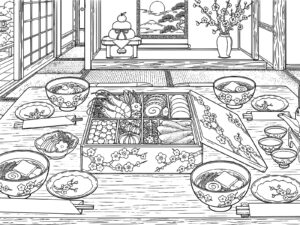
The third picture shows a dining table in a tatami room on New Year's morning.
In the middle is the opened jubako box. Bowls of ozoni soup are lined up around it.
In the alcove at the back, you can see a kagami mochi, a hanging scroll with the rising sun and pine trees, and plum blossoms in a vase.
Each Box Tier Has its Own Dishes
In Osechi (Japanese New Year Food), each tier of the jubako box often has set foods to put inside.
The first tier holds "iwai-zakana" (celebration appetizers) like black soybeans and herring roe, plus "kuchitori" (sweet treats) like datemaki and kamaboko.
The second tier often has grilled items like shrimp and yellowtail fish. The third tier usually has simmered dishes like lotus root and taro root.
Every family packs their boxes in their own fun way!
How to Color Osechi (Japanese New Year Food)
Use Black and Red for the Bento Boxes
For the bento boxes, color the outside black and the inside red.
For the first coloring page, try coloring the clouds on the bento box gold or yellow, and the plum blossoms pink or white. That will make it look just like New Year's Day!
You can color the wrapping cloth any color you like.
Combining Colors Is Key for Osechi (Japanese New Year Food)
For the second coloring page, your Osechi (Japanese New Year Food) will look delicious if you use red, yellow, black, white, and green.
Color the shrimp red, the sweet chestnut paste and sweet rolled omelet yellow, and the black soybeans black. Color the edges of the fish cakes pink.
Color the herring roe yellow, the kelp rolls dark brown, and the leaves tucked in between them green.
A Dining Table Filled with Bright Morning Light
On the third coloring page, the bowls and small plates have plum blossom patterns too.
Coloring the patterns pink will make your dining table look super bright!
Color the bitter orange on top of the pounded rice cake orange, and the sunrise on the wall scroll red.
Color the Soup Bowl with Care
For the Japanese New Year soup on the third coloring page, color the rice cakes white, the spiral on the fish cake pink, and the greens green.
Color the broth light yellow or light brown to make it look warm and yummy.
If you color the plum branch on the bento box lid with pink flowers and a dark brown branch, your dining table will look so grand!
Color the tatami mat light yellow-green and the sitting table dark brown to make the feast stand out.
If you color the garden behind the paper screen with light colors, it will look like bright morning light!
Fun Facts About Osechi (Japanese New Year Food)
Ozoni changes by region
Ozoni is a soup you eat with Osechi (Japanese New Year Food). The recipe is different depending on where you live!
In Eastern Japan, people often bake square rice cakes and put them in clear soup.
In Western Japan, some areas use round rice cakes in white miso soup.
Celebration chopsticks are thin on both ends
Celebration chopsticks used at New Year's are thin at both ends.
People say this means you are sharing a meal with the gods, using one end while the gods use the other.
Lots of rice cake events too
Around New Year's, there are many events about food, like making rice cakes, Kagami Biraki (opening the mirror rice cakes), and Nanakusa-gayu (seven-herb rice porridge).
Shrimp's color is a happy red
Shrimp turn red when you boil them.
Red and white are happy colors in Japan! Osechi (Japanese New Year Food) often has red and white foods, like red and white fish cakes.
The long whiskers and bent back look like an old man, so they mean a long life.
When you eat Osechi (Japanese New Year Food), try thinking about all these special wishes!
Share These Osechi (Japanese New Year Food) Coloring Pages


More Winter Events Coloring Pages

-
Osechi bento box
-
Osechi in Jubako Boxes
-
-
New Year's morning dining table
-