Reticulated python Coloring Pages
 ~

About Reticulated python
The Longest Snake in the World
The Reticulated python is a snake that lives near water and in tropical forests of Southeast Asia.
It is known as the longest snake in the world.
The big ones are said to grow nearly 7 meters long!
Its body has a net-like pattern with black outlines. This pattern gives it its name.
This pattern blends in with fallen leaves and sunlight in the forest so it is hard to find.
No Venom, Strong Squeeze
The Reticulated python is a snake with no venom.
When it catches prey, it coils its long body around it, squeezes tight, and swallows it whole.
It eats mice and birds. When it gets big, it eats even bigger animals, too.
It is also good at swimming and is often seen near rivers and ponds.
It sometimes climbs trees and rests on the branches.
3 Coloring Pages
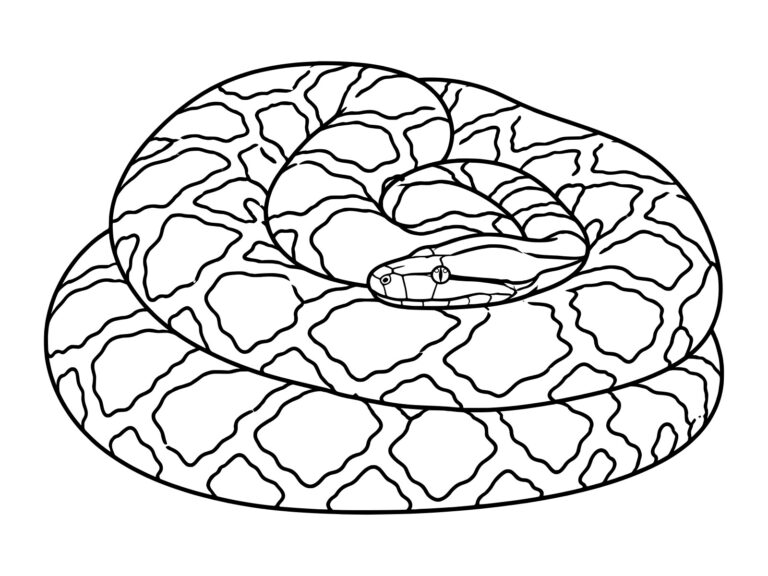
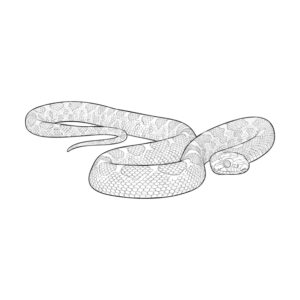
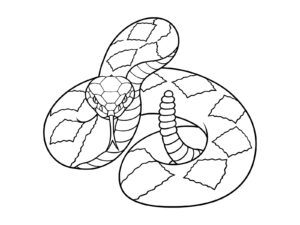
The 1st coloring page shows a coiled Reticulated python based on a photo.
You can see the net-like pattern all over its body!
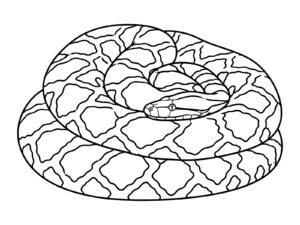
The 2nd coloring page shows a Reticulated python wrapped around a tree branch in a tropical forest.
Look for the bird with the big beak sitting on the tree behind it.
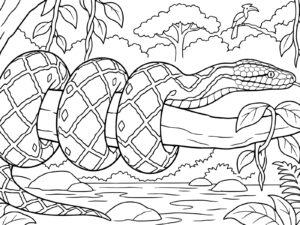
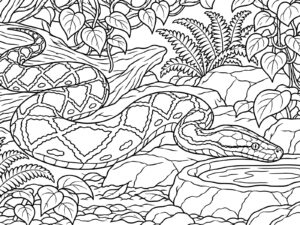
The 3rd coloring page shows a Reticulated python resting near rocks and water, like in a zoo reptile house.
Follow its long body from its head to its tail.
How a Snake's Body Works
The Reticulated python has many bones linked together in its body. This lets it bend freely.
Its jawbones spread wide open, so it can swallow prey much bigger than its own head whole!
After eating big prey, it can go for weeks without eating again.
As snakes grow bigger, they shed their skin many times and leave the old skin behind.
Because it is a big snake, zoos keep it in a warm, spacious room. Sometimes several keepers take care of it together.
When you see a Reticulated python at the zoo, take a close look at how long it is and check out its net-like pattern!
How to Color Reticulated python
Let's Color the Net Pattern
The body of the Reticulated python is yellow-ochre, light brown, or golden brown.
Color the edges of the net pattern with black or dark brown.
Inside the edges, make the square shapes a grayish brown to look like the real thing.
Leave the small spots inside the pattern white or cream-colored.
If you color each part carefully one by one, the pattern will stand out clearly!
Tropical Forests and Watersides
On the 2nd and 3rd pages, use both light green and dark green for the leaves.
Color the water light blue, and the rocks gray or brown. Layer darker colors along the bumps.
Color the tree branches dark brown, drawing lines along the bark pattern.
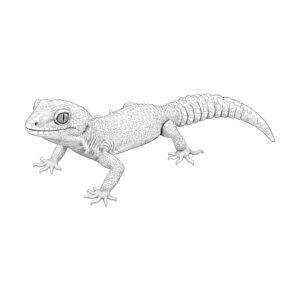
We also have a coloring page for another reptile, the Leopard Gecko, so try comparing their patterns.
Check out the coloring page for the Japanese snake, the Japanese Rat Snake, and the venomous snake, the Rattlesnake, too!
Shiny Bodies and Matching Patterns
If you leave a thin white line of light down the middle of the snake's body, it will look shiny!
Color one part of the net pattern first, then repeat the same color mix everywhere else.
When the colors match, the pattern looks connected all over its body.
Try making the top of its head a slightly brighter yellow-ochre than its body.
When you finish coloring, step back a little and look at the whole picture.
On the 2nd page, try coloring the bird with the big beak black and white, and its beak yellow or orange.
Color the water light blue, and leave the wavy lines on the surface visible.
Fun Facts About Reticulated python
Sensing the Heat of Prey
Around the mouth of the Reticulated python, there is a row of small holes called pit organs.
They can feel the heat from the body of their prey with these holes.
That is why they can find prey like mice even in the dark of night.
They can also stick their tongue in and out to collect scents.
Moms That Hug and Protect Their Eggs
When a Reticulated python mom lays eggs, she wraps her body around them to protect them.
It is said that she sometimes shivers her body to keep the eggs warm.
She can lay dozens of eggs at one time.
Even a newborn baby can be over 50 centimeters long, and when it grows up, it can be many meters long.
"Nishiki" Means Beautiful Cloth
The "Nishiki" in "Nishikihebi" is written as 錦 (Nishiki), which means colorful cloth with beautiful patterns.
They got this name because the patterns on their body are so beautiful.
No members of the python family live in the wild in Japan.
Share These Reticulated python Coloring Pages


More Reptiles & Amphibians Coloring Pages
-
Coiled reticulated python
-
Reticulated python wrapped around a forest branch
-
-
Reticulated python resting by rocks and water
-
-