Rattlesnake (Western Diamondback Rattlesnake) Coloring Pages
 ~

About Rattlesnake (Western Diamondback Rattlesnake)
A snake that makes noise with its tail
Rattlesnake (Western Diamondback Rattlesnake) is a kind of venomous snake that lives in the Americas.
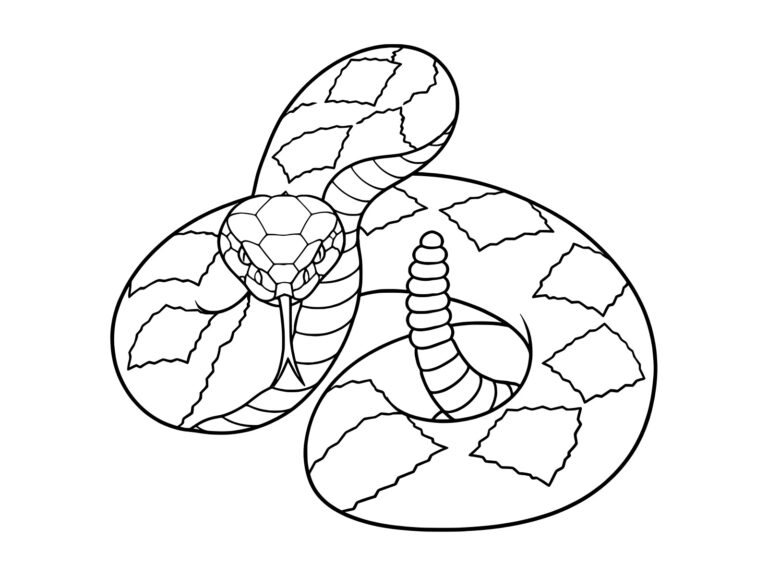
This coloring page shows a Rattlesnake (Western Diamondback Rattlesnake), which lives in the deserts and rocky areas of the American Southwest and Mexico.
At the tip of its tail, it has a "rattle" made of hard, overlapping segments.
When an enemy gets close, it shakes its tail to make a loud "shhh" sound to warn them to stay away.
They can be anywhere from 1 meter long to almost 2 meters long for big ones.
Diamond patterns
The back of the Rattlesnake (Western Diamondback Rattlesnake) has a long row of diamond shapes.
These shapes look like the diamonds on playing cards, which is how it got the name "Diamondback."
The brown and gray patterns help it blend into the desert sand and rocks so it is hard to see.
Right in front of the rattle on its tail, there are black and white stripes.
3 Coloring pages
The 1st coloring page is based on a real photo. It shows a Rattlesnake (Western Diamondback Rattlesnake) coiled up with its tail rattle held high.
The 2nd page shows a Rattlesnake (Western Diamondback Rattlesnake) in a sunny desert with tall cacti.
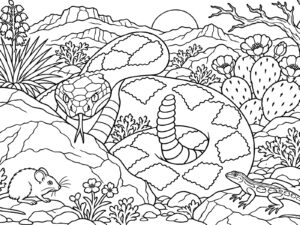
The 3rd page shows one peeking out from between rocks in the evening desert.
Try to find the blooming cacti, the mouse, and the lizard, too!
Rattlesnake venom and fang secrets
Near the front of its mouth, the Rattlesnake (Western Diamondback Rattlesnake) has long fangs that shoot venom.
When it closes its mouth, these fangs fold back against the roof of its mouth.
It only swings its fangs forward when it bites its prey.
Rattlesnake (Western Diamondback Rattlesnake) does not lay eggs; it gives birth to live babies raised inside its tummy.
Even newborn baby snakes have venom!
At the zoo, because they are venomous snakes, they are kept safely behind glass.
When you look at a Rattlesnake (Western Diamondback Rattlesnake) at the zoo, try to spot the rattle on its tail and the diamond patterns on its back.
It is good manners to watch them quietly through the glass.
Try counting how many segments the rattle has!
You can also count how many diamond shapes there are.
How to Color Rattlesnake (Western Diamondback Rattlesnake)
Color the Diamond Shapes
Color the body light brown or grayish beige.
Color the diamond shapes a darker brown than the body.
Real ones have whitish edges around the diamonds. If you leave a little white around the shapes, they will pop out!
Right before the rattle on the tail, make black and white stripes.
Try coloring the rattle light yellowish-brown or light brown.
The Desert Scenery
Make the sand light yellow or beige, and the rocks orangey-brown to look just like a desert.
Color the cactus yellow-green or bluish-green.
For the evening sky in the third picture, blend the colors from orange to pink to purple as you go up. It will make a pretty sunset!
Try coloring the cactus flowers pink or yellow.
How to Color the Head and Rattle
Make the head the same light brown as the body. Add a dark line running from the eye to the mouth to look like a real one!
Color the eyes yellowish and make the pupils dark.
If you color the tongue red or pink, it will really stand out!
For the rattle sections, make the edges of each piece a bit darker. Then you can see how they overlap.
When you finish coloring, step back and look at the whole picture.
If you color all the diamonds with the same shade, the pattern on the body will connect nicely.
Compare the pattern with the Reticulated Python coloring page, the longest snake in the world!
Fun Facts About Rattlesnake (Western Diamondback Rattlesnake)
The rattle grows every time it sheds its skin
The rattle on its tail gets one new segment every time the snake sheds its skin.
The rattle is made of hollow segments loosely joined together. When the snake shakes its tail, the segments bump into each other and make a sound.
However, old segments can sometimes snap off and fall off.
So, you cannot tell the snake's age by counting the segments.
The "heat sensor" between its eyes and nose
Between the Rattlesnake (Western Diamondback Rattlesnake)'s eyes and nose, there are small holes called pit organs.
They can sense the body heat of their prey right here.
They can pick up even very tiny changes in temperature.
Even in the pitch-black desert at night, they can tell right where a mouse is!
Snake relatives living in Japan
The Rattlesnake (Western Diamondback Rattlesnake) is a venomous snake in the same family as Japan's Mamushi and Habu.
Mamushi and Habu have pit organs between their eyes and nose, too.
On the other hand, the Japanese Ratsnake, which is the biggest snake on the Japanese mainland, is not venomous.
If you spot a snake outdoors, make sure you do not get close or touch it!
Share These Rattlesnake (Western Diamondback Rattlesnake) Coloring Pages


More Reptiles & Amphibians Coloring Pages
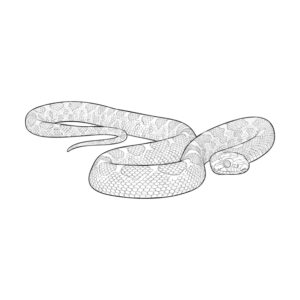
-
Rattlesnake raising its rattle
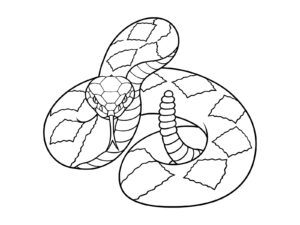
-
Rattlesnake in a cactus desert
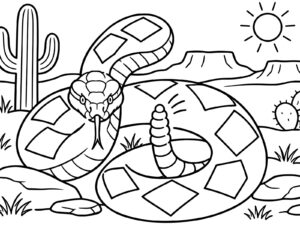
-
-
Rattlesnake in the desert at sunset
-
-