Road roller Coloring Pages
 ~
~ 
About Road roller
Pressing New Roads Flat with Heavy Weight
The Road roller is the very last vehicle to show up at road construction sites.
If you just lay down asphalt, the road stays soft. If cars drove on it like that, it would get bumpy right away.
So this heavy vehicle rolls back and forth over it to press it flat with its weight. This is called compaction.
After the Road roller passes over, the road becomes smooth and flat. The roads you walk on every day were finished by this vehicle!
Iron Drums Instead of Tires
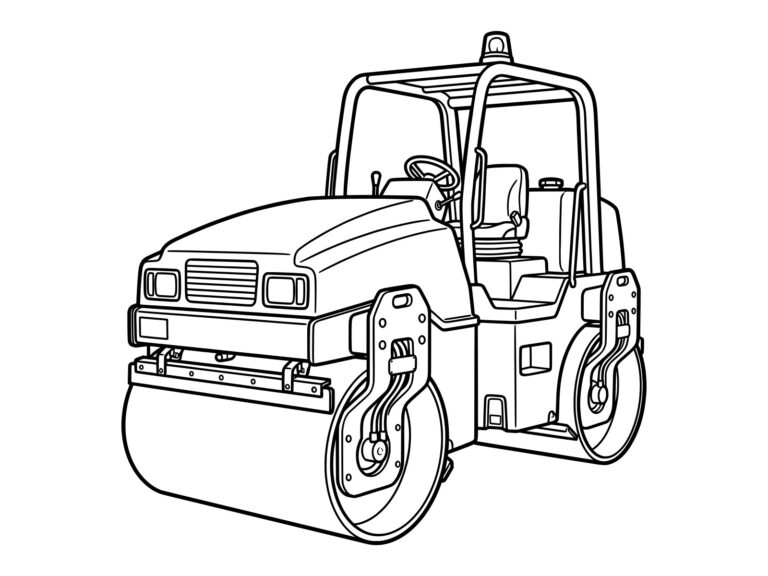
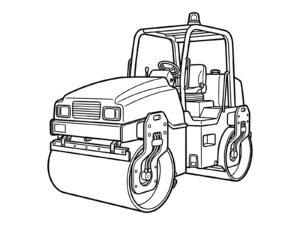
Its biggest feature is that its wheels are wide iron cylinders instead of tires. These cylinders are called drums.
Regular tires have small contact spots, so they leave marks on the ground. A drum can press evenly across its whole width.
The kind with one drum in the front and one in the back is called a tandem roller. It is the type you see most often.
In the coloring page, these big drums are the main feature, too!
Driving While Sprinkling Water on the Drums
Freshly laid asphalt is very hot and sticky. If you roll over it with iron drums as it is, it will stick and peel right off.
That is why the Road roller carries a water tank behind the driver seat and sprinkles water on the drums as it drives.
Thanks to the water, the asphalt does not stick, and the road gets a nice smooth finish.
If you see a Road roller at a work site, check to see if its drums are wet!
Pressing Quickly Before It Cools Down
The Road roller has a time limit for its job.
Fresh asphalt is 110 to 140 degrees Celsius (230 to 284 degrees Fahrenheit). It will not pack tightly unless it is still hot.
So at construction sites, the Road roller starts moving right after the asphalt is laid.
After that, a roller with rubber tires does the final touches. Once the surface cools down to about 50 degrees Celsius (122 degrees Fahrenheit), cars can finally drive on it.
When roadwork happens at night and cars can drive on it by morning, it is all thanks to this teamwork!
All Kinds of Friends
The Road roller comes in several shapes to match different jobs.
The macadam roller has one iron drum in the front and two in the back. The tire roller lines up many rubber tires. The vibratory roller shakes its drum to pack the ground tight.
Because the vibratory roller uses shaking power, it can pack the ground tightly even with a lighter body.
At construction sites, these vehicles take turns to finish the road step by step!
How to Color Road roller
Use White for the Drum
The drum is made of iron, so it is best to use light gray, or just leave it white.
If you color it too dark, it will look just like the body, and it will not look like a round cylinder anymore.
Instead, try adding a thin gray line along the edge of the drum. Just doing that will make it look nice and round!
The Body Is Yellow or Orange
Construction vehicles are painted in bright colors so people can see them easily from far away.
Yellow, orange, and lime green are common for a Road roller. Any of these choices will look real!
If you make only the driver's seat and levers dark gray or black, the body color will stand out even more.
Use Orange for the Warning Light
The small cylinder standing behind the driver's seat is a rotating warning light. It tells people that the vehicle is working.
Make this a bright orange, and leave the middle part white. It will look like it is shining bright!
If you color the square lights in the front and back light yellow, or leave them white, they will look just like glass.
Color the Road in 2 Colors
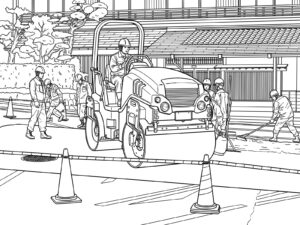
In a construction scene, if you use different colors for the finished road and the unfinished road, people can tell what the Road roller is doing!
Use dark gray for where the Road roller has already gone, and light gray for where it has not gone yet. There is a line at the border, so try changing colors there.
Use red and white for the traffic cones, and yellow and black for the striped bars. Making only these parts bold will make it look like a real work site!
Fun Facts About Road roller
It weighs more than 10 tons
Small Road rollers weigh about 3 tons, and big ones weigh 10 to 13 tons.
A regular car weighs about 1.5 tons, so that is as heavy as 7 or 8 cars!
It focuses all this weight on the thin strip where the drum touches the ground to press the asphalt tight.
It can only drive slowly not because it is too heavy, but because driving slowly packs the ground better.
Shaking helps it pack the ground even if it is lighter
Vibratory Road rollers spin an off-center weight fast inside the drum to make the body shake.
When it shakes, the bits of asphalt and dirt move around and fill in the gaps easily.
Thanks to this, it can pack the ground deeper with less weight than just relying on heavy pressure.
In small work spots, walk-behind vibratory Road rollers that a person pushes from behind are hard at work too.
Road rollers can drive on regular roads too
You might think work vehicles are always carried on the back of a truck.
But some Road rollers have license plates and can drive on public roads by themselves.
However, they go very slowly. Their top speed is only about 10 kilometers per hour, which is slower than a bicycle!
When they need to go to a far-away work site, they are carried on a truck after all.
Share These Road roller Coloring Pages


-
Road roller
-
Road Construction Site (Detailed)
-