Shimeji (Beech Mushroom) Coloring Pages

About Shimeji (Beech Mushroom)
"Shimeji" at the Supermarket Is Beech Mushrooms
Most of the mushrooms sold as "Shimeji" at the supermarket are actually a type called Beech Mushrooms.
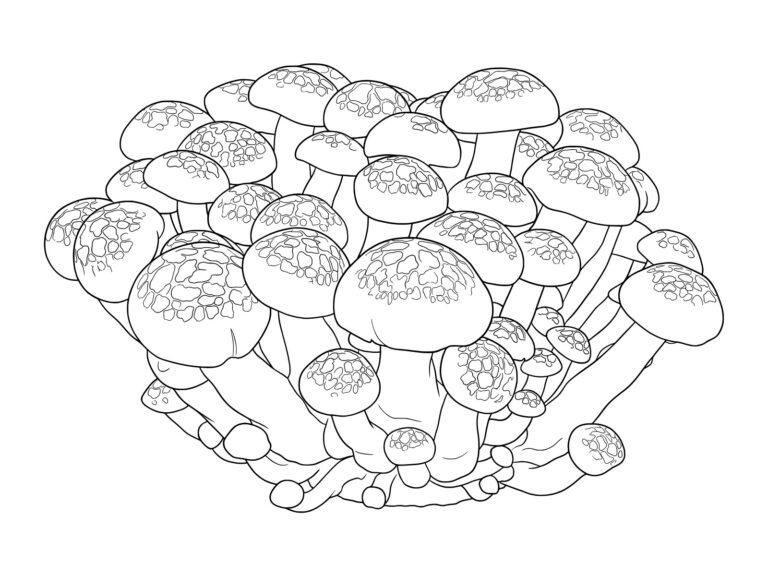
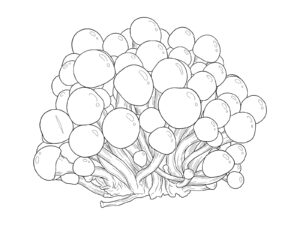
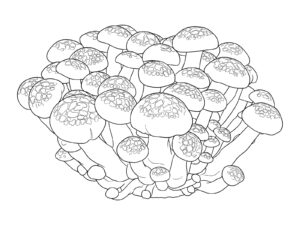
The white stems grow together at the bottom, with lots of small round caps crowded tightly on top to form a cluster.
In the mountains, they grow in autumn on fallen logs or dead standing beech trees. The Japanese name comes from the beech tree too.
A Marble Pattern on the Caps
If you look closely at the caps of Shimeji (Beech Mushroom), you can see a net-like pattern just like marble.
The caps are gray to light brown, and they curve roundly like a sweet bun.
Underneath the caps are white gills, and the stems are white, curving a bit as they grow upward.
Growing Inside Bottles
Shimeji (Beech Mushroom) are grown inside bottles.
Farmers fill bottles with sawdust mixed with nutrients, plant the mushroom seeds, and grow them in a room with just the right temperature and humidity.
Fluffy clusters pop right out of the top of the bottle. It takes about 3 months to grow them!
Nagano Is Number One in Japan
Nagano Prefecture grows the most Shimeji (Beech Mushroom) in Japan. A 2025 study shows that it grows more than one-third of all Shimeji (Beech Mushroom) in the country.
Niigata Prefecture is second, and Fukuoka Prefecture is third.
Shimeji (Beech Mushroom) can be used in many dishes, like rice cooked with ingredients, miso soup, and stir-fries. Compare them with the king of autumn mushrooms, the Matsutake Mushroom.
How to Tell the Caps and Stems Apart
If you look closely at a cluster of Shimeji (Beech Mushroom), you will find many tiny caps hiding under the big caps.
Those small caps are baby caps that are still growing.
Each stem has a different thickness too, with a mix of straight ones and curvy ones.
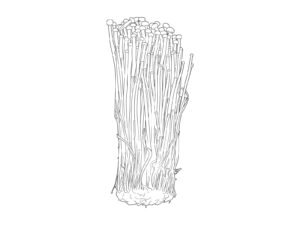
The first coloring page uses a photo as a guide, so the number of caps and the curves of the stems are drawn just like the real thing.
Cut Off the Hard Base Before Cooking
When you cook with Shimeji (Beech Mushroom), you cut off the hard base at the bottom, then pull the cluster apart into smaller pieces with your hands.
Mushrooms soak up water easily, so people usually just wipe off any dirt instead of washing them.
The great thing about Shimeji (Beech Mushroom) is that you can break them apart with your hands without using a knife.
They have a mild flavor, so you can use them in Japanese, Western, or Chinese dishes.
They taste delicious in spaghetti, doria, and soup too.
How to Color Shimeji (Beech Mushroom)
The Cap Has a Pale Brown Pattern
Try coloring the cap pale brown.
If you color the small shapes inside the net pattern with a slightly darker brown, a cool marble pattern will pop out!
Making the top of the cap darker and the edges lighter makes it look round and full.
Keep the Stalks White and Only Color the Base
It is best to leave the stalks white.
Instead, put a little light gray or cream color in the deep spaces between the stalks to show how many stalks are bunched together.
Color the stem base at the bottom pale brown.
Enjoy the Colors of the Ingredients in Mushroom Rice
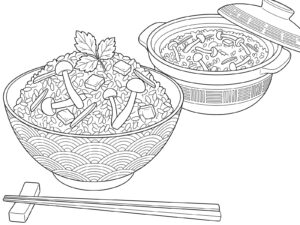
For the mushroom rice picture, make the rice pale brown to look like tasty soy sauce rice!
Color the Shimeji (Beech Mushroom) a slightly darker brown than the rice, the carrots orange, the fried tofu yellow-brown, and the Japanese parsley green.
Color the patterns on the rice bowl and clay pot in indigo or red to make a delicious-looking meal!
Make the Small Caps a Little Darker
Try making the small caps near the bottom of the cluster a slightly darker brown than the big caps.
This makes them look like they are in the shade, and it gives the cluster lots of depth!
Color the big caps at the top freely with a bright brown.
Where the caps overlap, make the cap in the back a little darker to show which one is behind.
Fun Facts About Shimeji (Beech Mushroom)
They Used to Be Sold as "Hon-shimeji"
Shimeji (Beech Mushroom) looks and tastes a lot like real hon-shimeji, so people used to sell it under the name "Hon-shimeji."
But since they are different mushrooms, it was confusing! Now, stores clearly label it as "Shimeji (Beech Mushroom)."
"Matsutake for smell, shimeji for taste"
There is a famous saying: "Matsutake for smell, shimeji for taste." It means matsutake smells the best, and shimeji tastes the best!
The "shimeji" in this saying is actually the hon-shimeji. Hon-shimeji grows together with live tree roots, so it used to be very hard to grow on farms.
There Are Pure White Mushrooms Too
At the store, you might see Shimeji (Beech Mushroom) that is pure white all the way to its cap!
This is a white type of Shimeji (Beech Mushroom).
It is fun to put brown and white ones side by side and color a page with both colors!
Freezing Makes Them Taste Even Better
You can keep Shimeji (Beech Mushroom) in the freezer to save it for later.
When you freeze mushrooms, their inside breaks down a bit. This makes their yummy flavor come out easily when you cook them!
If you freeze them in small batches, you can throw them right into soup or miso soup. It is super easy!
Share These Shimeji (Beech Mushroom) Coloring Pages


-
Beech beech mushroom
-
Shimeji mushroom rice
-