Turnip Coloring Pages
 ~

About Turnip
A round, soft vegetable
Turnip is a vegetable with a round white root and green leaves that you can eat.
Its best seasons are spring, and autumn to winter. Turnip harvested in cold weather is sweet and soft!
When you cook it in a stew, it becomes soft and melty right away. It is also delicious when you slice it thin and eat it raw as a pickle!
Turnip is a member of the Daikon radish and Chinese cabbage mustard family.
In Japan, it is a vegetable that people have grown for a very long time.
White roots and jagged leaves
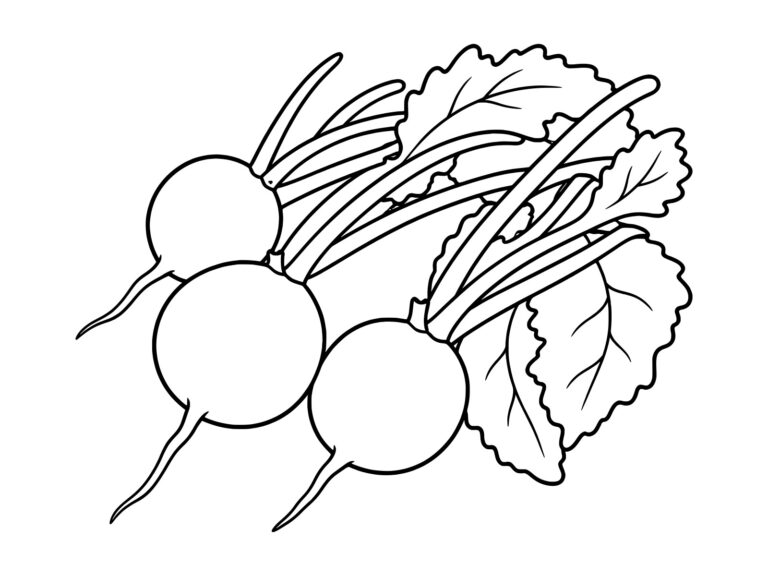
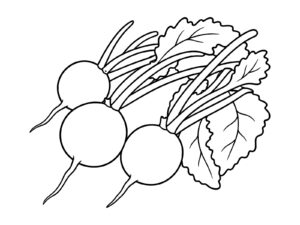
The first coloring page shows three white Turnips with leaves lined up together.
Under each round root, there is one thin root sticking out just like a little tail.
From the top, lots of thin stems grow in a bundle, and at the ends, leaves with jagged edges spread out.
These stems and leaves are packed with good stuff for your body, too, and you can eat them in stir-fries or miso soup!
Heave-ho, pull away!
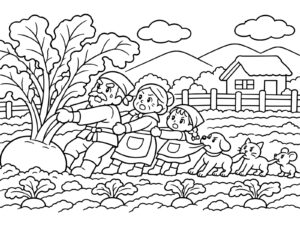
The second picture shows a scene from the Russian folktale "The Giant Turnip".
The Turnip the old man grew became so big that he couldn't pull it up all by himself.
The old woman pulls the old man, the girl pulls the old woman, and behind them, the dog, cat, and mouse are all lined up.
It is a story where everyone works together to finally pull the Turnip up.
In the surrounding field, lots of little Turnips are growing, too.
Winter Meals with Turnip
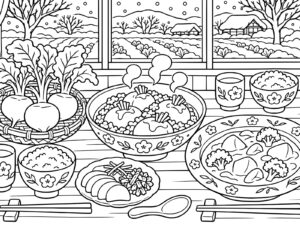
The third page is a winter dinner filled with dishes made with Turnip.
In the big bowl, there is a Turnip cooked whole, and in the soup bowl, there is cream stew with Turnip and broccoli.
On the small plate, there are sliced Turnip pickles.
In the basket at the edge of the table, there are three Turnips with leaves.
Outside the window, you can see a field covered in snow.
How to Tell Turnip and Daikon Apart
Turnips and daikon radishes look a lot like each other, right?
A daikon grows a long root downward, but a Turnip swells up round.
The round part of a Turnip is not just the root. It is made from the part between the root and the stem swelling up.
The real root is the thin tail at the bottom.
Next time you see a Turnip, try to find its tail!
How to Color Turnip
Tips to Make a White Turnip Look Round
For the Turnip's root, leave a lot of the paper white.
If you add a little light gray or light purple along the bottom edge, it will look like a round ball.
Near the base of the leaves at the top, use light yellow-green to make it look real.
If you want to make a red Turnip, it is cute to color the root with red-purple too!
Use Bright Green for the Stems and Leaves
Color the stems yellow-green and the leaves green, then trace the bumpy edges of the leaves with a slightly darker green.
If you leave the veins in the middle of the leaves whitish, the shape of the leaves will stand out nicely.
Use Cheerful Colors for Story Scenes
On the second coloring page, color the clothes of the old man, old woman, and girl with your favorite cheerful colors like red, yellow, or blue!
If you leave the giant Turnip white and color the field's soil around it brown, the Turnip will really stand out.
On the third coloring page of the dining table, if you color the broccoli in the stew green and the table a bright brown, the white Turnip dish will stand out really well.
The Field's Soil and the Animals
On the second coloring page, mix dark brown and light brown to color the field's soil.
If you leave the small Turnip in the field white just like the giant Turnip and color its leaves green, they will look matching!
If you color the dog brown, the cat gray or orange, and the mouse gray, it will look just like a scene from the story.
Color the sky light blue and the mountains far away light blue.
It is nice to color the wooden fence a bright brown!
Fun Facts About Turnip
"Suzuna" of the Seven Spring Herbs
Do you know about the Seven Herb Porridge eaten on January 7th after New Year's?
One of the seven herbs, "Suzuna," is actually the Turnip!
It is included in the seven herbs along with the Japanese radish, which is called "Suzushiro."
Grown for Over 1,300 Years
The Turnip also appears in the "Nihon Shoki," a history book put together in the Nara period.
It says that in the year 693, Empress Jito encouraged people to grow Turnips to help supplement grains like rice.
It is said that about 80 different kinds of Turnip are still grown in Japan today!
The Biggest Turnip in Japan
Kyoto's Shogoin Turnip is the biggest Turnip in Japan.
Large ones can even weigh around 5 kilograms!
Kyoto's famous pickling dish, "Senmaizuke," is made by cutting this Shogoin Turnip into thin slices.
There Are Red Turnips, Too
Turnips are not just white! Some Turnips have red or purple skin, too.
When you make pickles with red Turnips, they turn a pretty pink color.
Try lining up Turnips of many different colors and color them in!
Share These Turnip Coloring Pages


More Vegetables Coloring Pages
-
Turnip with Leaves
-
The Enormous Turnip
-
-
Winter Turnip Dish
-
-