Sailfin sandfish Coloring Pages
 ~
~ 
About Sailfin sandfish
Fish of the Sea of Japan in Winter
The Sailfin sandfish is a fish about 20 centimeters long that lives in the northern part of the Sea of Japan.
It is especially famous in Akita Prefecture and is even the official prefectural fish of Akita.
It usually lives in the cold ocean floor deeper than 200 meters, and during the day, it burrows into the sand. That is why it is called sandfish in English.
In winter, large groups come to the shallow waters near the beach to lay eggs.
Thunder Fish
Sailfin sandfish come to the beach around the end of November to December.
That is right when the sea gets rough and the thunder rumbles.
Because of that, the Sailfin sandfish is also called the "thunder fish."
In Kanji characters, it is written as "鰰" (fish with god) or "鱩" (fish with thunder).
People long ago thought it was a gift from God that brought lots of fish along with the thunder.
Let's find the secrets of its body
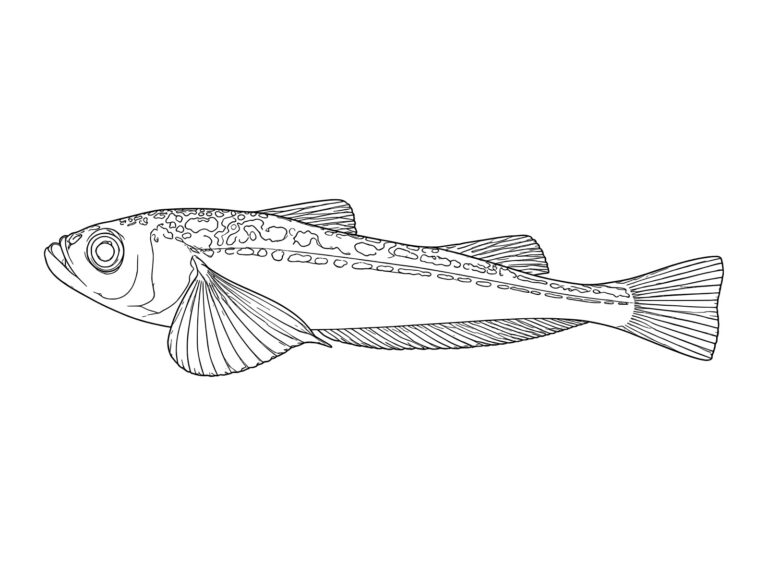
Sailfin sandfish don't have scales. Their bodies are nice and smooth.
Their mouths are big and face slanted upward, and their eyes are very big, too.
Their biggest feature is their large pectoral fins that spread out like hand fans.
On their backs, they have a mysterious spotted pattern that looks like it was eaten by bugs.
2 Sailfin sandfish coloring pages
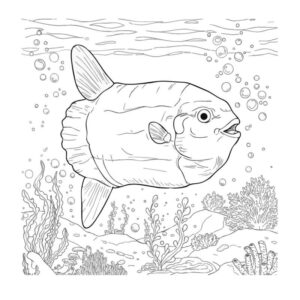
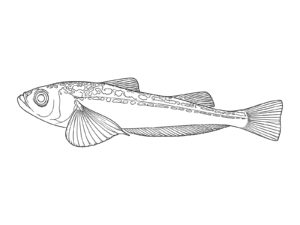
The first picture shows one Sailfin sandfish from the side, based on a photo. Try to find its big pectoral fins and two dorsal fins!
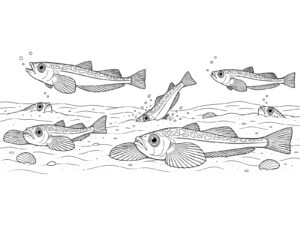
The second picture shows the sandy seafloor where the Sailfin sandfish usually lives. Look, there is a Sailfin sandfish with just its face poking out of the sand, one diving in headfirst, and another resting with its pectoral fins spread out. One has its mouth open and another has its mouth tightly closed. Each face looks different!
Sailfin sandfish on the Winter Dinner Table
The winter Sailfin sandfish that come to the shore are especially popular when the females have eggs.
People eat them grilled with salt, as sushi, or as dried fish.
Their bones are soft and the meat comes off the bone easily, so this fish is easy for small kids to eat.
Buriko has a fun, popping texture in your mouth!
Another fish that gets tasty in winter is Yellowtail. Try coloring the autumn Salmon and Salt-Grilled Pacific Saury coloring pages, too!
How to Color Sailfin sandfish
The back is brown and spotted, and the belly is white
For the Sailfin sandfish's back, color it with light brown or yellow-ocher, and color inside the spots with dark brown.
If you leave the belly white or make it light silver, it will look like a real Sailfin sandfish.
Try blending the colors where the back meets the belly by making the brown lighter and lighter.
Make the pectoral fins see-through
Color the big pectoral fins with light yellow or light gray so they look see-through.
If you layer a slightly darker color in lines along the fin rays, the fan-like fins will look super neat!
Color the sea water dark blue
On the second coloring page, color the sea water with dark blue or blue-green to show the cold water deep down at the ocean floor.
If you make the bottom near the sand a little darker and the top a little lighter, it will show how deep the sea is.
Leave the bubbles white.
If you color the shells on the sand light pink or white, they will stand out cutely in the sand.
Use yellow-ocher and light brown for the sand
On the second coloring page, color the sandy ocean floor with light yellow-ocher or light brown.
Layer a slightly darker color along the lines in the sand to make wavy sand patterns.
The spots on the Sailfin sandfish's back are the same colors as the sand, so it looks like it is hiding right in the sand!
Make the big eyes and mouth pop
On the first coloring page, make the big eyes pop by coloring around the pupils with gold or yellow, and leave the shiny spots white.
If you put a little light pink around the upward-facing mouth, your Sailfin sandfish will look full of life!
Fun Facts About Sailfin sandfish
The Secret of Buriko
In Akita, a group of Sailfin sandfish eggs is called "Buriko."
One single group has about 1,000 to 2,000 eggs packed together! They are sticky and stick to seaweed.
After a storm, a lot of Buriko sometimes washes up on the beach along with torn seaweed.
Catching stopped for 3 years
A long time ago, people caught over 10,000 tons of Sailfin sandfish a year in Akita.
But because of catching too many, the number of fish kept going down.
So, Akita Prefecture completely stopped catching Sailfin sandfish for 3 years starting in 1992 to wait for the fish to grow.
The fishermen decided this big move all on their own.
Shottsuru
In Akita, there is a seasoning called "Shottsuru." People make it by salting Sailfin sandfish and letting it sit for a long time.
Shottsuru Nabe is a hot pot dish flavored with Shottsuru, and it is a famous winter food in Akita.
The name "Hatahata"
In old Japanese words, thunder was called "Hatata-gami."
One story says the fish got the name "Hatahata" because it visits around the time thunder rumbles.
Share These Sailfin sandfish Coloring Pages


-
Sailfin sandfish (side view)
-
Sailfin sandfish burrowing in the sand
-